You know the vocabulary. You understand the podcast. And then a waiter says Vous avez choisi ? and your entire French vocabulary leaves the building without saying goodbye.
This is not a knowledge problem. It is a performance problem, and it has a method.
Ce que vous trouverez dans ce guide
- Pourquoi le blocage frappe au moment exact où vous avez besoin de parler
- L'échelle de désensibilisation en cinq étapes
- Des scripts à mémoriser pour les situations les plus fréquentes
- Que faire quand un Français vous répond en anglais
What the Fear Actually Is
"Fear of speaking French" is not one thing. It is usually four, and they need different cures.
Separate them and each becomes small. Treat them as one giant fear and it stays permanent.
Why French Feels Harder to Speak Than to Read
French punishes the mouth more than the eye. Three features cause most of the panic.
None of this is a reason to fear speaking. It is a reason to listen more and read aloud daily — because your mouth needs the same workout your eyes have been getting.
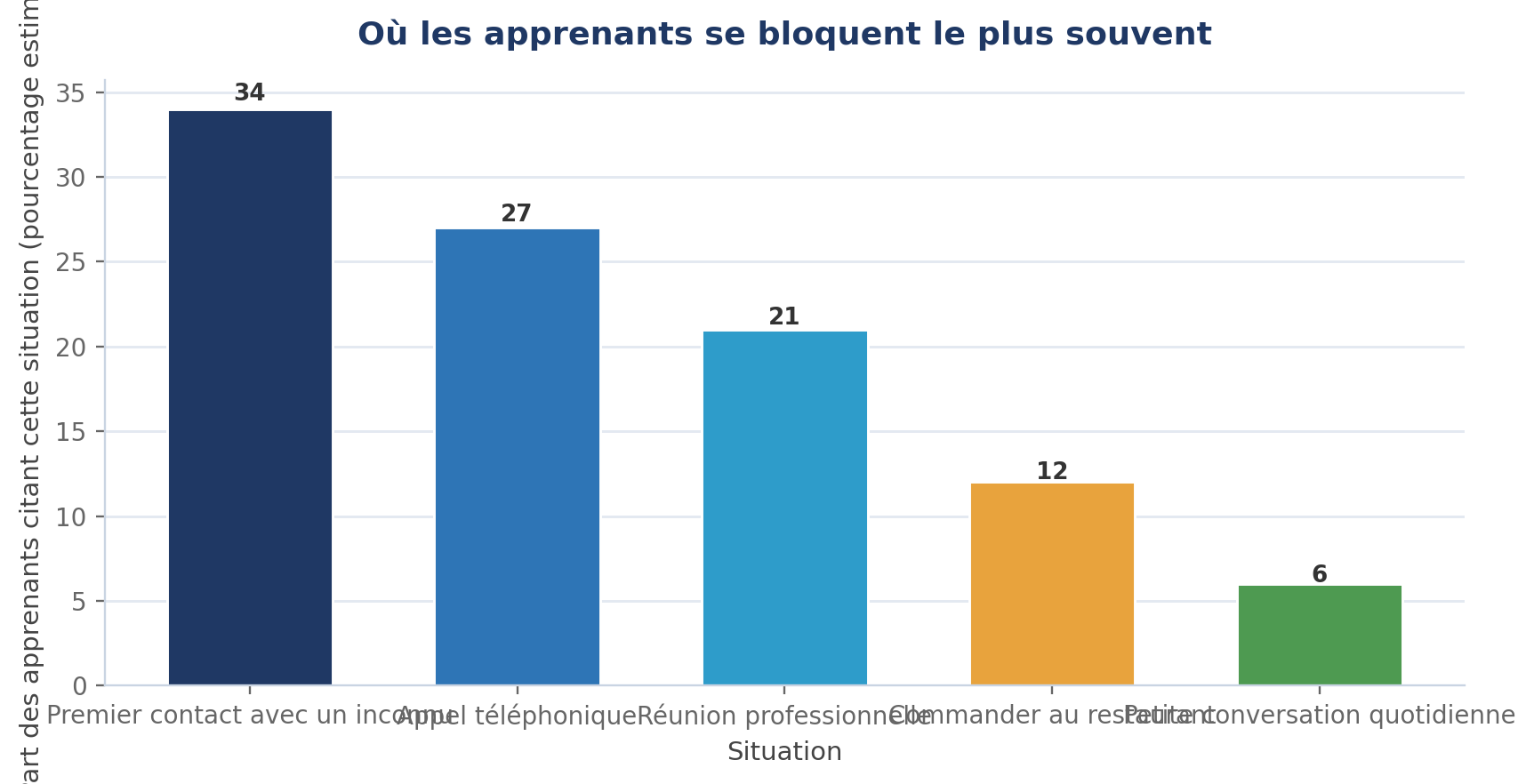
The pattern is revealing. The blocking happens at the start of an interaction and on the phone — precisely the moments with no visual support and no preparation window. That is where your scripts should go.
The Five-Step Desensitisation Ladder
You do not cure a fear by avoiding it or by jumping into the deep end. You climb.
Étape 1 and 2 feel absurd. They are also where most of the progress happens, because the fear is mostly internal. Once you have monologued in the kitchen for a week, a stranger's ear feels far less dangerous.
Scripts to Memorise, Word for Word
Having a script removes the blank-page problem. Six sentences carry a surprising amount of conversation.
That second and third row are the most valuable sentences you will ever learn. They convert a dead end into a conversation.
An AI tutor that expects you to make mistakes is the fastest cure
Fears fade with repetition in front of a patient listener. LanguageSkills.net's AI voice tutor provides speaking practice with feedback, keeping you talking without grading you.
Rejoindre un cours de conversation →Create a free accountWhen Someone Answers You in English
This happens constantly, and it hurts. Here is what it usually means and what to do.
A polite Merci, j'aimerais continuer en français, s'il vous plaît is remarkably effective. Most people switch because they think they are being helpful.
Three Habits That Keep the Fear Alive
- Waiting for fluency before speaking. Speaking is how you reach fluency. The order is not negotiable.
- Studying silently. Reading trains the eye. Your mouth stays a beginner for years.
- Apologising for your French before you start. Opening with Désolé, mon français est mauvais lowers expectations — including your own.
From blocked to fluent is mostly a matter of repetitions
Regular speaking practice, real corrections, and a self-paced routine that you follow whether you feel ready or not. That is how the fear dies — quietly, through frequency.
Voir les cours de français →Create a free accountQuestions fréquentes
Combien de temps faut-il pour ne plus avoir peur ? Avec une pratique régulière — lire à voix haute chaque jour et parler deux fois par semaine — la plupart des apprenants constatent une baisse nette de l'anxiété en quatre à six semaines.
Faut-il un accent parfait pour parler français ? Non. Un accent non natif n'empêche presque jamais la compréhension. La clarté compte, la perfection ne compte pas.
Dois-je éviter d'écrire pour me concentrer sur l'oral ? Non, mais équilibrez. L'écrit consolide la grammaire ; il ne développe pas la bouche. Faites les deux.
Que faire si je reste bloqué en pleine phrase ? Utilisez une formule de secours : Comment dit-on… ? ou Je ne me souviens plus du mot. Personne ne s'en offusque, et la conversation survit.
Références et lectures recommandées
- Institut français — cours, certifications et ressources pour apprenants: https://www.institut-francais.fr
- France Éducation international — DELF et DALF, descripteurs des niveaux: https://www.france-education-international.fr
- Conseil de l'Europe — Cadre européen commun de référence pour les langues: https://www.coe.int
- RFI — Journal en français facile, entraînement à l'écoute: https://www.rfi.fr
- LanguageSkills.net — cours de conversation en français: https://languageskills.net/french
Le mot de la fin
Le blocage oral n'est pas un défaut de caractère, et ce n'est pas un manque de vocabulaire. C'est une réaction prévisible à une situation inconfortable, et elle diminue exactement de la même façon qu'on apprivoise l'eau froide : par immersion répétée, brève et régulière. Commencez par lire à voix haute ce soir. Le reste suivra.