Nobody warns you that je suis plein means "I'm pregnant" in Québec, or that confidently saying je suis excité in a job interview will end the interview.
These are french learner mistakes with teeth — the kind that fossilise for years and only surface when a native speaker winces. Here are the twelve that cost the most, each with a fix you can apply this week.
What you will get from this guide
- The errors that follow learners from A1 all the way to B2
- Grammar fixes, pronunciation fixes and false-friend landmines
- A weekly self-audit that stops mistakes from setting
Mistake 1: Ignoring Gender Until It's Too Late
You learn le problème, la solution, le musée — and treat articles as decoration. They are not. Gender controls adjectives, pronouns and agreement across the whole sentence.
The fix: Never learn a noun without its article. Not "table" but une table. Not "livre" but un livre. Say the article out loud every time, and learn the endings that predict gender.
Exceptions exist — le silence, la page, le courage — but the ending system gets you to roughly 80% accuracy fast.
Mistake 2: Translating Word for Word from English
Je suis 25 ans. Je suis d'accord avec toi (…you are). J'ai pris une décision — fine, actually. The damage comes from structure, not vocabulary.
Note that second row carefully. Tu me manques literally means "you are missing to me." French reverses the direction. Learners produce the wrong version for years.
Mistake 3: Falling for Faux Amis
That list has ruined dinners. Memorise it once and you have eliminated a whole category of embarrassment.
Mistake 4: Skipping Liaison and Swallowing Sounds
French spelling is a museum. Spoken French is the street outside. Learners read with English habits and pronounce letters that were never meant to be spoken.
The fix: Learn spoken forms as separate vocabulary. Les amis becomes lezami. Vous avez becomes vouzavé. Silent endings — -s, -t, -d, -x, -e — stay silent unless liaison revives them. Record yourself reading a paragraph, then compare with a native audio version of the same text. The gap will be obvious and instructive.
Fossilised errors need focused practice to dissolve
Nobody fixes tu me manques by reading about it. You fix it by saying it wrong, getting instant AI feedback, and saying it right ten times in a row. Repeated speaking practice with immediate feedback is the only known cure for a habit.
Start practising your French →Create a free accountMistake 5: Passé Composé and Imparfait as a Coin Flip
Learners pick by feel. Natives pick by function.
Test yourself with one question: is this a snapshot or a film? Snapshot, passé composé. Film, imparfait.
Mistake 6: Que, Qui, Dont, Où — Guessing
The fastest diagnostic: say the sentence without the pronoun and find the original position. Subject? qui. Object? que. Behind de? dont.
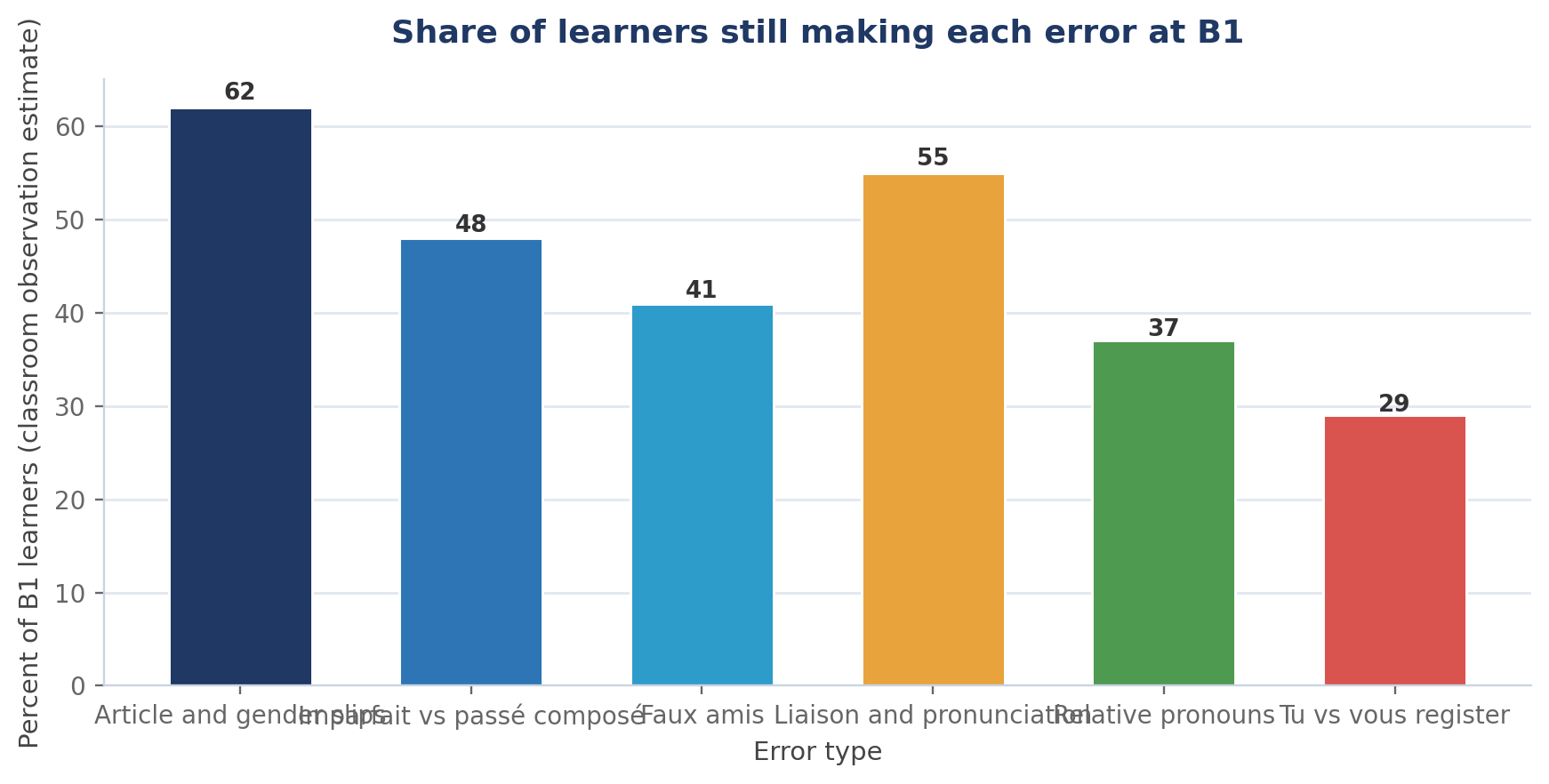
Which Mistakes Are Most Common by Level
Gender and pronunciation top the chart. Both are habit problems, not knowledge problems — which is why they need repetition, not another explanation.
Mistake 7: Using Tu and Vous by Luck
Standard rule: vous for strangers, elders, officials, superiors, and anyone you just met in a professional context. Tu for friends, family, peers, children. France has grown more informal over decades, but the shift is uneven — and getting it wrong in either direction is noticed.
When unsure, use vous, then listen. If they address you as tu, switch. That mirror move is completely natural.
Mistake 8: Counting Input as Progress
Watching twelve French films with English subtitles teaches you plot. Passive exposure without attention builds recognition, not production. The fix is proportionate effort: one French audio pass, one French-subtitle pass, then speak about what you heard for two minutes.
Mistake 9: Avoiding Speaking Until "Ready"
Nobody becomes ready. Fluency is a performance that improves through performance. Start speaking now — with an AI voice tutor, an exchange partner, or on your own — and let the discomfort do the teaching.
Mistake 10: Studying Grammar Without Sentences
Rules stored as rules are fragile. Rules stored inside ten memorised sentences are portable. For every new structure, write three sentences about your actual life. Not le chat est sur la table — but mon chat dort sur mon clavier pendant les réunions.
Mistake 11: Never Reviewing Past Errors
Keep an error log. One page, four columns: date, what I said, what was correct, why. Review it before every lesson. Five minutes a week. Learners who keep an error log stop repeating the same six mistakes — the rest of the language opens up.
Mistake 12: Chasing Accent Perfection Too Early
A slight accent is not an error. Comprehensibility is the goal. Fix rhythm and liaison first, individual sounds second, and only chase native-like vowels once you are comfortably producing at B2.
Twelve mistakes, one shortcut
You could read this list once and forget it. Or you could bring it into your self-paced practice and let an AI voice tutor catch you making every one of them in the first month. The second path is faster, and much less lonely.
Start fixing your French today →Create a free accountFrequently Asked Questions
What is the single most common French learner mistake? Dropping noun articles. If you learn maison instead of une maison, gender never enters memory, and every adjective agreement downstream collapses. Fix that one habit and your accuracy jumps.
Are faux amis really a big deal? Yes, because they hide. You understand 90% of a sentence and misread the one word that carries the meaning. Learn the high-frequency list cold — the twenty worst ones cover most real-life damage.
Should I learn grammar rules before speaking? Learn enough to build a correct sentence, then speak. Grammar isolated from conversation produces recognition without production. Grammar attached to your own sentences sticks.
How do I stop making mistakes I already know are wrong? Speed of speech matters. Under pressure you fall back on habits. Slow down deliberately in practice, and drill the correct version aloud until it becomes the automatic one.
References & Further Reading
- Académie française — grammatical guidance and language notes. https://www.dictionnaire-academie.fr
- Le Robert — Dictionnaire des difficultés du français and usage notes. https://www.lerobert.com
- France Éducation international — DELF/DALF assessment criteria. https://www.france-education-international.fr
- Office québécois de la langue française — usage differences between French varieties. https://www.oqlf.gouv.qc.ca
- TV5Monde — free French learning exercises by level and skill. https://www.tv5monde.com