The week you decide to learn French, you plan two hours a day. By Thursday you're doing thirty minutes, and by Sunday you've stopped entirely and are quietly ashamed.
The problem was never discipline. It was the size of the promise. A french study routine works when it is small enough to survive a bad day and structured enough to compound. Here is the one that survives contact with real life.
Start With 25 Minutes, Not Two Hours
Twenty-five focused minutes, six days a week, beats a heroic Sunday. That's roughly 2.5 hours weekly and around 130 hours a year — enough, with a personal AI voice tutor, to move a determined beginner toward A2 and a returning learner toward B1.
The rule that makes it stick: if you miss a day, you never miss two. One skipped session is a rest. Two is a trend.
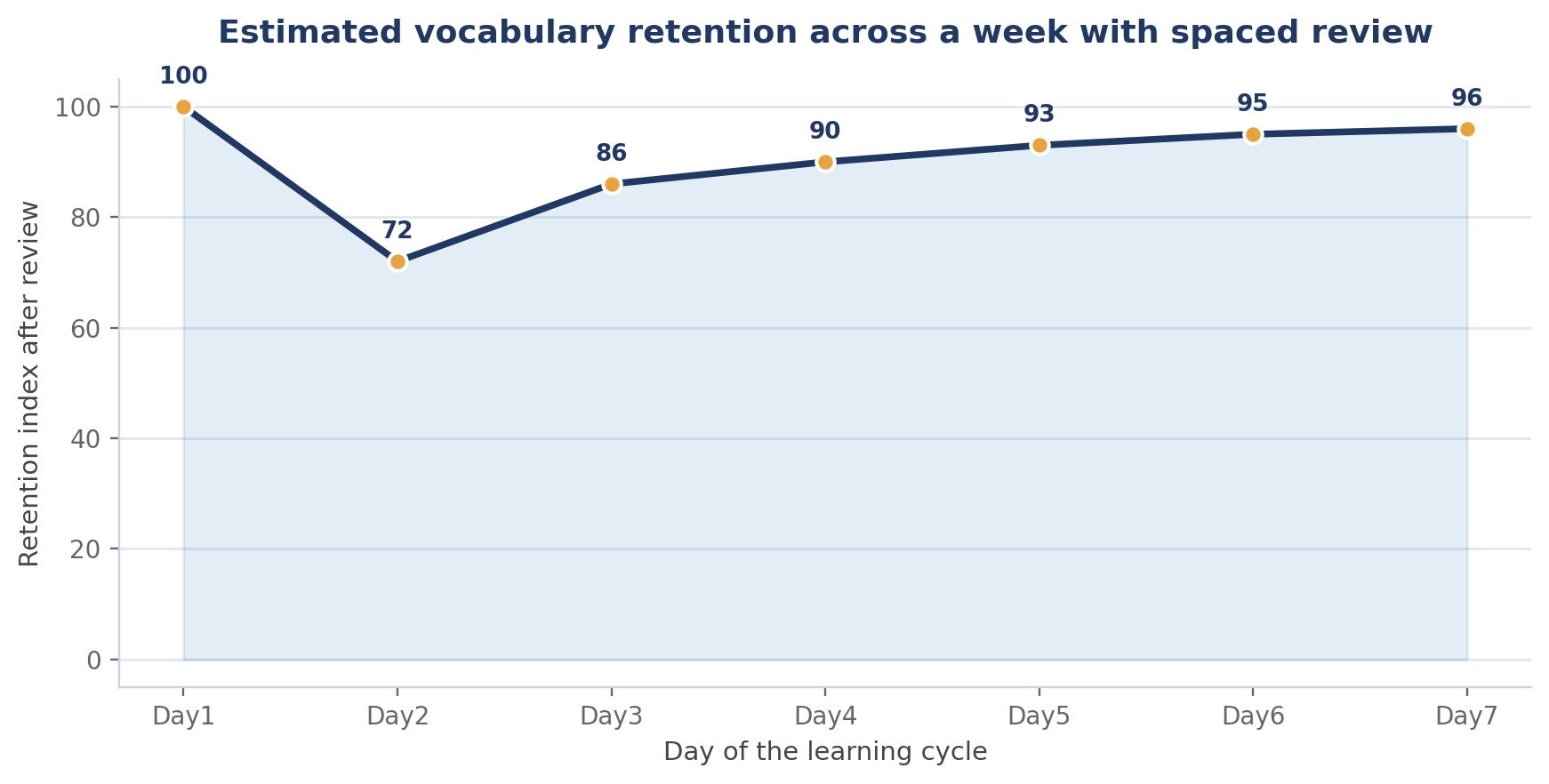
That last row is the one nobody wants to hear. Cramming French into one weekly block feels productive and resets your memory before the next block arrives.
The 25-Minute Skeleton
Structure inside the session matters more than length. Use a fixed shape so you never waste the first five minutes deciding what to do.
Notice there is no "grammar study" block. Grammar should arrive attached to a sentence you already want to say. Rules learned in isolation evaporate.
What you will get from this guide
- A 25-minute daily session you can actually keep
- The right skill split for your level
- A weekly rhythm with AI tutor sessions anchoring it
- The four habits that quietly sabotage learners
Splitting Skills by Level
Beginners and intermediate learners need different diets. Copy the wrong column and you'll stall.
The shift at B1 is subtle but decisive. You stop learning words and start learning chunks — en fait, du coup, à mon avis, ça dépend. These are the connective tissue of real French, and learners who ignore them sound permanently mechanical.
The Weekly Rhythm
Daily consistency needs a weekly spine. One AI tutor session, one long session, one rest day.
Wednesday is the anchor. Everything else is preparation for it and follow-up from it. Without that AI feedback, you're rehearsing your own mistakes with growing confidence.
The Four Habits That Kill Progress
Translating everything. If you think « I would like a coffee » and then convert it, you'll always be slow. Learn « je voudrais un café » as a single sound.
Silent study. Reading French builds recognition, not speech. Your mouth needs repetition just as much as your eyes.
Chasing perfection before speaking. Waiting until you're "ready" means waiting forever. Speak badly now, on purpose.
Switching methods every three weeks. Every new app resets your streak-based motivation and your progress. Pick a system, stay twelve weeks.
Give your routine an AI anchor
Ready to turn reading into real French? Start your self-paced course today.
Start the French course →Create a free accountThe daily minutes are yours. The correction needs feedback. One AI tutor session a week turns twenty-five minutes of practice into twenty-five minutes of actual improvement. Button: Add a weekly AI French tutor session →
Making It Fit a Real Day
Routines fail on logistics, not motivation. Attach each piece to something you already do.
Notice you never need a free hour. You need five small, fixed slots that already exist in your day.
Tools, Kept Minimal
Three tools is the maximum. More becomes administration.
The notebook deserves a warning. Copying rules you found online is transcription, not learning. Write only what you can explain out loud afterwards.
What Twelve Weeks Actually Looks Like
Set a checkpoint, not a vague goal. Twelve weeks of this routine, at 25 minutes plus one weekly AI tutor session, is roughly 55 guided hours plus daily practice — enough to feel a real shift in listening, even if your speaking still lags.
Expect this sequence: week two feels great, week five feels pointless, week eight feels suddenly easier, week twelve feels obvious in hindsight. The week-five dip is not failure. It's the normal shape of skill acquisition.
Twenty-five minutes a day. One AI tutor session a week. Twelve weeks.
Ready to turn reading into real French? Start your self-paced course today.
Start the French course →Create a free accountTake the placement test, get your level, and start a routine with an AI tutor built into it — so your daily practice has somewhere to land. Button: Start your French routine →
Frequently Asked Questions
How long should I study French every day? Twenty-five focused minutes is the sweet spot for most people. Ten maintains, forty-five accelerates. Consistency beats duration every time.
Is it better to study French in the morning or at night? Whatever slot you'll actually keep. Morning suits listening and vocabulary; evening suits reading and writing. Fix the time, not the theory.
Can I learn French with only 15 minutes a day? You can hold and slowly advance a level, especially if you add one weekly AI tutor session. Fifteen minutes alone from zero will feel glacial.
How many words should I learn per day? Five to eight as a beginner, eight to twelve at B1 and above — always inside full phrases, never as isolated words.
References & Further Reading
- CEFR level descriptors and self-assessment grid, Council of Europe: https://www.coe.int/en/web/common-european-framework-reference-languages
- RFI Journal en français facile, daily news in accessible French: https://www.rfi.fr/fr/podcasts/journal-en-francais-facile/
- TV5Monde Apprendre le français, exercises and authentic video: https://apprendre.tv5monde.com/
- France Éducation international, DELF/DALF exam frameworks: https://www.france-education-international.fr/
- Alliance Française, learning resources and placement guidance: https://www.fondation-alliancefr.org/