Day nineteen. Your French app sends a sad owl emoji. You swipe it away and feel a small, specific shame — the kind reserved for abandoned gym memberships and half-read novels.
Motivation did not fail you. Your habit design did. Here is how to build a french study habit that survives a bad week, a busy job and a Tuesday when you simply cannot be bothered.
What you will get from this guide
- Why streaks collapse and what to do instead
- A 20-minute daily French routine you can copy
- Weekly targets mapped to real CEFR progress
The Real Reason Streaks Die
Every broken streak has the same shape. You set an ambitious target — one hour a day — you hit it for a week, life intervenes, you miss once, and the perfect record collapses. Then quitting feels rational.
The fix is not more willpower. It is a smaller unit of success. Success must be achievable on your worst day, not your best.
The floor plan wins. Ten minutes is not impressive, but it is repeatable — and repetition beats intensity in language learning.
Use Triggers, Not Reminders
A reminder is a notification you ignore. A trigger is something already in your day that pulls French behind it. Habit researchers call this habit stacking, and it works because you are not creating a new slot in your schedule — you are borrowing an existing one.
Five triggers, all borrowed. Total time: under forty-five minutes, spread thin enough to be invisible.
The 20-Minute French Routine
If you want one routine, take this one. It covers input, output, and correction — the three things solo learners neglect.
The output block is the one people skip, and it is the one that matters most. Speaking aloud alone feels ridiculous. Do it anyway. Your mouth needs the reps as much as your memory does.
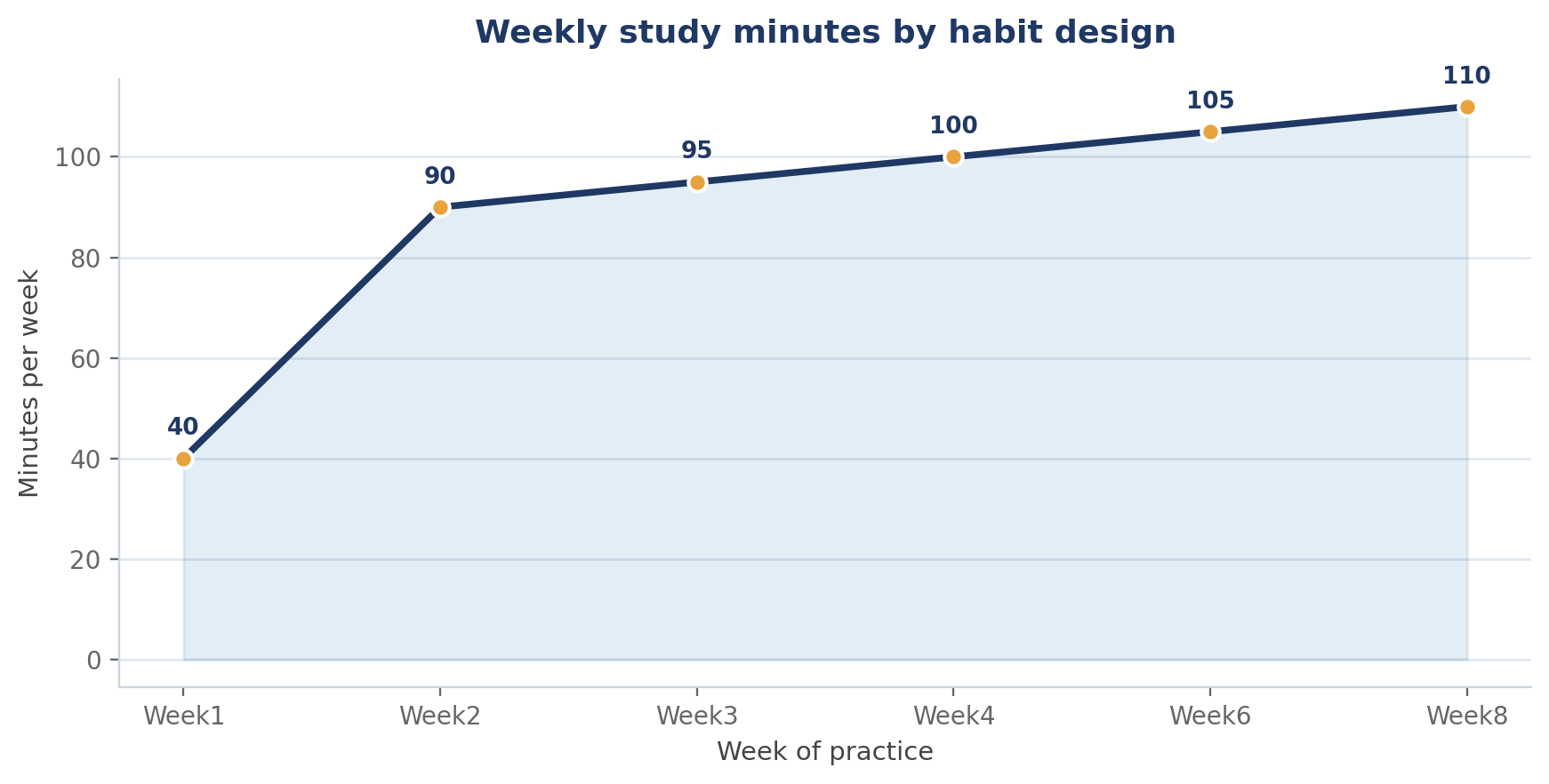
Notice the shape. It is not a rocket. It is a staircase that keeps going up because it never breaks.
Make Progress Visible
Invisible progress is where motivation goes to die. French improves too slowly to feel daily, so you need a scoreboard that moves.
Track three of these, not twelve. A scoreboard you ignore is decoration.
When You Miss a Day
You will miss a day. The rule is simple: never miss twice.
Boredom and plateau are different problems. Boredom needs novelty. A plateau needs output with feedback — which is exactly what a live instructor provides.
The habit needs feedback on the other end
You can build the routine alone. You cannot correct yourself alone. A personal AI voice tutor gives your daily practice a target and structured feedback.
See the French course →Create a free accountThe Weekly Shape of Real Progress
A daily habit needs a weekly rhythm, or it becomes a treadmill. Give each day a job.
Six days of input, one day of extended speaking practice. That is the engine.
How Long Until It Feels Easy?
Honestly? The habit gets easy in about three weeks. The French does not.
CEFR planning estimates put A1 at roughly 90 guided hours and A2 near 180. Daily twenty-minute practice lands you around 120 hours a year — enough to clear A1 comfortably and push into A2. To get faster, raise the ceiling, not the floor.
Same person, same talent — different arithmetic. This is why habit design matters more than study intensity.
Ten minutes a day, with a tutor that never cancels
Keep the daily floor going and add structured AI-guided lessons on top. That combination is what turns scattered practice into B1 French.
Start your French habit →Create a free accountFrequently Asked Questions
How long does it take to form a French study habit? Most people find the routine feels automatic after about three weeks of daily repetition, though the exact timeline varies by person and by how strong the trigger is.
Is ten minutes a day enough to learn French? Ten minutes a day keeps the habit alive and slowly builds vocabulary. It is not enough for rapid progress — pair it with structured speaking practice with AI feedback to convert practice into steady progress.
What if I miss several days in a row? Restart with the ten-minute floor plan, not with a heroic catch-up session. Never miss twice in a row; the second miss is what ends habits.
Should I study grammar every day? No. Grammar in small doses, twice a week, works better than daily drills. Spend the saved time listening and speaking.
References & Further Reading
- Council of Europe — CEFR self-assessment grid and can-do statements
- Alliance Française — conversation course formats and placement information
- France Éducation international — DELF/DALF official exam resources
- LanguageSkills.net — self-paced French courses with a personal AI voice tutor
- BBC — French language learning resources and listening practice