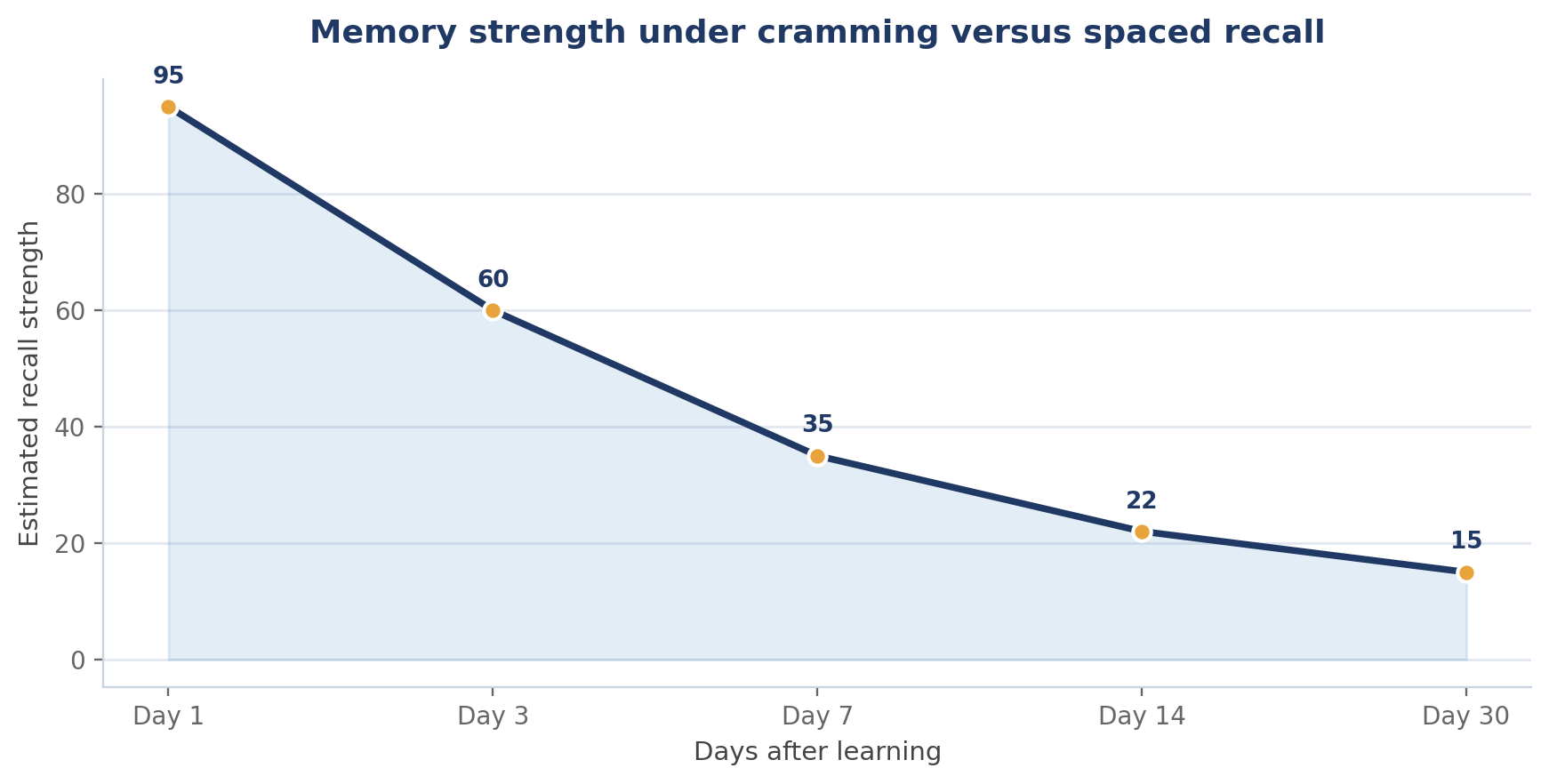
You memorised brouillard last Tuesday. Today it is gone, and you can feel the shape of the hole where it used to be.
That is not a memory problem. That is a method problem — and it is fixable by Thursday.
What you will get from this guide
- Why rereading word lists fails, in one clear picture
- The spaced repetition schedule that actually holds French words
- Gender and word-family patterns that cut memorisation work in half
- Five-minute drills you can run on a bus, with no app open
Why your list keeps evaporating
Your brain discards what it decides is irrelevant. A word seen once, in a tidy column, next to its English translation, looks like trivia. It gets dropped.
A word you used, in a sentence you built yourself, at a moment you were slightly unsure, looks like experience. It stays.
So the fix is not more repetition. It is better-timed, more effortful recall. Re-reading a list feels productive because it is easy. Easy is exactly the problem.
Recall beats review — every time
Notice the pattern: the harder the recall, the longer the word stays. A gap of a few seconds where you genuinely struggle is not failure. It is the mechanism.
The schedule that does the work
Spaced repetition is not a gimmick, it is the shape of forgetting. Review a word just before you would lose it, and the memory flattens out.
Skipping a stage does not ruin the word. It just sends it back one step. Miss a review, repeat the previous interval.
Cut the workload with patterns, not brute force
French hands you shortcuts. Use them and you memorise hundreds of words instead of thousands.
Learn travailler once and you unlock travailleur, travail, travaillant. That is the compounding interest of vocabulary.
Gender: stop guessing, start categorising
Gendered nouns are where learners bleed points. Memorise the ending, not just the word.
Exceptions exist — la plage, le silence — and you learn those by meeting them, not by fearing them. Learn every noun with its article attached, as one sound: le bureau, never bureau.
Five drills that take under ten minutes
Concrete beats theory. Pick two and run them this week.
Words stick when someone makes you use them
Ready to turn reading into real French? Start your self-paced course today.
Start the French course →Create a free accountSelf-study builds the list. A personal AI voice tutor turns it into speech, giving you feedback on your gender and your verbs before they harden. Button: Learn French live →
The habits that quietly destroy progress
Keeping a giant A to Z list instead of thematic clusters. Learning isolated words instead of chunks like avoir envie de. Translating from English word for word. Studying in silence and never hearing the word. And reviewing only what is already easy, because easy feels good.
One more: cramming the night before a lesson. Two twenty-minute sessions across the week beat one ninety-minute session, every time, for every learner.
Making it automatic
Vocabulary learning is not a talent lottery; it is a schedule plus a bit of discomfort. Choose thirty words this week, run them through the six stages, and use all thirty aloud by Friday. Repeat next week.
Do this for six months and you will hold roughly seven hundred reliable words — enough to hold real conversations and to build on. The Alliance Française level framework calls that a solid A2 to B1 foundation. That is where French stops being a subject and becomes a language you live in.
From word lists to real conversation
Ready to turn reading into real French? Start your self-paced course today.
Start the French course →Create a free accountBring your vocabulary practice into structured self-paced lessons with an AI voice tutor. The course pass includes speaking practice with AI feedback and a CEFR-aligned route from A1 to B2. Button: Start your French course →
Frequently Asked Questions
How many French words should I learn per day? Ten to fifteen new words a day is a durable pace for most learners, with reviews of the previous weeks layered on top. Fewer words with better recall beat longer lists every time.
Does spaced repetition really work for French vocabulary? Yes. Spaced repetition is built on the well-documented forgetting curve and works especially well for the irregular forms and gender that French demands. Use it for retrieval, not just recognition.
How do I remember French noun genders? Learn each noun with its article as a single unit, then group by ending — most -tion, -té and -ence nouns are feminine, most -ment, -age and -isme nouns masculine.
Should I learn words or full sentences? Both, but sentences carry more. Chunks like je viens de finir give you grammar and vocabulary in one memorisable package.
References & Further Reading
- Ebbinghaus, H. (1885), Über das Gedächtnis — the original forgetting curve research.
- Council of Europe, Common European Framework of Reference for Languages — vocabulary and proficiency descriptors.
- France Éducation International — DELF and DALF lexical expectations by level.
- Nation, I.S.P., Learning Vocabulary in Another Language (Cambridge University Press).
- Alliance Française — level and vocabulary progression guidance for French learners.