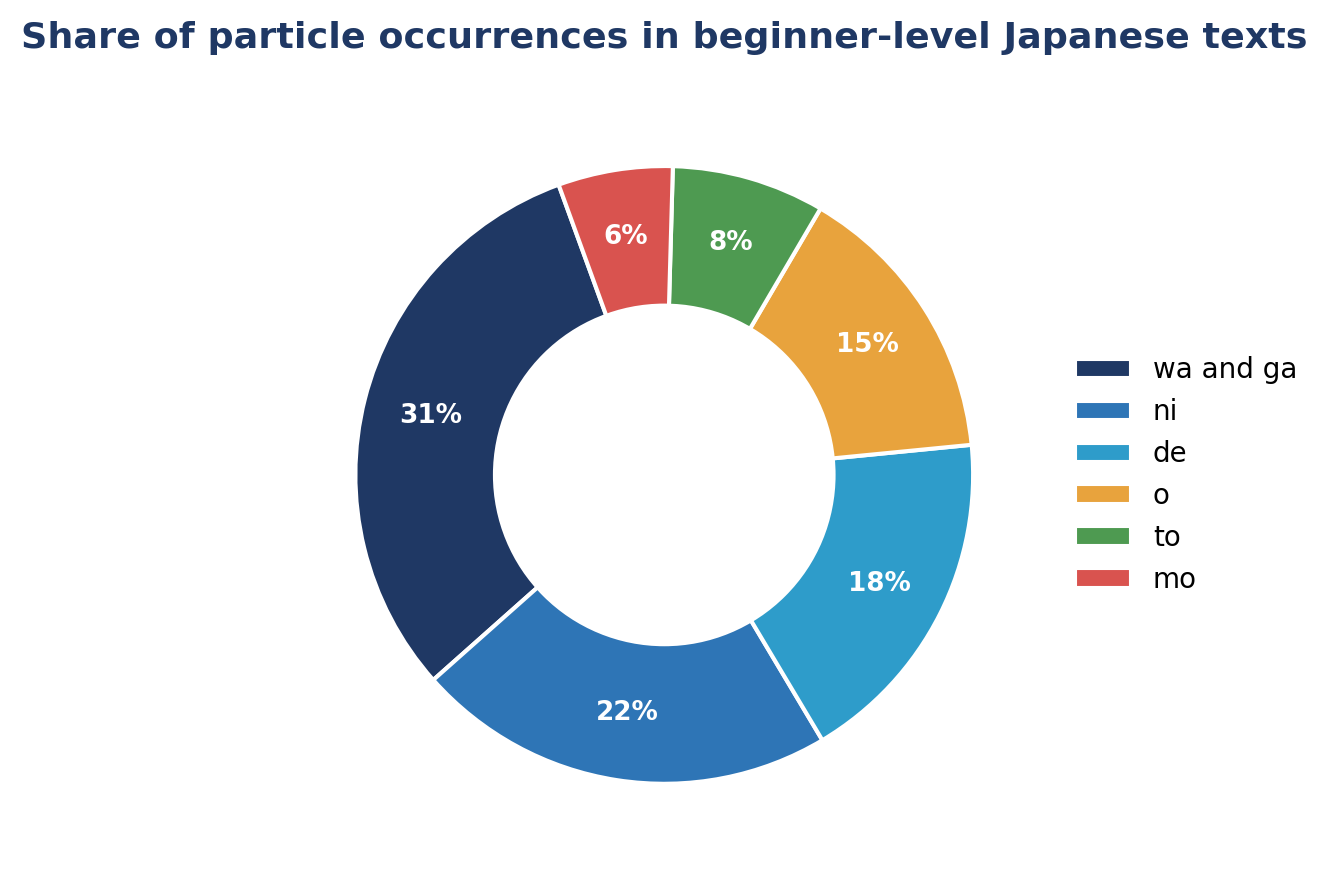
Japanese grammar has a reputation for being difficult, and the reputation is mostly undeserved — with one exception. Particles are genuinely hard at first, because they do something English does not do at all.
In English, word order tells you who did what to whom. In Japanese, word order is comparatively free, and little words called particles do that work instead. The verb comes at the end, and every noun in front of it wears a tag announcing its job.
Five particles carry most of the weight in beginner Japanese: wa, ga, o, ni and de. Learn what each one marks and the language stops looking like a maze.
The Five Particles at a Glance
Two things are worth noticing immediately. First, は is written with the hiragana character normally read ha, and only the particle is read wa. Second, を is used almost exclusively as a particle, which makes it one of the easiest signs to spot in a sentence.
The Topic Particle は
Think of は as a spotlight operator. It announces "here is what this sentence is about", and it can mark almost anything.
Because は marks the topic rather than the doer, it can also set up a contrast. 私は often means "as for me, unlike someone else". That contrast reading is why learners are told not to use は for every sentence — you are quietly emphasising a difference each time.
The Subject Particle が
が marks the grammatical subject, and it is the particle learners confuse with は most often. The distinction is not really about grammar; it is about focus.
The practical rule that resolves most cases: use は when the thing is already known or is the general topic, and が when you are introducing something new, answering a question, or pointing out who specifically. If someone asks who did it?, the answer is marked with が.
Two patterns worth memorising early:
Those three use が where English uses a direct object, and they catch learners out for months if they are not learned as fixed shapes.
The Object Particle を
を marks the direct object — the thing being acted upon. It is the least ambiguous particle in the language.
Because the verb sits at the end, を tells you what to expect before you hear it: the sentence is heading toward a transitive verb. That is the payoff of particles — they let you predict the end of the sentence while it is still being spoken.
The Particle に — Destination, Time and Recipient
に is the most versatile of the five. It has four common jobs, and they are all about a point in space, time or people.
Note the last row carefully, because this is exactly where learners mix up に and で.
The Particle で — Where the Action Happens
で also marks location, which is why it collides with に in beginner minds. The difference is the type of verb.
The clean test: if you are doing something, use で. If you are going somewhere or something simply exists, use に. And if the sentence is about how you do it, で marks the method — by bus, with chopsticks, in Japanese.
Learn particles by using them, not by memorising them
Particle rules make sense in a lesson and evaporate in conversation. Our Japanese Course Pass pairs you with a personal AI voice tutor that corrects your particles as you speak, sentence by sentence, at your own pace. Explore the Japanese Course Pass →
Start the Japanese course →Create a free accountSentence Patterns That Use All Five
Once each particle is familiar alone, combine them. These five patterns cover a very large share of everyday Japanese.
The fourth row is the model sentence for beginner Japanese: topic, location of action, object, verb, all in one line. Write it out, swap the nouns, and you have a hundred correct sentences.
Five Mistakes That Slow Beginners Down
That last row is the real method. Particles are learned by hearing them attached correctly to words a few hundred times, not by recalling a rule under pressure. Grammar explanations tell you why; practice is what makes them automatic.
A Two-Week Practice Routine
The day-twelve step is the one that matters most. Writing sentences and having them corrected is the fastest way to convert particle rules into particle instinct, because your own mistakes are far stickier than someone else's examples.
Turn particle rules into particle instinct
Two weeks of guided practice fixes what months of reading alone will not. Our Japanese Course Pass gives you a personal AI voice tutor, structured levels from A1 to B2, and correction from the first lesson — all self-paced. Start your Japanese Course Pass →
Start the Japanese course →Create a free accountFrequently Asked Questions
What is the difference between wa and ga? は marks the topic, the thing the sentence is about, and often carries a contrast. が marks the subject and introduces new or specifically identified information, especially in answers.
When should I use ni instead of de? Use に for destinations, time points, recipients and the place where something exists. Use で for the place where an action happens and for means or methods such as transport and tools.
Do Japanese speakers always use particles in casual speech? Some particles are dropped in very casual speech, especially を and は, but the patterns remain. Learn them properly first, and only then notice what gets omitted.
Which particle should I learn first? Start with は and です as fixed frames, then を with common verbs. Add に and で together, because learning them as a pair prevents the most common confusion.