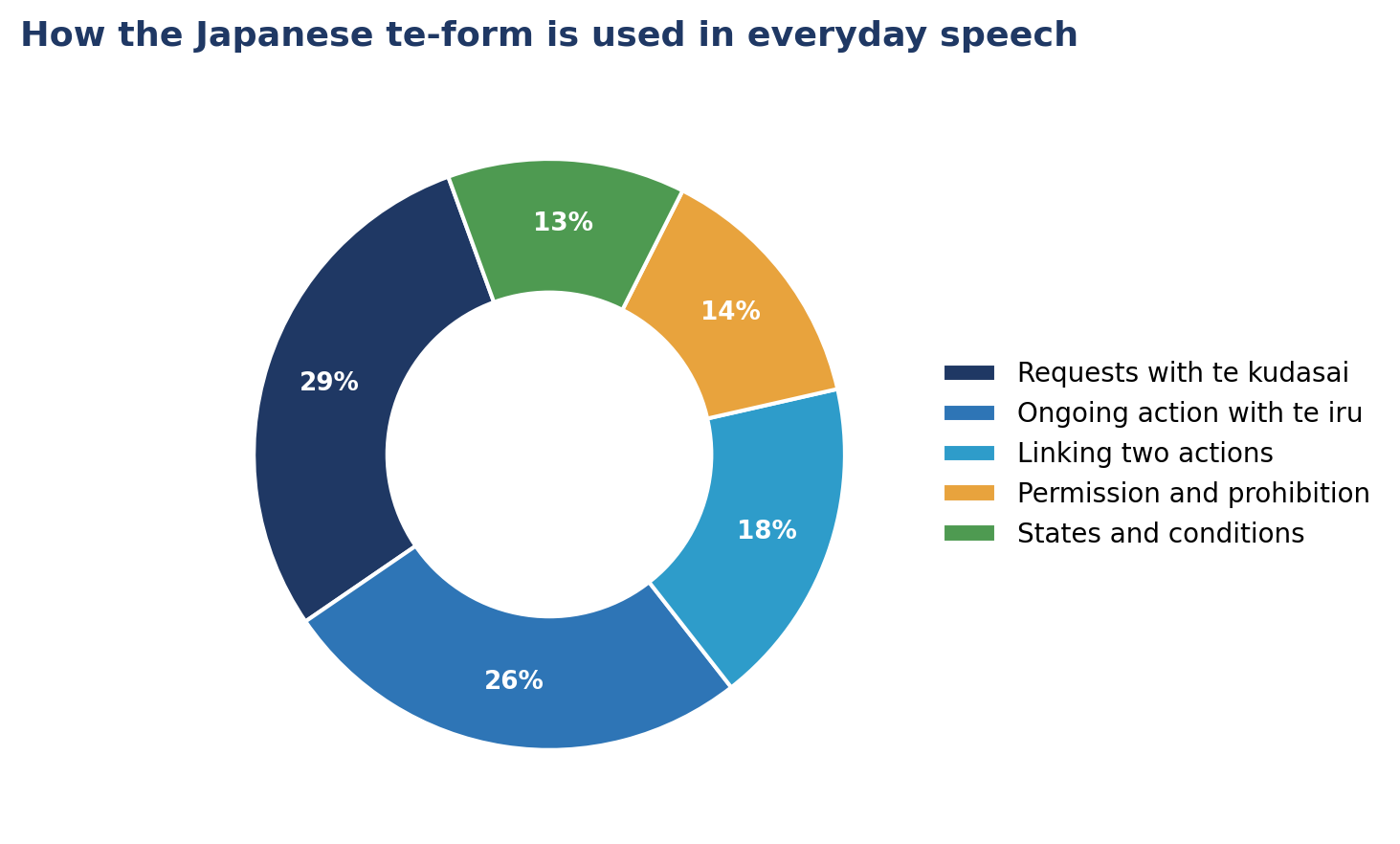
If Japanese grammar has a master key, it is the te-form. Almost every structure that lets you move beyond simple statements runs through it — requesting, describing what is happening now, linking two actions, asking permission, reporting a state.
That is the good news. The work is in the conjugation, because the te-form is not one rule but a small family of rules that depend on how the verb ends. The good news about the work: there are only three verb groups, and the patterns are fixed.
Here is the whole system, from conjugation to the five uses that appear constantly in real Japanese.
The Three Verb Groups
Everything about te-form conjugation depends on which group a verb belongs to. Identify the group first and the rest follows.
The main trap in identification is that some る-ending verbs belong to group 1, not group 2. Verbs like 帰る (kaeru, to return), 入る (hairu, to enter) and 走る (hashiru, to run) look like group 2 but conjugate as group 1. Learn those exceptions as a short list and the rest of the system stays clean.
Group 1: The Sound Shifts
Group 1 verbs change their final syllable according to a fixed pattern. There is no shortcut except repetition, but the pattern is regular.
One verb is irregular within this group for historical reasons: 行く (iku, to go) becomes 行って (itte), not 行いて. It is the only exception worth memorising separately.
Groups 2 and 3: Simple and Simpler
The two irregulars are the two most common verbs in Japanese, which means you will use their te-forms more than any others. Learn して and 来て on day one and they will carry you for a long time.
Note the last two rows. Adjectives have te-forms as well, and they behave predictably: い-adjectives drop い and add くて, while な-adjectives take で.
The Five Uses You Will Meet Constantly
Conjugation is the mechanic. These are the reasons the mechanic exists.
The second row deserves attention because it does double duty. 食べている can mean "is eating" right now, but also "has eaten" as a resulting state — as in 結婚している, which usually means "is married" rather than "is getting married". Context decides, and learners often find the second reading surprising.
Linking Sentences With the Te-form
This is the use that changes how you speak. In Japanese you do not chain clauses with "and" the way English does; you attach them with the te-form and put the final verb at the end, which carries the tense for the whole sentence.
That last row is a good reminder that the te-form is not only for verbs. Adjective te-forms let you describe two qualities in one sentence, and they are used constantly in conversation.
Learn the te-form by using it in conversation
Drills get you the endings; conversation makes them automatic. Our Japanese Course Pass gives you a personal AI voice tutor who guides you through te-form patterns in structured, self-paced lessons until they become automatic. Explore the Japanese Course Pass →
Start the Japanese course →Create a free accountThe Patterns Worth Learning as Whole Units
Some te-form structures are so frequent that it is faster to learn them as fixed phrases than to build them each time.
The last three are the ones that make learners sound natural rather than textbook-correct. 〜てみる and 〜ておく appear in everyday conversation constantly, and knowing them transforms the range of things you can express.
Five Mistakes That Slow Beginners Down
The fourth row is the most common practical error. 食べて and 食べた are easily swapped in fast speech, and the two are different words with different jobs: one links or requests, the other completes in the past. Drill them in pairs — 読んで / 読んだ, 書いて / 書いた — until the distinction is automatic.
A Two-Week Te-form Routine
By day fourteen, conjugation should be automatic and the uses should be familiar in speech — which is exactly what unlocks the rest of intermediate Japanese grammar.
Two weeks of te-form, then real conversation
Once the te-form is automatic, a great deal of Japanese opens up. Our Course Pass gives you a personal AI voice tutor and a structured, self-paced curriculum (A1 to B2) that builds on it from the next lesson. Start your Japanese Course Pass →
Start the Japanese course →Create a free accountFrequently Asked Questions
What is the te-form in Japanese? It is a verb form ending in て or で that connects verbs to other grammar. It is used for requests, ongoing actions, linking sentences, permission and prohibitions.
How do I know which conjugation rule to use? Identify the verb group first. Group 2 verbs drop る and add て, group 1 verbs follow a sound-change pattern, and する and 来る are irregular.
What is the difference between te-form and past tense? The te-form connects, requests or describes an ongoing action, while the past tense (た-form) completes an action in the past. They are often confused because they sound similar.
Is the te-form used more in speech or writing? Much more in speech. Requests, ongoing actions and sentence-linking all depend on it, which is why it usually appears in a learner's first month of conversation.