You open a French course page. It says A2. You open another. It says B1 entry required. Nobody explains the alphabet soup — so you guess.
Stop guessing. The CEFR is a six-step ladder, and once you see it, every course, exam and job advert in the French-speaking world suddenly makes sense.
What you will get from this guide
- What each CEFR level (A1 to B2) actually means in French
- How DELF and DALF map onto the ladder
- Realistic hours per level, and how to find your own level today
What the CEFR Actually Is
The Common European Framework of Reference for Languages is a scale published by the Council of Europe. It describes what a learner can do — not what they have memorised. That is the whole point: it is a functional ladder, not a grammar syllabus.
Three broad bands sit underneath. A means basic user. B means independent user. C means proficient user. Each band splits into two levels, giving six rungs from A1 to B2.
The A1 to B2 Levels, One by One
Here is the ladder, rung by rung, with the honest description nobody puts on the marketing page.
Notice that A1 to A2 is a short hop and A2 to B1 is a chasm. Most learners stall exactly there. It is the level where "tourist French" stops working and real grammar becomes mandatory.
How DELF and DALF Map Onto the CEFR
This is where learners get confused. DELF and DALF are not extra levels. They are exams that certify CEFR levels. France Éducation International awards them, and they never expire.
The split is elegant. DELF covers A1 to B2. DALF covers B2. The TCF and TEF are different again — quick scoring tests rather than diplomas — but they report results using the same CEFR scale.
That single shared scale is why a B2 from a Paris school means the same thing as a B2 from a Montreal one. Portability is the CEFR's superpower.
Find your rung, then climb it.
A placement check tells you exactly where you sit — A1, B1 or beyond — and a personal AI voice tutor builds the plan from there. No restarting, no wasted months.
Take the placement check →Create a free accountHow Long Does Each Level Really Take?
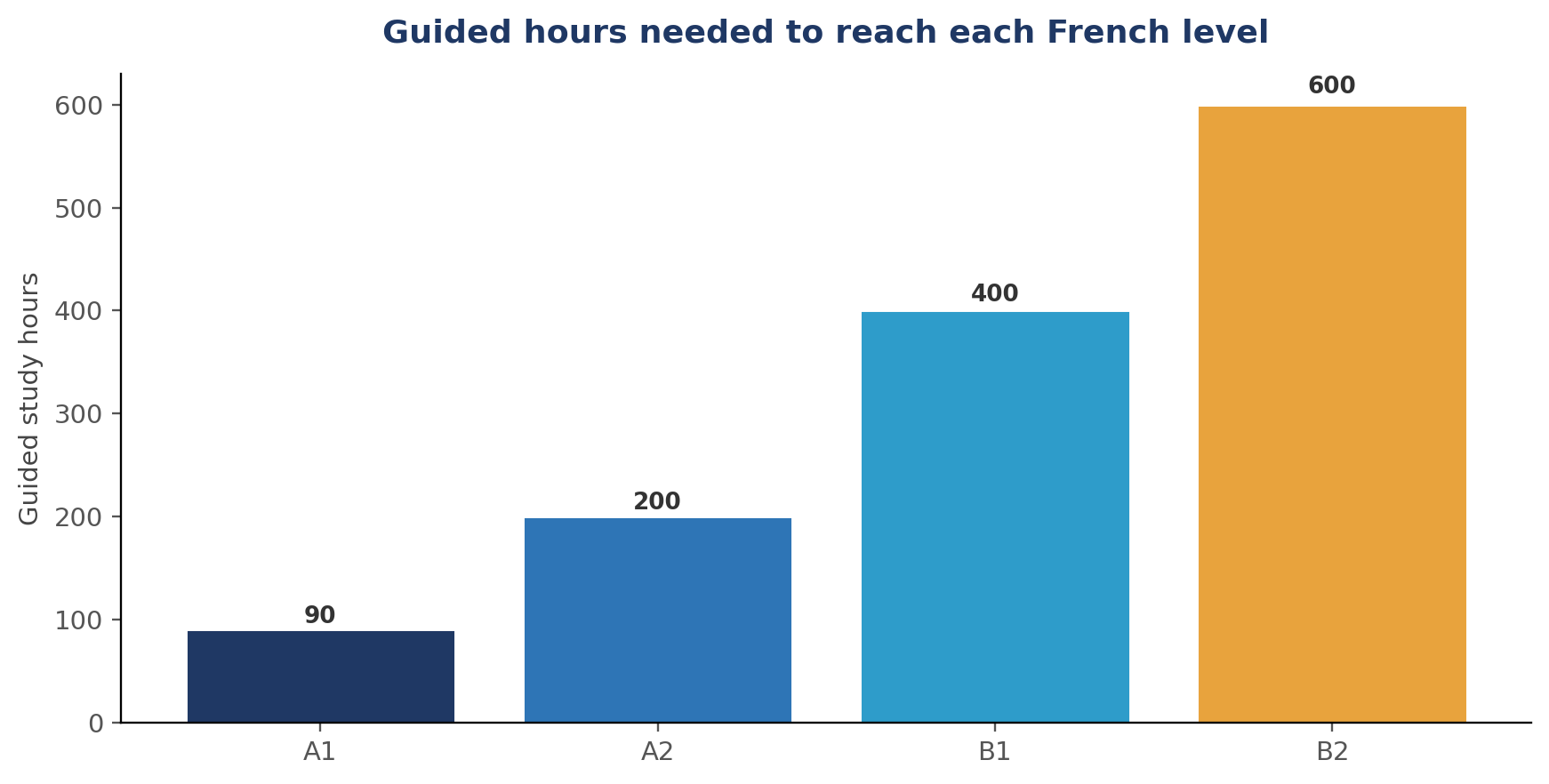
Hours matter more than talent. The CEFR does not publish fixed hour counts, so treat every number below as an estimate drawn from widely used course planning bands.
Two learners with identical hours get different results, because one speaks and the other highlights. The ladder measures performance, not exposure.
How to Find Your Own Level Today
Skip the quiz-hunting. Answer one question honestly: what is the hardest thing you can do in French right now, without preparation?
Be strict. A learner who reads Le Figaro but freezes on the phone is usually A2, not B2. Reading is the easiest skill to inflate.
The good news: an honest level is a fast lever. Twenty hours at the correct level beats two hundred spent re-learning le passé composé for the fourth time.
The ladder has six rungs. Pick yours and start climbing.
A personal AI voice tutor, speaking practice with AI feedback, and a self-paced path to real confidence. Your first session costs you nothing but nerve.
Start learning French →Create a free accountFrequently Asked Questions
Do CEFR levels ever expire? No. The scale describes ability, and DELF/DALF diplomas are valid for life. Only some test scores, like the TCF, carry a validity window — usually two years.
Is B2 enough to study at a French university? Usually yes. Many universities require DELF B2 or its equivalent, though competitive programmes and medical or law faculties may ask for C1.
How is the CEFR different from a school grade? A grade compares you to classmates. The CEFR asks whether you can perform a real task — book a flat, defend an idea, follow a lecture. It travels across countries and employers.
Can I skip A2 and jump straight to B1? You can, if a placement test places you there. What you cannot skip is the speaking. Gaps at A2 resurface at B2 as wobbling tenses and thin vocabulary.
References & Further Reading
- Council of Europe — Common European Framework of Reference for Languages: https://www.coe.int/en/web/common-european-framework-reference-languages
- France Éducation International — DELF and DALF diplomas: https://www.france-education-international.fr/en/diplome/delf-dalf
- Institut français — French courses and certification worldwide: https://www.institut-francais.fr/
- Alliance Française — global network of French schools: https://www.fondation-alliancefr.org/
- LanguageSkills.net — self-paced French courses from A1 to B2: https://languageskills.net/french