B1 French is a strange purgatory. You can order a coffee, complain about the metro, and then a French friend makes a joke and you smile like you understood it.
B2 is the level where the smile becomes real. It is also the level that opens doors: universities, jobs, and permanent residence applications. Here is what upper-intermediate French actually means, and how to get there.
What you will get from this guide
- What you can genuinely do at French B2, in plain terms
- How the DELF B2 exam is structured and scored
- Realistic hour bands from B1 to B2
- A study plan that targets your weakest skill first
What Upper-Intermediate French Really Means
The Council of Europe descriptors put it elegantly: at B2 you can understand the main ideas of complex text, interact with a degree of fluency and spontaneity, and produce clear, detailed text on a wide range of subjects.
Translate that into a Tuesday night:
B2 is competent. Not invisible. And that is entirely fine.
The Gap Between B1 and B2 Is Not Vocabulary
Most learners assume the jump is word count. It is not. The real distance is three things:
The connector column is the quiet MVP. Learn forty sophisticated connectors and your French sounds two levels older overnight.
How Many Hours From B1 to B2?
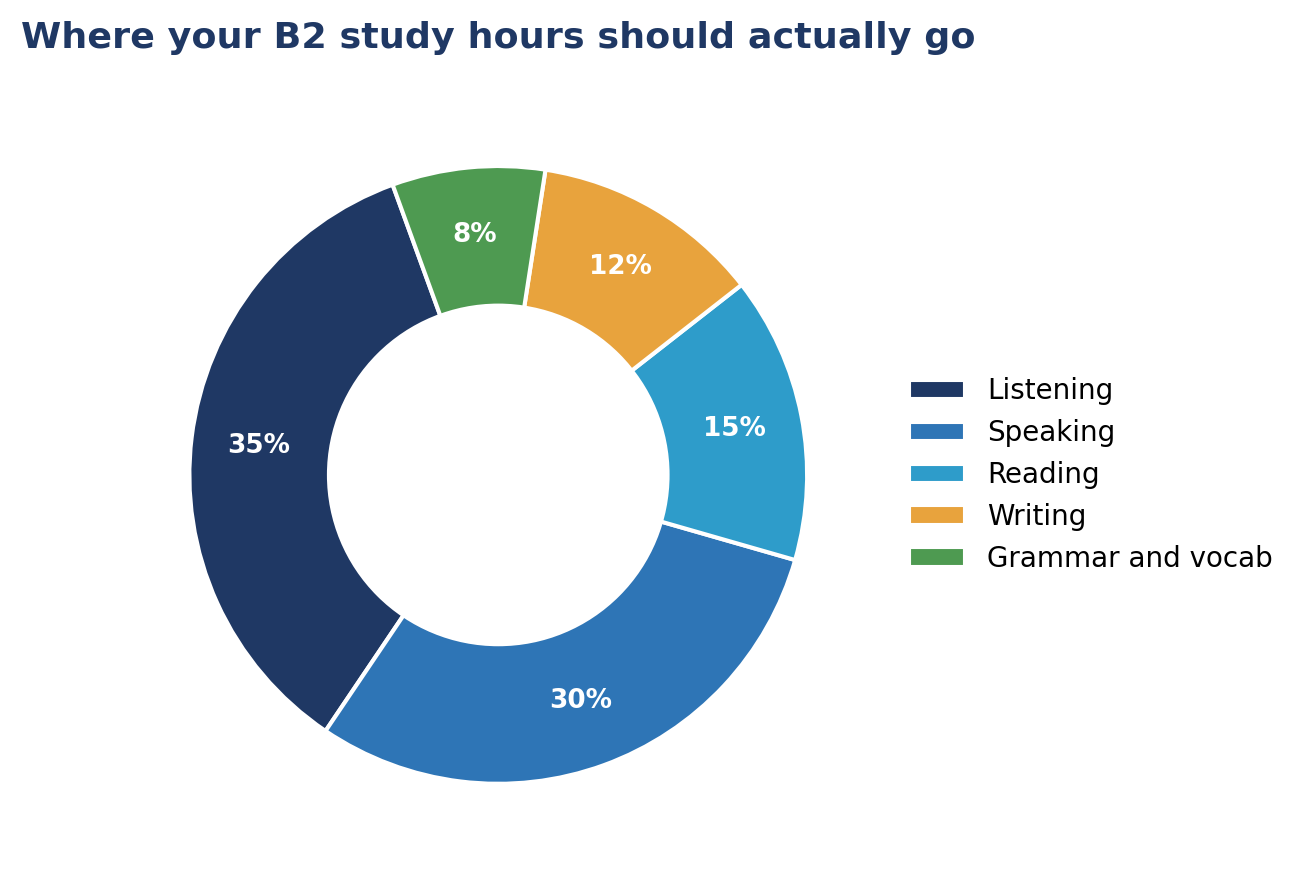
Roughly 250 to 400 guided hours from a solid B1. That is not a weekend project — but it is absolutely a year of steady work, or a focused six months.
Speaking and listening take 65 percent of the pie. Most learners do the opposite and then wonder why the exam feels like a wall.
Inside the DELF B2 Exam
The DELF B2 is run by France Éducation international and is valid for life. Four sections, each worth 25 points. You need 50 out of 100 to pass, with a minimum of 5 per section.
The oral is the killer for most candidates. You get 30 minutes to prepare, then you must argue for ten minutes and survive a debate. Silence is fatal, and hesitation is normal — the examiner is testing argument, not perfection.
A Skill-First Study Plan
Do not study evenly. Study your weakest link, twice as hard.
The self-recording habit sounds silly. It is the single fastest way to fix fossilised errors.
B2 is a speaking level. Practise it out loud.
Ready to turn reading into real French? Start your self-paced course today.
Start the French course →Create a free accountOur self-paced French courses with an AI voice tutor give you speaking practice with instant feedback, push you into debate, and align with DELF B2 criteria. Exactly the reps the exam demands.
Button: Train toward French B2 →
Where French B2 Opens Doors
The pieces of paper differ by purpose, so pick your target deliberately.
Note the Canadian row: TEF Canada and TCF Canada score differently, so check the current threshold before you book.
The Trap: Passive Fluency
Many B1 learners read beautifully and freeze when spoken to. They have built a library, not a mouth.
That first row is the one that costs people a year.
Choosing an Exam or Skipping It
A certificate is a tool, not a personality. Use it when it opens a specific door.
Your B2 is closer than you think.
Ready to turn reading into real French? Start your self-paced course today.
Start the French course →Create a free accountTake a free level check, get an honest assessment against DELF criteria, and start a plan built around your weakest skill. AI voice tutor, real debate, real progress.
Button: Start your French B2 plan →
Frequently Asked Questions
How long does it take to reach French B2?
From a solid B1, expect 250 to 400 guided hours. With 8 hours a week that is roughly a year; with 15 to 20 hours a week, six months or less.
Is DELF B2 hard?
It is demanding but very passable. The writing and the oral debate trip up most candidates. Practice the exam format specifically for four to six weeks before sitting it, and you raise your odds considerably.
Is B2 French fluent?
Functionally, yes. You can work, study and socialise in French. You will still miss jokes, slang and very fast speech — that is normal at B2 and improves with exposure.
Can I self-study to French B2?
Partly. Reading, listening and grammar work well alone, but the DELF B2 oral and writing need human correction. Most successful self-studiers add regular tutor sessions for the final stretch.
References & Further Reading
- France Éducation international — official DELF and DALF exam specifications, including the B2 format and marking criteria.
- Council of Europe — Common European Framework of Reference for Languages: Companion Volume, source of the B2 descriptors.
- Institut français — cultural and language programmes abroad, including exam centres and course listings.
- Académie française — reference guidance on French usage, register and style.
- TV5Monde — Apprendre le français with free level-graded exercises built on authentic broadcasts.