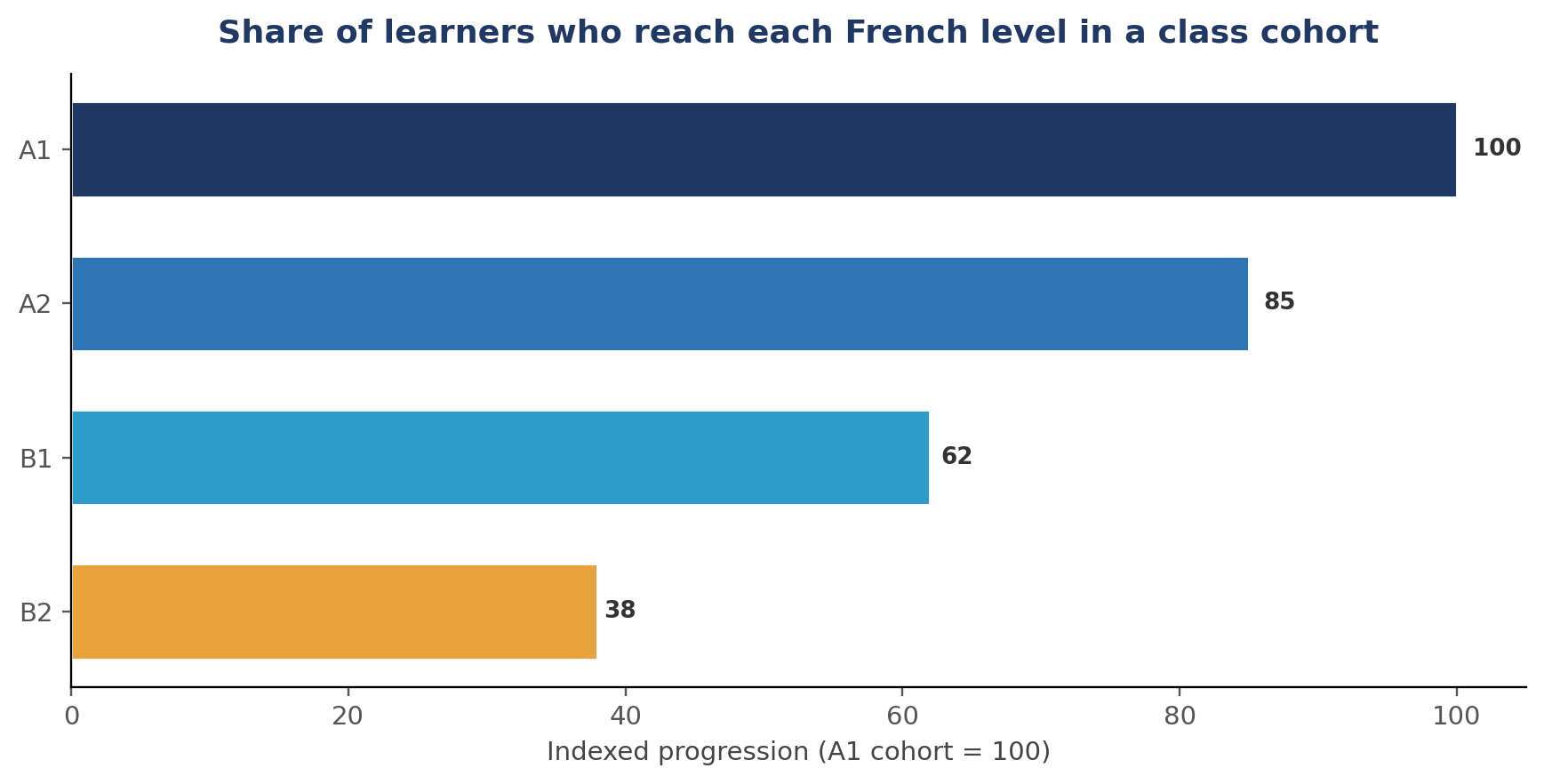
Levels are useless until they get concrete. "I'm B1" tells nobody whether you can argue with a landlord in Lyon or book a table in Nice.
So here it is, task by task: a french level can-do map, from saying your name to running a meeting — with the honest limits nobody prints on the certificate.
What you will get from this guide
- A can-do checklist for A1, A2, B1 and B2
- Where each level breaks — the real ceiling
- Which DELF or DALF exam matches your level
- How to test your level without paying a cent
The One-Line Version of Each Level
If you read nothing else, read this table.
That "threshold" word at B1 is not decoration. B1 is where the language flips from a puzzle into a tool.
A1 and A2: The Survival Zone
At A1 you can introduce yourself, ask simple questions, and understand slow, clear speech about familiar topics. Ordering coffee works. Understanding the waiter's reply about the specials does not.
At A2 the world opens a little. You can describe your background, handle shops, transport, and appointments, and write a short message that a French speaker reads without wincing.
Both levels punish you in the same place: native speed. You will understand your teacher and nobody else.
B1: Where French Becomes Real
B1 is the level most learners actually want. You can deal with most situations while travelling, describe experiences and hopes, and give short reasons for opinions.
Concretely, a solid B1 learner can:
The remaining gap is speed and nuance, not vocabulary.
Stuck at "almost B1"? That is a teaching problem
The jump from A2 to B1 is where self-study quietly fails. A personal AI voice tutor drills the exact structures that keep you stuck in the survival zone, at your own pace.
Book a French level check →Create a free accountB2: The Professional Band
B2 means you understand the main ideas of complex text, interact with fluency, and write clear, detailed text on many subjects. This is the level employers and universities usually ask for.
B2 is competence — and the difference shows up in how much energy French costs you at the end of a day.
Which Exam Matches Which Level?
Exams are the sanity check. Here is the mapping for French.
DELF and DALF diplomas never expire. TCF and TEF scores do — usually two years — so exam timing matters as much as exam choice.
How to Find Your Level Without Paying
Four cheap tests, ranked by honesty:
The self-assessment grid is where everyone lies to themselves — usually upward, by roughly half a level. A teacher who hears you speak settles it in ten minutes.
The Level Nobody Advertises
Between A2 and B1 there is a swamp. Learners recognise hundreds of words, read decently, and freeze in conversation. This is normal, it is temporary, and it breaks only with structured speaking practice and correction.
Name the swamp, plan for it, and walk through it. That is how the can-do list stops being aspirational and starts being a report card.
Find your real level with a personal AI voice tutor
No grid, no guessing. Speak with your AI voice tutor, get your exact level, and start at the right rung on the ladder — at your own pace, any time.
Start a French course →Create a free accountFrequently Asked Questions
What level of French is considered fluent? B2 is usually the working definition of fluent — you can work, argue and live in French.
Is B1 enough to live in France? Yes for daily life, renting, and basic work. For professional roles, universities, or visa points, B2 and above is normally the bar.
How long from B1 to B2? Roughly 200 guided hours, more if you never speak outside class. Conversation hours and real input shorten it noticeably.
Do French levels expire? Levels are a snapshot, not a licence. Without practice you drift down, mostly in speaking. Reading and listening fade slower.
References & Further Reading
- Council of Europe — Common European Framework of Reference for Languages, global scale descriptors
- France Éducation international — DELF and DALF official level specifications
- Alliance Française — French course pathway from A1 to B2
- TCF and TEF exam documentation — score-to-CEFR equivalency tables
- Goethe-Institut / Council of Europe joint publications on self-assessment grids
Ready to move up a rung? Start a self-paced course with your personal AI voice tutor and get your real French level measured today at languageskills.net/french.