Nobody warns you about the bakery. You rehearse bonjour in your head for the whole walk, you say it perfectly, and the baker fires back four seconds of rapid French that turns your ears to static. That moment — not the grammar book — is where French A1 actually lives.
French A1 is the level where you survive that bakery. Not win. Survive. And survive with a smile, a merci, and the right croissant in your hand.
What you will get from this guide
- The exact CEFR definition of French A1, in plain language
- A real hour count for reaching it, plus a week-by-week shape
- The full A1 syllabus: grammar, vocabulary, and the four skills
- How DELF A1 works, and whether you need it
What French A1 Actually Means
The CEFR framework places A1 at the bottom rung — the découverte level. The Council of Europe's official phrasing is that you can "understand and use familiar everyday expressions and very basic phrases aimed at the satisfaction of needs of a concrete type." Read that again. Concrete needs. Coffee. Trains. Directions. Your apartment number.
It does not mean debates about cinema. It means you can introduce yourself, ask where the toilet is, and say you do not understand — which is, honestly, the most useful sentence in the whole level.
Why A1 Feels Harder Than It Should
Here is the busted myth: A1 is not the easy level. It is the densest level. In your first hundred hours you absorb pronunciation rules, gendered nouns, two sets of articles, the present tense of the most irregular verbs in the language, and the entire sound system. Later levels add shade. A1 builds the whole building.
The French classroom adds one more villain: liaison. Words glue together. Vous avez becomes vou-z-avez. Les amis becomes lé-z-ami. Your textbook prints them separately and your ears receive them merged. This is why A1 learners who study only from paper plateau around 60 spoken words per minute while conversation runs at 150.
What You Learn at French A1: The Real Syllabus
Five hundred words. That is the honest number. Not five thousand. If someone sells you a beginner vocabulary list with 3,000 entries, they have swapped the word beginner for miserable.
The DELF A1 exam from France Éducation International tests exactly this ground: a 20-minute guided interview, 30 minutes of listening, 30 minutes of reading, and 30 minutes of writing. Nothing exotic. Nothing cruel.
How Long Does It Take to Reach French A1?
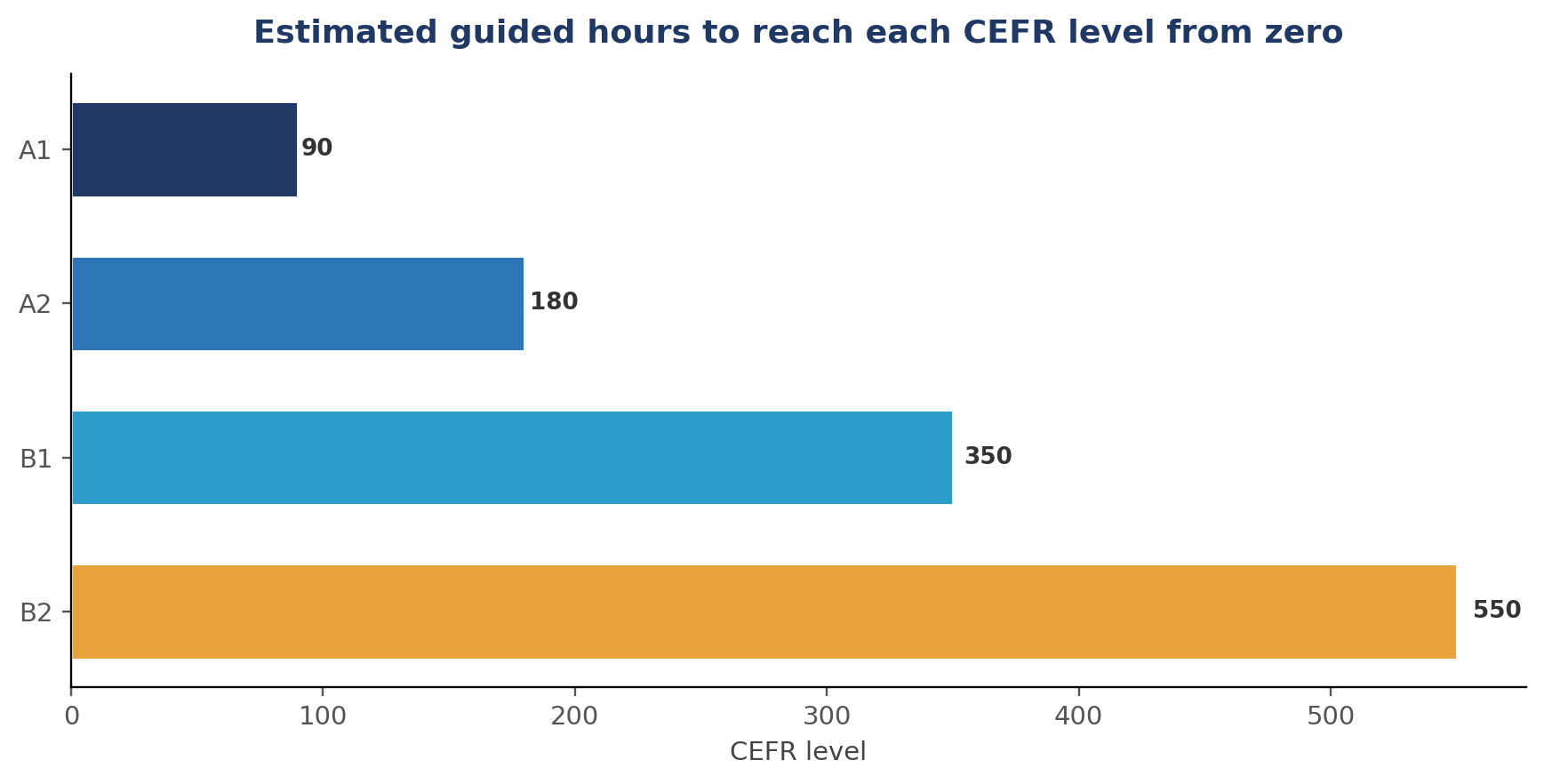
Ninety hours. That is one full university module, or roughly two evenings a week for three months. Reachable.
Ninety hours in, and you still freeze at the counter?
Guided hours beat solo hours because you get feedback in real time — your r, your liaisons, your nervous face. A self-paced French A1 course with an AI voice tutor gives you speaking practice and instant feedback that a passive app cannot.
Start beginner French with an AI voice tutor →Create a free accountA Week-by-Week Shape for Beginner French
Notice what is missing: the imperfect tense, the subjunctive, relative clauses. Those wait. A1 is about surviving, and surviving is a skill you build with repetition, not with more rules.
The Three Traps That Keep People at A1 Forever
The silent trap. You can read French beautifully and cannot say one sentence aloud. Fix: read every exercise out loud, even the boring ones. Your mouth needs the reps more than your eyes do.
The perfection trap. You wait to speak until the sentence is perfect. Native speakers at A1 will forgive a wrong article instantly. They will not forgive twenty seconds of silence while you rebuild the sentence in your head.
The noun trap. You memorise word lists as chat = cat instead of un chat = a cat. Gender is not decoration in French. It controls articles, adjectives, and pronouns. Learn the noun with its article from day one, or you will relearn five hundred words later.
Should You Take DELF A1?
For most learners, DELF A1 is optional. It is a lovely trophy and a useful motivation deadline, but employers rarely ask for it, and the jump to A2 is short. Take it if a certificate unlocks something — a school requirement, a visa file, a personal milestone. Skip it if you would rather spend those exam weeks pushing into A2 conversation.
In Canada, note the distinction: TEF and TCF measure the same CEFR levels for immigration, and TEF A1 corresponds to the same floor. Same rungs, different ladders.
Your A1 starts with one conversation, not one more app download
Study at your own pace, any time, with an AI voice tutor that corrects your pronunciation before it sets like concrete. The bakery is survivable. We will get you through it.
Start your French A1 course →Create a free accountFrequently Asked Questions
Is French A1 enough to travel in France? Yes, in the practical sense. A1 covers greetings, ordering, prices, directions, and basic problems. Add "Pouvez-vous répéter, s'il vous plaît ?" and you can handle a week in Lyon without panic.
How many words do I need for French A1? Around 500–600 active words. That is enough for the A1 topics: self, family, food, time, travel, and shopping. Active means you can produce them without a prompt.
Can I reach French A1 in one month? With an intensive course of 10–15 guided hours per week plus daily practice, yes. Solo, with an app at one hour a week, no — a month gets you a hundred words and a lot of confidence you cannot yet use.
Is A1 harder than A2? Many learners say yes. A1 carries the shock of a new sound system, gendered grammar, and spoken French blending together. A2 adds vocabulary and tenses, but the foundations already stand.
References & Further Reading
- Council of Europe — Common European Framework of Reference for Languages, global scale descriptors: https://www.coe.int/en/web/common-european-framework-reference-languages
- France Éducation International — DELF tout public (A1–B2) exam descriptions: https://www.france-education-international.fr/en/diplome/delf-tout-public
- Institut français — courses and cultural programmes for French learners worldwide: https://www.institutfrancais.com/en
- Alliance Française — global network of French language centres and A1 course catalogues: https://www.fondation-alliancefr.org/
- Radio France Internationale — Journal en français facile, slow-news audio built for beginner ears: https://www.rfi.fr/fr/podcasts/journal-en-fran%C3%A7ais-facile