There is a moment in every French learner's life when the polite small talk runs out. You can order coffee. You can say where you are from. Then someone asks what you think about the film, and your French evaporates.
That gap has a name. It is the gap between A2 and French B1 — and it is the single most useful level you will ever reach.
What you will get from this guide
- Exactly what B1 adds that A2 never gave you
- The DELF B1 exam, decoded
- A realistic hour budget and study plan
- The mistakes that stall learners at this level
What "B1" Actually Means
The Common European Framework describes B1 as the seuil — the threshold. Not fluent, not native, but independent. You can deal with most situations that arise while travelling, describe experiences and ambitions, and give short reasons for an opinion.
Read that last part again: reasons. A2 describes. B1 argues. That is the real border between the two levels, and it is why so many learners plateau.
What You Actually Learn on the Way to B1
Grammar at this level stops being decoration and becomes plumbing. You will meet the tenses that let you tell stories and the connectors that let you argue.
- Le passé composé vs l'imparfait. Background versus event. Il pleuvait quand je suis sorti.
- Le futur simple. Plans, predictions and promises.
- Le subjonctif présent. The mood of doubt, wish and necessity — il faut que tu viennes.
- Les pronoms compléments. le, la, lui, leur, y, en in real sentences.
- Les connecteurs. pourtant, donc, alors que, d'ailleurs — the glue of opinions.
Vocabulary shifts too. Instead of isolated words you collect collocations: prendre une décision, poser une question, faire attention. Chunks, not bricks.
The DELF B1 Exam, Decoded
DELF B1 is the certificate most employers and French universities read. It is issued by France Éducation international and it is valid for life — you never retake it.
You need 50 out of 100 to pass, with no single section below 5 out of 25. That rule catches people who write beautifully and never speak.
How Many Hours From A2 to B1?
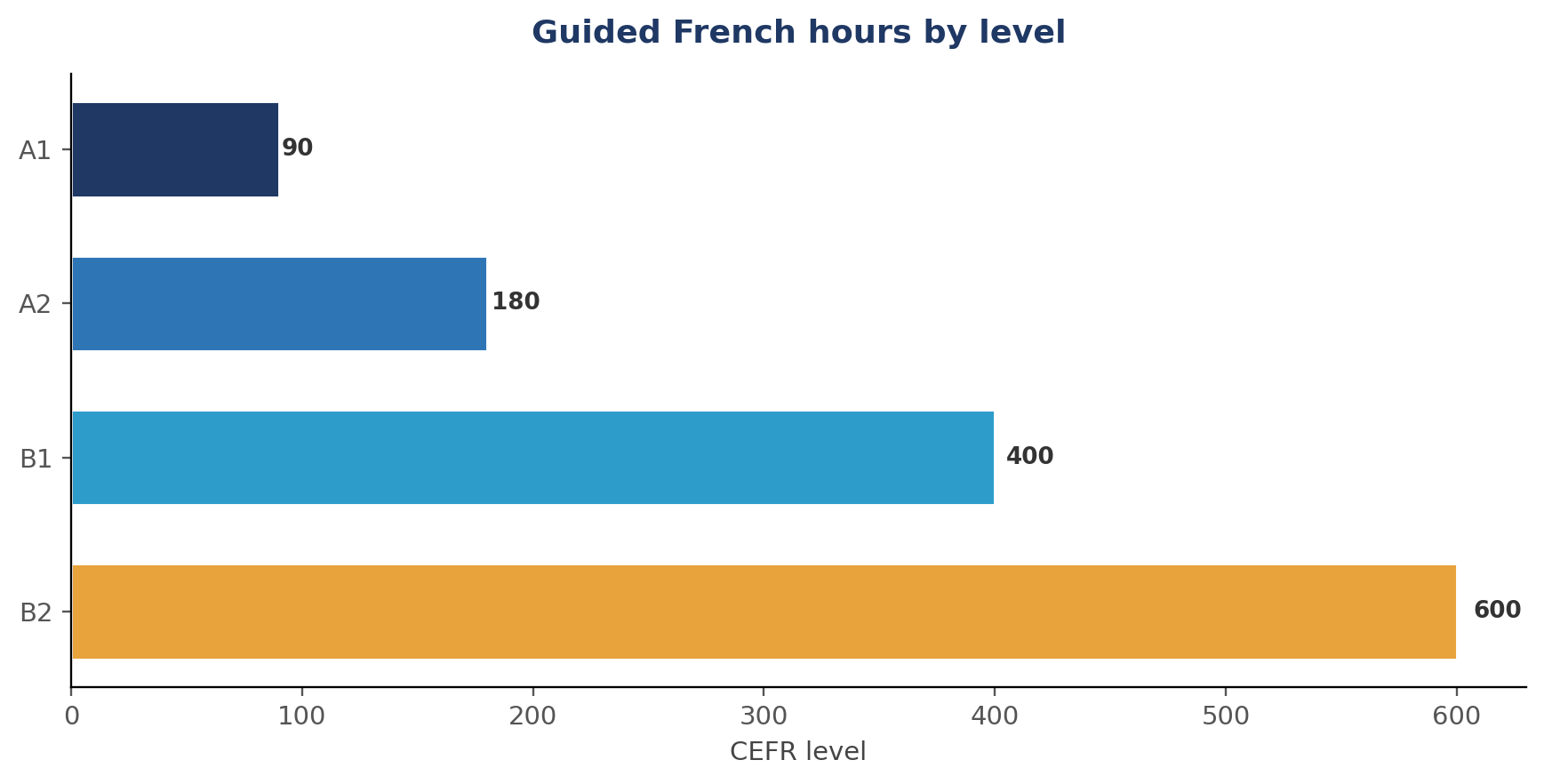
Honest answer: roughly 150 to 250 guided hours on top of your A2 base, spread over six to nine months for most people. Cramming does not compress this level — the jump to independence requires accumulated exposure, not one heroic month.
You are closer than you think — and one level away from real independence
Our B1 course is built around the four DELF sections: listening, reading, writing and the speaking interview people fear most. A personal AI voice tutor, structured lessons, speaking practice with AI feedback, and printable study materials — all at your own pace.
See the French B1 course →Create a free accountA Six-Month Plan That Fits Real Life
Six focused hours per week. That is the whole budget, and it works.
Recording yourself is brutal and effective. You hear the euh, the dropped endings, the sentences that quietly die halfway.
Four Traps That Stall Learners at This Level
The perfect-tense trap. Learners master passé composé and refuse to learn imparfait, then tell stories that sound like a police report.
The translation trap. You think in English, translate word for word, and produce French that is grammatically legal and culturally odd. Collect whole phrases instead.
The silent-reading trap. You read beautifully and pronounce nothing. B1 speaking requires the mouth, not just the eye.
The grammar-first trap. Another tense table feels productive. It is not. At B1, production is the bottleneck, not knowledge.
Beyond B1: What Changes at B2
At B2 you stop being a tourist in the language. You defend a position, understand nuance, follow a debate. The gap from B1 to B2 is smaller in felt difficulty than A2 to B1 — because you finally know how to learn.
If a certificate is a goal for work or study in France or a francophone country, B2 is usually the requirement. Plan for roughly 200 more guided hours after B1.
Build the speaking confidence you wish you had
Structured speaking practice with AI feedback, guided lessons, and printable study materials — all at your own pace, any time. Your B1 is within reach.
Start your French course →Create a free accountFrequently Asked Questions
Is B1 French good enough to work in France? For many customer-facing and international roles, no — B2 is the usual bar. B1 French is, however, excellent for daily life, travel and social confidence.
How long does DELF B1 take to prepare? From a solid A2, six months at six hours a week. If you are already near B1, three months of exam-focused work is often enough.
Does DELF B1 expire? No. Unlike TOEFL or IELTS, the DELF diploma is valid for life.
Can I reach B1 without a teacher? Yes. With a personal AI voice tutor, guided lessons, speaking practice with AI feedback, listening practice and printable study materials, you can study at your own pace, any time. There are no self-paced lessons or human teachers.
References & Further Reading
- France Éducation international — DELF and DALF — official exam content and descriptors.
- Common European Framework of Reference (CEFR) — the source of the B1 descriptor.
- Alliance Française — the global French teaching network.
- TV5MONDE — Apprendre le français — free level-graded listening exercises.
- RFI Savoirs — Français facile — daily news in simplified French.