You can order a coffee in Lyon. You can conjugate être in your sleep. Then somebody at a dinner table asks what you do for a living, and you answer in the present tense like a very polite robot.
That gap — between A1 and B2 — is where most French learners live permanently. Passer de A1 à B2 en français is not a matter of talent. It is a matter of hours, order and a plan. Here is the honest map: how long each jump takes, what changes at each border, and the three plateaus where people quietly give up.
What you will get from this guide
- Guided hour bands for every level, A1 to B2
- What actually changes at A2, B1 and B2
- The three plateaus and how to break each one
- A weekly schedule and a DELF-aligned finish line
The hour bands, straight up
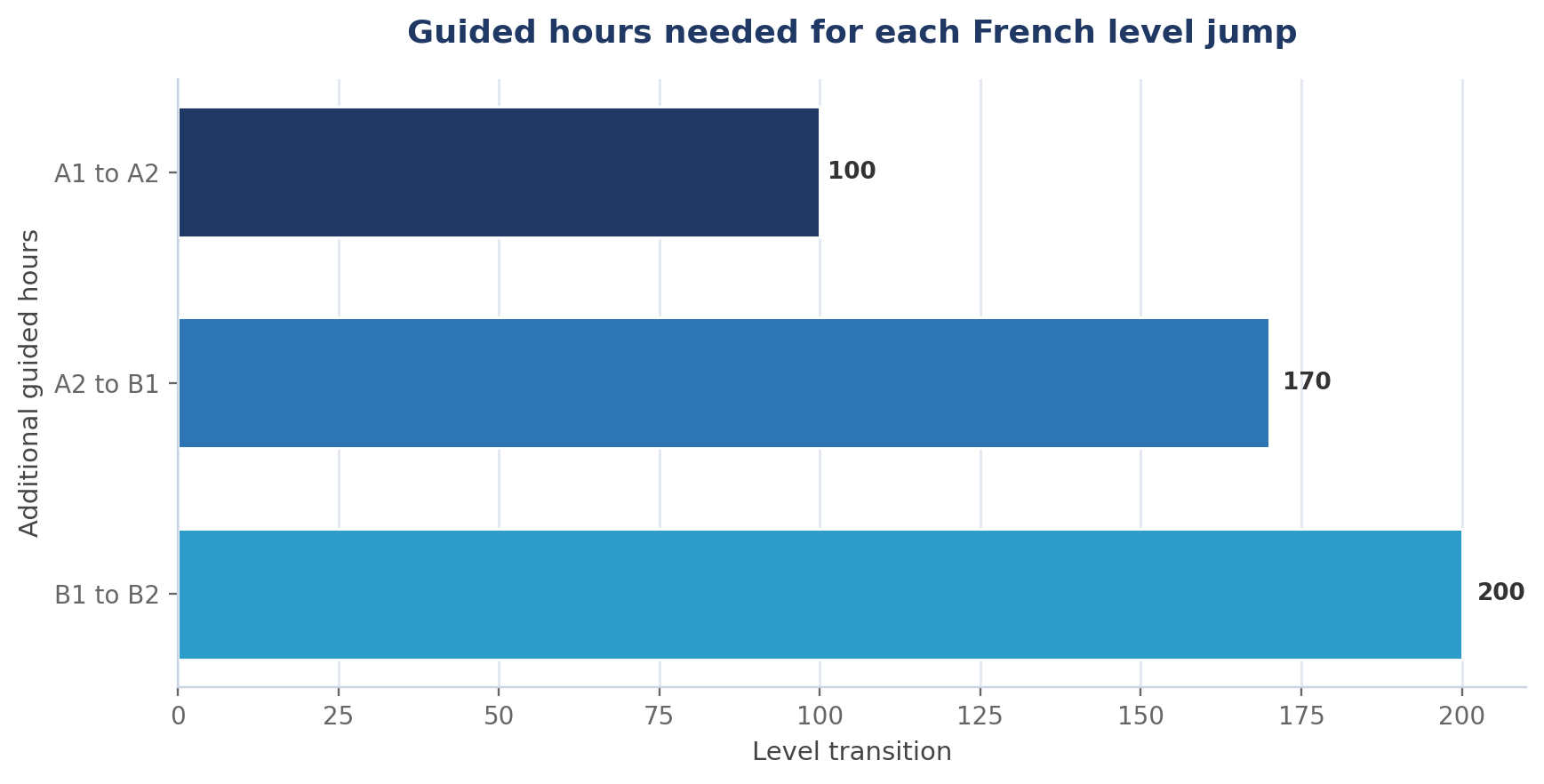
The Common European Framework describes what you can do, not how long it takes. Institutions add the hours. These are the widely used planning bands for French.
Roughly 550 hours from zero, and about 450 of them sit between A1 and B2. That number explains more frustration than any grammar rule.
What actually changes at each border
Levels are not vocabulary totals. They are new capabilities, and each one costs a specific skill.
Notice that A2 to B1 is where the past tense arrives, and B1 to B2 is where opinion becomes argument. Most learners stall precisely there, because both jumps require producing long stretches of speech rather than answering questions.
The three plateaus, and how to break them
Every plateau has the same shape: you understand more than you can say, and studying more input makes it worse.
The B1 wall is the cruelest. Students at B1 sound great until the topic moves away from their daily routine — then fluency evaporates. The cure is not more vocabulary lists. It is practice discussing things nobody plans in advance.
Get pushed past the wall by a personal AI voice tutor
Plateaus break under pressure, not under apps. Self-paced B1 and B2 lessons with an AI voice tutor put you on the spot, give you instant feedback, and keep the hours accumulating.
See French courses →Create a free accountA weekly plan that reaches B2
Two lessons and four short solo sessions a week gets you there. This is the shape that survives real life.
About four hours of guided work plus three hours of input a week. At that pace, A1 to B2 lands in roughly eighteen to twenty-four months. At two hours a week, expect four years.
Milestones you can actually test
Don't guess your level. Verify it with something measurable at each stage.
DELF B2 is the certificate employers and universities actually ask for. Its four-paper structure is a useful syllabus in itself: if you can't follow a radio debate or write a formal letter, you're not there yet — and now you know exactly what to fix.
Cost and time: the honest ledger
The hours are similar. The difference is how many of them are wasted repeating your own errors.
Frequently Asked Questions
How long does A1 to B2 in French really take? With four to five hours a week of guided study plus steady input, roughly eighteen months to two years for most adults. Fewer hours means a longer calendar, not a smaller total — the 550-hour band does not shrink.
Can I skip a level? You can skip a course, but not the capability. Jumping from A1 to a B2 class usually ends in silence in the room. Test into the level you can actually produce, not the one you can understand.
Is B2 fluent? B2 is professionally functional. You can work, argue and follow native conversation, with occasional gaps. Most people's definition of "fluent" sits beyond B2, which is another 200 hours away.
Do I need DELF B2 or is a course certificate enough? For visas, universities and many employers, only DELF B2 counts. Choose a course whose syllabus maps to the exam so your study doubles as preparation. Note: LanguageSkills.net does not issue certificates or provide exam preparation.
References & Further Reading
- Council of Europe — Common European Framework of Reference for Languages, level descriptors: https://www.coe.int/en/web/common-european-framework-reference-languages
- France Éducation international — official DELF and DALF exam information and sample papers: https://www.france-education-international.fr/en/delf-dalf
- TV5MONDE — Apprendre le français free exercises mapped to CEFR levels: https://apprendre.tv5monde.com
- Alliance Française — French courses and level framework: https://www.fondation-alliancefr.org
- Centre national de ressources textuelles et lexicales (CNRTL) — French dictionary and corpus: https://www.cnrtl.fr
You already have A1. The only question left is the calendar.
Put the 550 hours on a schedule
Create a free account, get a placement test that tells you exactly where you stand, and start the B-level path this week. Your DELF B2 date is a decision, not a dream.
Start free →Create a free account