Picture the moment you land in Paris and the taxi driver says something you half-understand, so you nod, smile, and hope. Then the bill arrives and you realise you agreed to the scenic route twice. That is the cost of guessing your level. You need to test my french level properly, and you need it to cost nothing but twenty focused minutes.
Here is the honest map: which free tests are worth your time, what each CEFR band really means, and how to read your score without lying to yourself.
What you will get from this guide
- The four types of free French level tests, ranked by accuracy
- A plain-English CEFR table so A2 and B1 finally stop blurring together
- A 20-minute self-check that tells you which course tier fits you
- How the Institut français and DELF/DALF exams define the official benchmarks
Why Your Level Matters More Than Your Years
Nobody cares that you studied French for six years. Employers, universities and teachers care about one thing: what can you do today? CEFR is the shared language for that, and it splits learners into six bands from A1 to B2.
The trap is self-flattery. Most people guess one band high. They book a B2 conversation class, drown in the first ten minutes, and quit. A free test takes twenty minutes and saves you a semester of misery.
The Four Kinds of Free French Test
Not every free test is the same animal. Some measure grammar. Some measure nerve. Here is the honest comparison.
Use two of them together. A quiz tells you where your knowledge sits. A live chat tells you where your mouth sits. Those two numbers are often a full band apart.
What the CEFR Bands Actually Mean
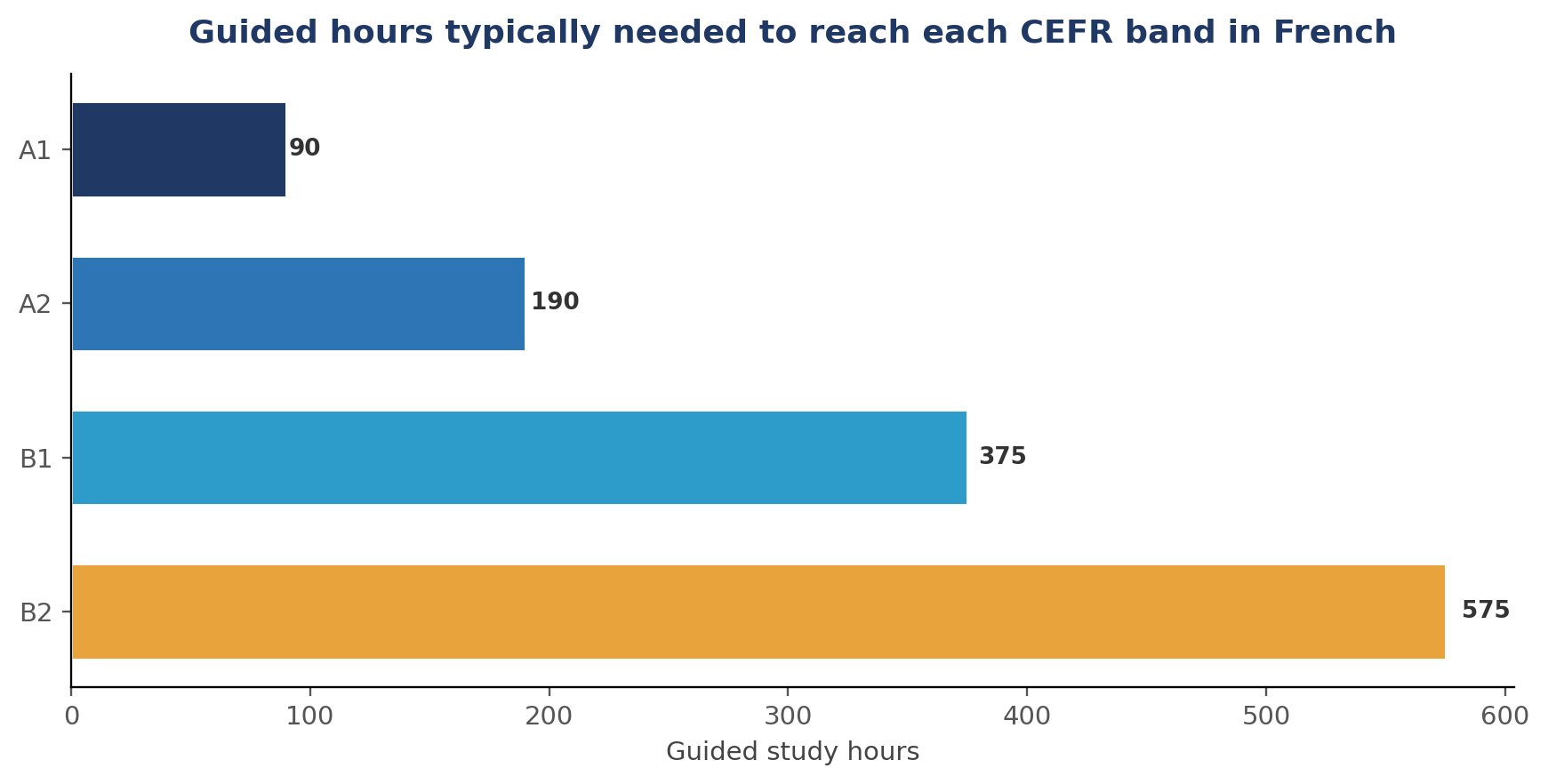
Forget the jargon. Here is the working version, with the hours that most course planners use as a rough guide.
Notice the jump from B1 to B2. That single step costs more hours than A1 through B1 combined in some learners' experience. It is also the step most people attempt with a mislabelled starting point.
A Free 20-Minute Self-Check You Can Run Today
Do this in order. Write your answers down, because honesty needs evidence.
Three passes or more and you are likely one band above where you guessed. Two or fewer and you are likely one below. That gap is exactly why an outside opinion matters.
Your self-check found the gap — now close it with a human
Ready to turn reading into real French? Start your self-paced course today.
Start the French course →Create a free accountA twenty-minute session with your AI voice tutor confirms what no quiz can: how you sound, how fast you recover, and which tier actually fits. Your free account gets you a guided placement session and a plan built around the result. Button: Take a French placement session →
Free Tests vs Official Exams: Don't Mix Them Up
Free placement tests sort you into a class. Official exams certify you for a visa, a job or a degree. They answer different questions.
DELF and DALF are issued by France Éducation international and are recognised worldwide. If your goal is a French university or a residency file, you will eventually need one of these. But do not sit an exam before a free test tells you which one to book. Booking the wrong exam level is an expensive way to learn your own level.
Common Ways People Misjudge Themselves
The mistakes repeat with almost comic regularity.
Most learners are not one level. They are a jagged shape: B2 reading, A2 speaking, B1 listening. That is normal. A good placement test reports the jagged shape, not one tidy number.
Turning Your Score Into a Plan
A score you do nothing with is trivia. Turn it into four weeks.
Stop guessing. Start at exactly the right level.
Ready to turn reading into real French? Start your self-paced course today.
Start the French course →Create a free accountThe fastest route from a free test to real progress is a self-paced AI tutor that matches your measured tier — no wasted weeks, no repeating what you already know. Book a placement session, get your level confirmed, and start the same week. Button: Get my free French placement →
Frequently Asked Questions
Is a free online French level test accurate? For reading and grammar, yes, usually within one CEFR band. For speaking it is unreliable, because a quiz cannot hear you hesitate or self-correct. Pair a free quiz with a short AI tutor conversation and the combined picture is solid.
How long does it take to move up one CEFR level in French? Roughly 100 to 200 guided hours per band for most learners, with bigger jumps between B1 and B2 and beyond. Consistency beats intensity: four hours a week for a year outperforms a two-week crash.
Do I need DELF or DALF to prove my level? Only if someone official asks, such as a university, an employer or an immigration authority. For choosing a class, a free placement test plus an AI tutor's assessment is enough.
Can I test my French level for free without a tutor? Yes. Use an adaptive quiz, a timed writing prompt and a recording of yourself speaking for two minutes. Listen back a week later with fresh ears — the recording is brutally honest.
References & Further Reading
- France Éducation international — DELF and DALF official exam information: https://www.france-education-international.fr
- Council of Europe — Common European Framework of Reference for Languages, the source of the A1 to B2 bands: https://www.coe.int/en/web/common-european-framework-reference-languages
- Institut français — courses, cultural programmes and French learning resources: https://www.institut-francais.fr
- TV5MONDE — free French exercises and level tests built on authentic video: https://apprendre.tv5monde.com
- RFI Savoirs — free listening material graded by level: https://savoirs.rfi.fr