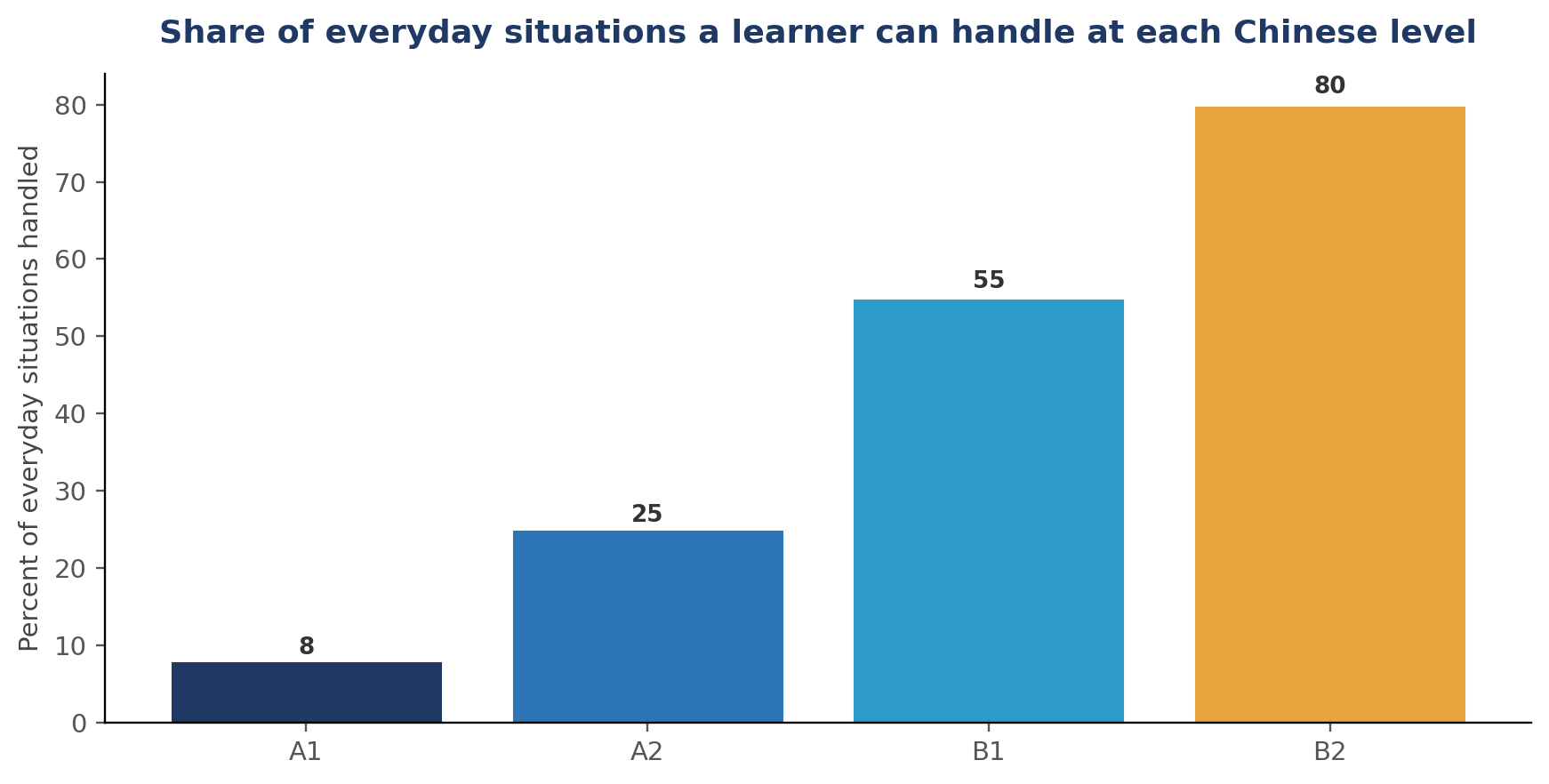
Level labels are abstract until you attach them to a situation. "I'm at B1 in Chinese" means very little. "I can hold a ten-minute conversation about my work, but I still can't read a newspaper headline" means a great deal — and it tells you exactly what to study next.
This article translates each Chinese level into concrete tasks: what you can do in a shop, on the phone, in a conversation, at a desk with a book. It also flags the one thing that makes Chinese levels unusual — the spoken and written tracks move at different speeds, and almost every learner is ahead in one.
Read the level you think you are at, and check the row below it. Most learners are one band lower than they believe.
A Quick Orientation
A1: You Can Survive
At A1 you can handle the fixed situations you have rehearsed and little else. This is not a criticism; it is the level doing its job.
A2: You Can Travel
A2 is where Chinese starts being genuinely useful for a trip. You can complete transactions, ask for help, and describe simple past and future events.
The typical A2 profile can spend a day in a Chinese city in Chinese and come home satisfied — but will switch to English the moment the other person speaks at normal speed.
B1: You Can Hold a Conversation
B1 is the level most learners are actually chasing, and it is the level where the two tracks visibly separate.
The mismatch in that table is the defining feature of intermediate Chinese. A B1 speaker is often an A2 reader, and closing that gap takes roughly as many hours as the speaking did.
B2: You Can Argue and Read
B2 is where the written track finally catches up and the language becomes academic or professional grade.
B2 is the level universities and most employers mean when they ask for fluent Chinese. It is also the point at which the language stops being a subject.
Find out which level you are actually at
Most learners overestimate by one band. Our Chinese Course Pass starts with a four-skill assessment and builds a level-based plan from your real starting point. Explore the Chinese Course Pass →
Start the Chinese course →Create a free accountTesting Your Own Level Honestly
Run this table honestly. If you are mixed across two columns, you are at the lower level — and, usefully, the column above tells you exactly what the next six months of study should contain.
Which Level Do You Need?
Most learners should aim at B1 as the first real milestone and B2 as the career milestone.
Go from your level to the next one
Whether you are A2 and want to travel well or B1 and need B2 for work, our Chinese Course Pass builds the next level with a personal AI voice tutor and a measurable curriculum. Start your Chinese Course Pass →
Start the Chinese course →Create a free accountFrequently Asked Questions
What is B1 Chinese equivalent to in HSK? HSK 4 is generally treated as roughly B1, and HSK 5 as roughly B2. The systems are not identical, but the mapping is close enough for planning study.
How many characters do I need to read Chinese comfortably? About 1,500 to 2,000 characters covers the vast majority of everyday and news text. Sub-1,000 leaves frequent gaps.
Is it normal to speak better than I read? Yes, and it is the norm in Chinese. Speaking and characters are separate skills, and most learners have a gap of one level or more between them.
What level of Chinese do I need to live in China? B1 is the practical threshold for independent daily life: housing, admin, health appointments and social conversation. Below that, most tasks need help.