A1 to B2 sounds like a straight line on a chart. In Chinese it is not a line — it is two lines running side by side, one for everything you can say and one for everything you can read, and they almost never move at the same speed.
That is the single most useful thing to understand before you start. Learners who treat Mandarin as one skill hit B1 in conversation and discover they cannot read a news headline. Learners who understand the split plan for both tracks deliberately, and they arrive at B2 with a level that holds up in a real room.
Here is the route, level by level, with the honest hours and the milestones that tell you that you are on track.
The Four Stages, and What Each One Demands
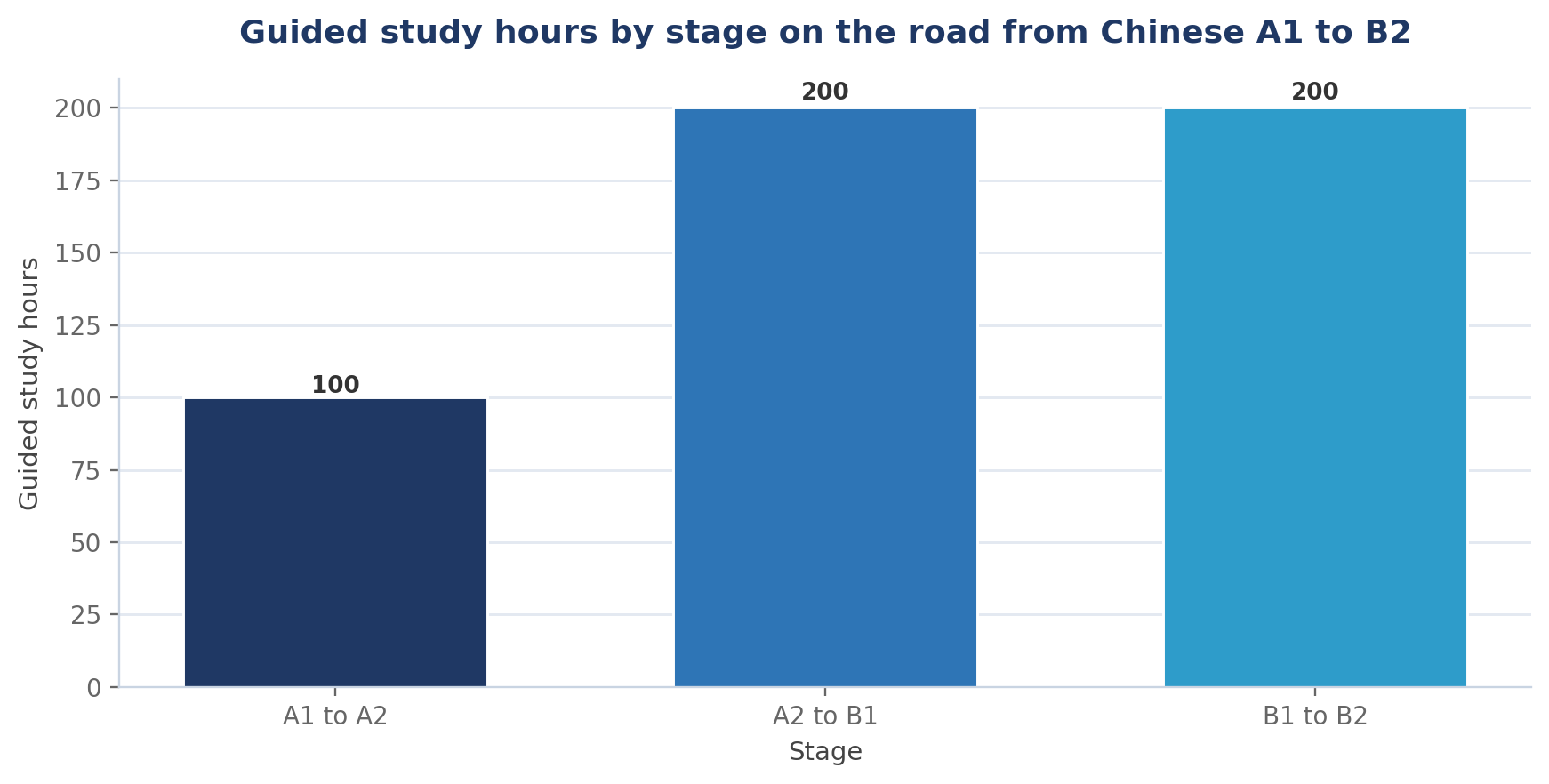
The jump from A1 to B2 is three transitions, not one. Each has a different bottleneck, which is why generic advice fails.
Total from zero: roughly 600 guided hours, plus independent practice. From A1, assume 500.
Stage One: A1 to A2 — Fix the Sounds First
Week by week, this stage is about breadth: vocabulary, tones, and the ability to hear words you already know at speed.
The tone system must be nailed here, because tone errors that survive into B1 become permanent. Spend ten minutes a day on tone pairs — mā, má, mǎ, mà — and, more importantly, on tone pairs in real words, which is where learners actually break down.
The second priority is the tonal sandhi rule for consecutive third tones. Learn it as a rhythm, not a rule, and it stops being a calculation.
Stage Two: A2 to B1 — Build Sentences, Not Word Lists
This is where most self-learners stall, because they keep doing what worked at A2 and wonder why progress stops.
Two habits separate the ones who reach B1 from the ones who plateau. First, speak out loud daily, even alone, because production is a separate skill from recognition and only speaking trains it. Second, read every new word inside a sentence, because Chinese word order carries meaning that vocabulary lists cannot show.
At the end of this stage you should be able to hold a ten-minute conversation about familiar topics and follow a slow podcast. That is B1, and it is genuinely useful.
Stage Three: B1 to B2 — Where Characters Decide Everything
B2 is the level where reading becomes the limiting factor, and it is the stage where the two-track reality of Chinese matters most.
Notice that reading and writing absorb more than half the remaining hours. That is not a coincidence: characters are a memory system, and memory systems respond to volume and repetition rather than to cleverness.
Progress faster with a tutor tracking both tracks
Our Chinese Course Pass builds spoken and character tracks together, so you never reach B1 in conversation and stay illiterate on paper. A personal AI voice tutor, clear levels, measurable milestones. Explore the Chinese Course Pass →
Start the Chinese course →Create a free accountThe Monthly Milestones That Keep You Moving
Abstract levels are hard to feel. These checkpoints are not.
Thirty-six months is the slow, part-time version. At two hours a day with regular speaking practice, learners commonly compress this to eighteen to twenty-four months.
The Five Traps That Delay B2 by a Year
The last row is the quiet killer. A2 feels good — you can order food, you can chat, you understand the lesson. B2 requires the discomfort of texts and conversations you only partly understand. That discomfort is the level.
From A1 to B2 with the route mapped out
Our Chinese Course Pass follows a level-by-level curriculum with a personal AI voice tutor that gives you feedback at each stage, so you always know exactly where you are and what comes next. Start your Chinese Course Pass →
Start the Chinese course →Create a free accountFrequently Asked Questions
How long does it take to go from A1 to B2 in Chinese? Roughly 500 guided hours, or eighteen to twenty-four months with consistent practice of one to two hours a day. Character learning usually adds several months compared with spoken progress.
Is B2 in Chinese the same as HSK 5? In practice, yes — HSK 5 is widely treated as roughly CEFR B2, and HSK 4 as roughly B1. The systems are not identical, but the mapping is close enough for planning.
What is the hardest part of reaching B2? Reading volume. Listening and speaking respond well to focused practice, but reaching B2 reading level requires 1,500 to 2,000 characters and sustained exposure to real text.
Can I skip A2 and go straight to B1 material? You can try, but the gap usually shows up as vocabulary holes that keep resurfacing. Consolidate A2 properly and B1 goes faster, not slower.