There is a particular kind of confusion that only Chinese learners experience. You can hold a conversation about your weekend and be unable to read the menu you are holding. You can recognise eight hundred characters and freeze when a shopkeeper speaks at normal speed. So what level are you?
Free tests are abundant and genuinely useful, but they measure different things, and most of them measure only one. Taking the wrong one gives you a number that flatters or misleads you, and then you plan your study around it.
This guide covers what each free test actually measures, how to choose, and a thirty-minute protocol that gives you four separate scores instead of one misleading one.
What Free Tests Actually Measure
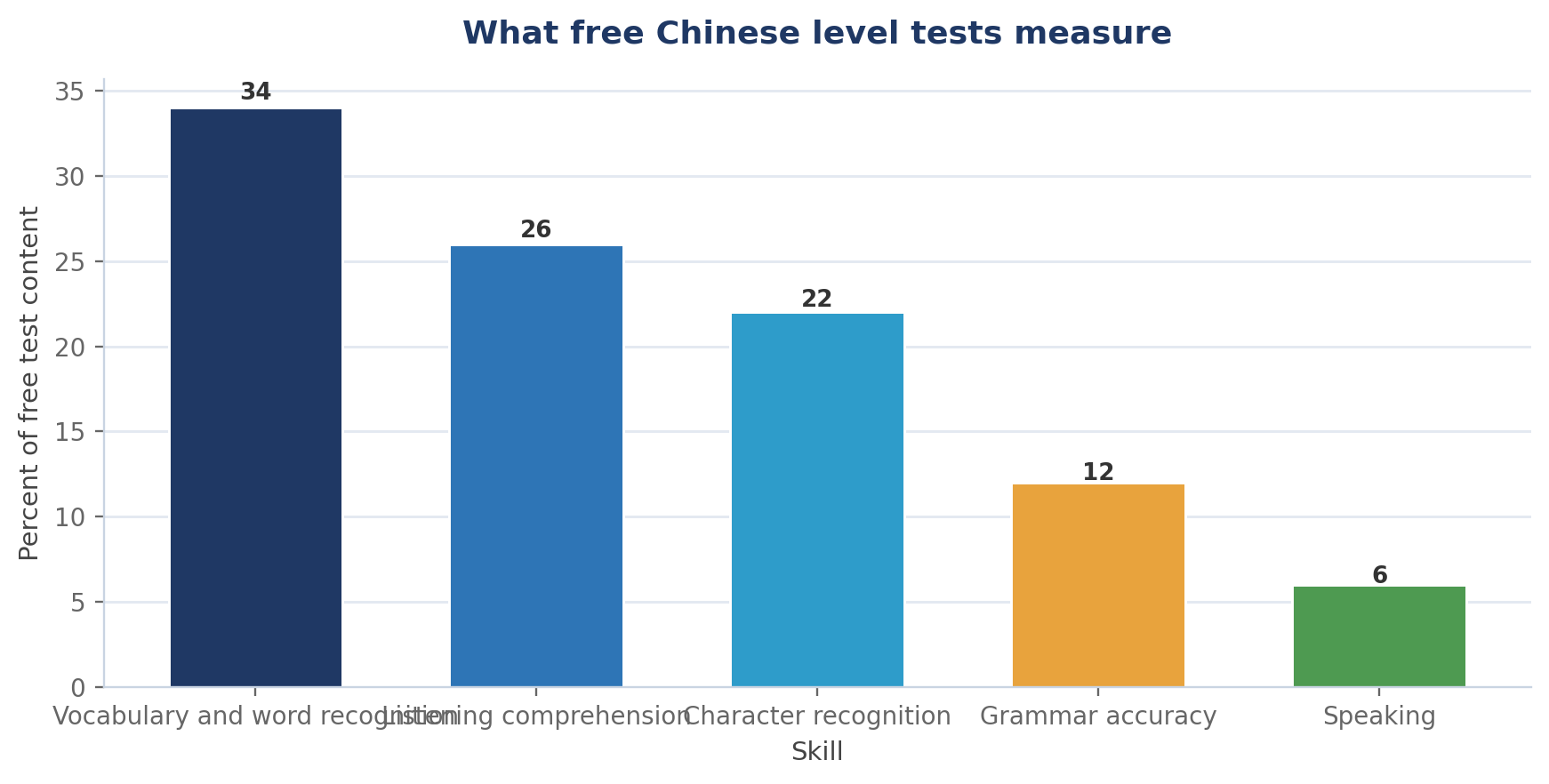
The honest answer is that most free tests are narrow. Here is the breakdown of what they cover.
The gap at the bottom of that table is the important one. Almost no free test measures speaking seriously, because speaking requires a human or a speech model. If you only take free written tests, you will end up with an accurate picture of your reading and an inflated picture of your overall level.
The Free Tests Worth Your Time
The most useful free combination is an HSK sample paper plus a CEFR self-assessment grid. The first gives you a hard number for reading and listening; the second forces you to be honest about speaking, which the paper ignores.
HSK Sample Papers: The Best Free Benchmark
The official HSK sample papers are the most reliable free instrument available, for three reasons: they are standardised, they are scored, and they map onto a level the world recognises.
Sit one level below where you think you are, then move up if you score above 85 percent. If you score below 60 percent, drop a level. Two or three sample papers will locate you within one band, which is precise enough for planning.
A Thirty-Minute Self-Test You Can Run Today
This protocol produces four scores instead of one, and it needs nothing but a timer and a phone.
Four scores in four columns is far more useful than one number, because the columns move at different speeds and each one tells you what to study next.
Get a four-skill score in one session
Our free placement check rates your listening, speaking and reading separately with an AI voice tutor — so you know which track is holding your Chinese back. Take the free Chinese level check →
Start the Chinese course →Create a free accountWhy Speaking Is Almost Always the Missing Score
Free tests measure what can be marked by a machine. Speaking is expensive to mark, so it gets dropped, and learners end up with a score that describes two thirds of their ability.
The cost of that gap is real. A learner scoring around HSK 4 in reading may have spoken Chinese at roughly HSK 2, because conversation demands real-time production that no multiple-choice test touches. The mismatch shows up the first time they need to speak to a person.
The fix is straightforward: test speaking with a human at least once. It is the one score you cannot generate for yourself, and it is usually the lowest.
How to Read Your Results and Plan
Whatever the profile, test again in six to eight weeks with the same instrument. Comparing two identical tests tells you more than any single score ever will, because the change is the signal.
Turn a free score into a real level
A free check locates you. A structured course moves you. Our Chinese Course Pass gives you an AI voice tutor, level-based lessons and progress checks at every stage from A1 to B2. Start your Chinese Course Pass →
Start the Chinese course →Create a free accountFrequently Asked Questions
Is there a genuinely free Chinese level test? Yes. Official HSK sample papers are free to download and are the most reliable option, because they are standardised. Most university placement tests are also free to enrolled students.
How accurate are free online Chinese level tests? They are accurate for vocabulary and character recognition, and reasonably accurate for slow listening. They almost never assess speaking, so treat the result as a reading and listening estimate.
What Chinese level am I if I speak fluently but cannot read? You may be spoken B1 with written A2 or lower. Chinese has a wide spoken–written gap, so it is normal for the two skills to sit at different CEFR levels.
How often should I test my Chinese level? Every six to eight weeks with the same test. Testing more often than that measures noise rather than progress.