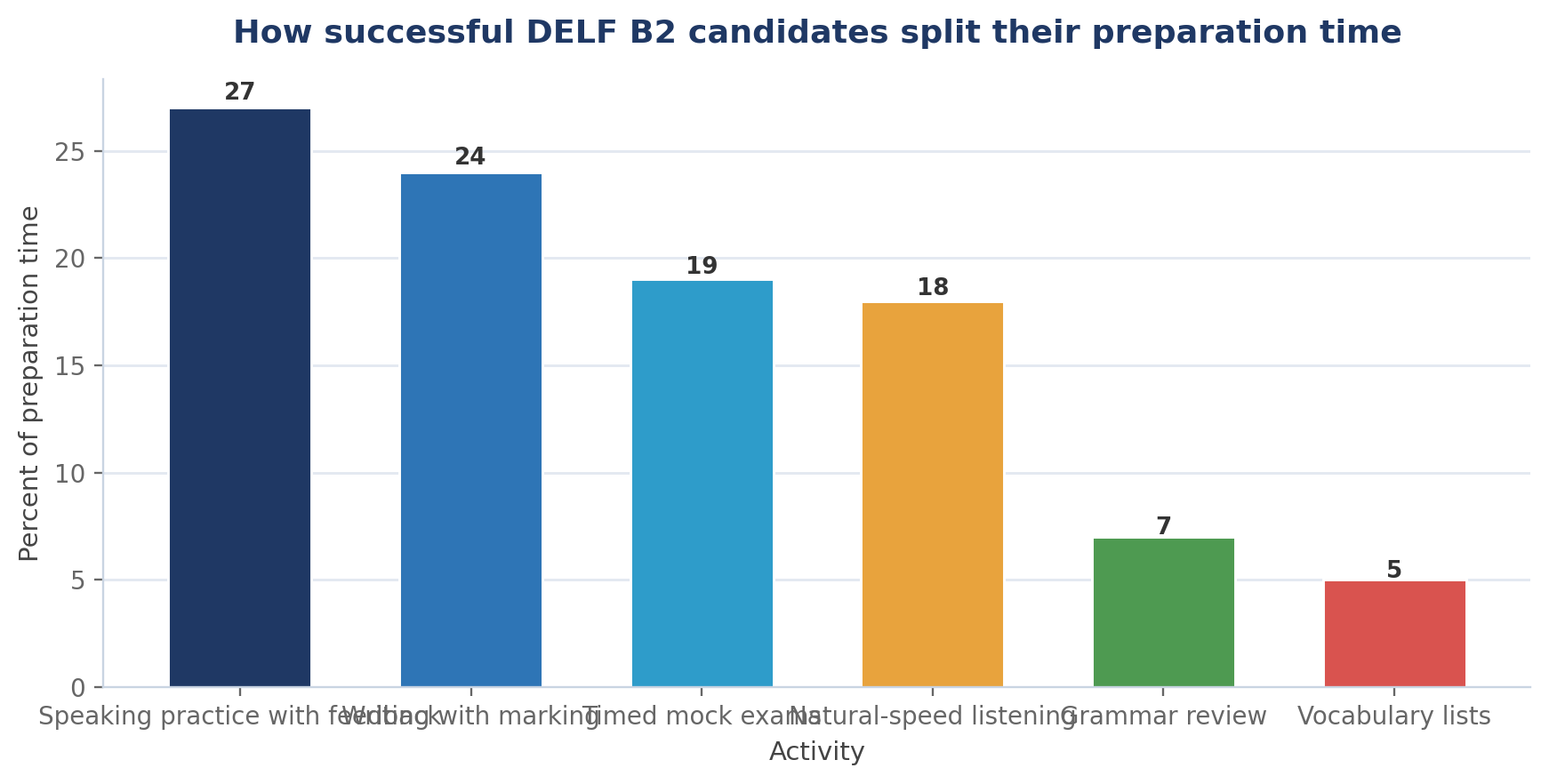
Most DELF B2 preparation fails for the same reason: it is a study plan rather than a preparation plan. Learners read grammar, build vocabulary, listen to podcasts — all useful activities — and then sit an exam whose two decisive papers (writing and speaking) they have never once practised under real conditions with real marking.
The best preparation is narrower and more uncomfortable than generic study. It starts with a diagnostic that tells you which paper is weakest, spends the majority of your hours on production skills, and creates feedback loops so that every error is corrected rather than repeated.
Here is the method, in the order it should be applied.
Step One: Diagnose Before You Study
Almost nobody does this, and it is the single highest-return hour in the whole process.
The fifth row matters. Learners with an even profile often try to improve everything at once and end up improving nothing measurably. In practice, 10 points of improvement is easier than 3 points spread across four skills, because a single paper responds to a focused block of work.
Step Two: Build the Weekly Rhythm
Successful preparation is unglamorous and repetitive. This is the weekly pattern that works.
The Wednesday slot is the one most learners skip, and it is the one that converts marks. Rewriting your marked essay is how a correction becomes a habit. Without it, you receive feedback, nod at it, and make the identical error three weeks later.
Step Three: Spend Your Hours on Production
Look again at that chart. Speaking and writing together take more than half of the time of learners who pass, while the two activities learners most enjoy — grammar review and vocabulary lists — take about a tenth.
The reason is structural. Input skills are usually ahead of output skills for every learner, so the marginal hour spent on reading buys less than the marginal hour spent on writing. And the writing paper is the one where structure, not vocabulary, decides the score.
Comfort is the warning sign. If your preparation always feels pleasant, you are probably working in the wrong skill.
Step Four: Create Feedback Loops
You cannot mark your own writing or hear your own oral errors. Preparation without feedback plateaus quickly, which is why every serious plan includes structured feedback.
The writing row is where most self-study learners fall short. Ask specifically for marking against the four criteria — task completion, coherence, connectors, range and accuracy — rather than an overall impression. Vague feedback produces vague improvement.
Get marked against the real DELF grid
Generic language lessons will not move your score. Our French Course Pass gives you a personal AI voice tutor that marks your writing against the official criteria and plays the examiner in your oral. Explore the French Course Pass →
Start the French course →Create a free accountStep Five: Use Mocks Properly
A practice exercises is not practice. It is a measurement, and it only works under exam conditions.
Three spaced mocks tells you something one cannot: whether your improvement is real or a lucky paper. It also trains stamina, which is a genuine factor in a two-and-a-half-hour exam.
The Five Preparation Mistakes That Cost Marks
The last row is the whole argument of this article compressed into one line. Twelve weeks is enough time to pass DELF B2 comfortably — if you spend them on the paper that is actually weak, and get feedback on it every single week.
Twelve weeks, aimed at the right paper
Our French Course Pass starts with a diagnostic and builds weekly writing and oral feedback with your AI voice tutor — so nothing about the exam is a surprise. Start your French Course Pass →
Start the French course →Create a free accountFrequently Asked Questions
How long should I spend preparing for DELF B2? From a solid B1, twelve weeks of consistent work with weekly feedback is realistic. If your diagnostic shows a paper below 10 out of 25, allow sixteen weeks.
Is it better to self-study or take a course for DELF B2? Self-study works well for listening and reading. Writing and speaking need marking, because you cannot reliably see or hear your own errors.
What should I practise most for DELF B2? Writing and speaking. Together they carry half the marks, and they are the papers candidates most often neglect because they are the least comfortable to practise.
How many practice exercises should I sit before the real one? At least three, spaced about two weeks apart. Anything less gives you a single data point rather than a trend.