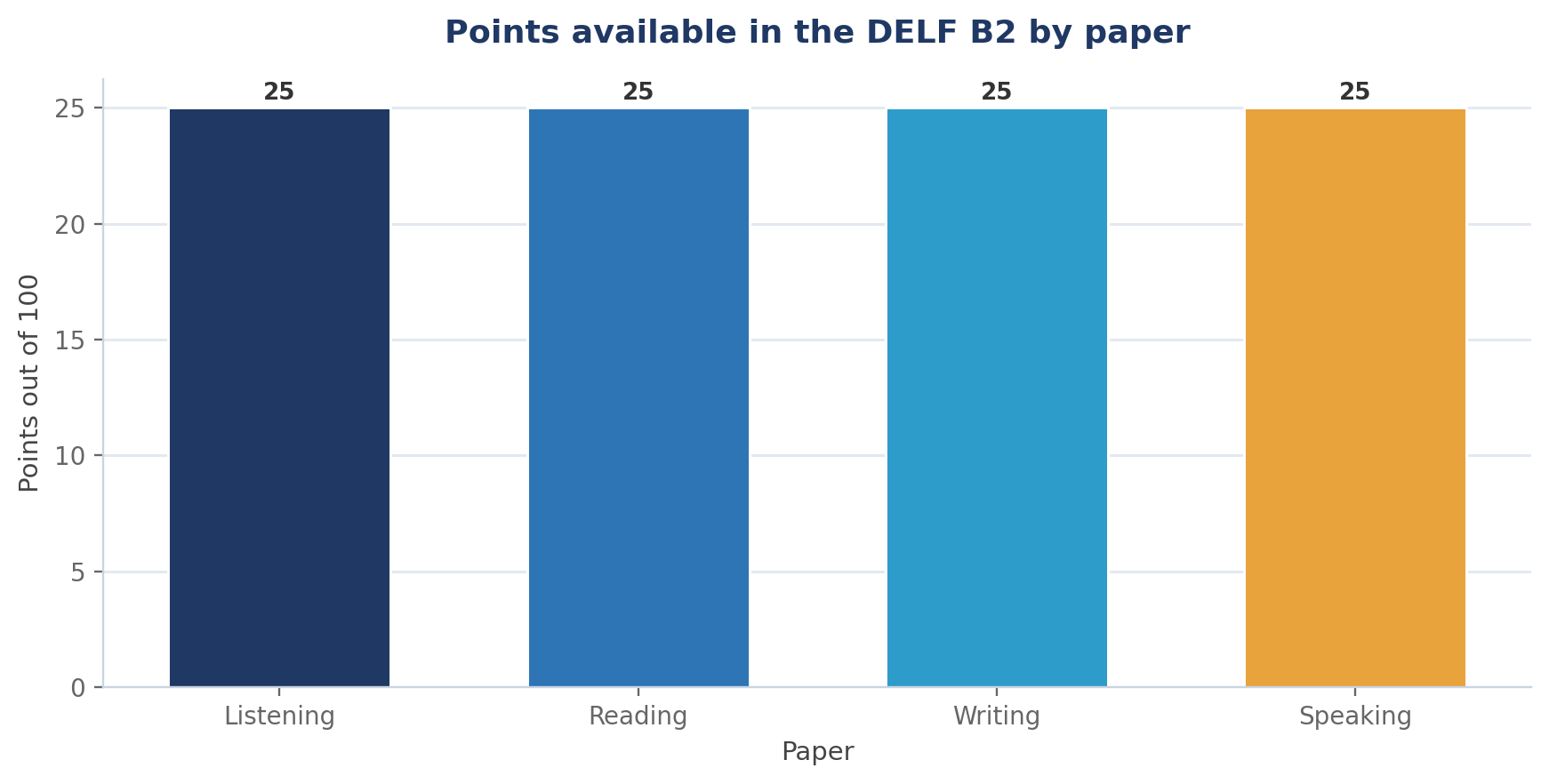
Most DELF B2 guides tell you what to study. Very few tell you how the exam is actually marked, and that gap costs candidates real points every session.
The format is not complicated, but it has two features that decide results: the per-paper minimum, which eliminates people who scored well overall, and the fact that each paper is marked against its own internal grid rather than a general impression. Once you understand both, your preparation changes — you stop optimising for accuracy in general and start optimising for the specific things the examiners are told to look for.
Here is the whole structure, deciphered.
The Four Papers, Side by Side
The Pass Rules, Precisely
The pass rule is stated in two clauses, and the second one is where candidates fall.
The second clause exists to prevent a candidate from compensating for a totally absent skill. In practice it means 20 points of your total are structurally unattainable if one paper collapses — a candidate scoring 22, 23, 24 and 4 has 73 points and still fails.
That is the single most important sentence in this article. Balance beats excellence.
How Each Paper Is Marked
Listening — 25 Points
Two recordings, played twice each, with questions following the order of the audio. Marks come from locating specific information, not from global understanding.
Reading — 25 Points
Two texts of increasing difficulty, sixty minutes total. The trap here is answering from general knowledge instead of from the text.
Writing — 25 Points
One formal argumentative text of about 250 words in sixty minutes. The grid is roughly: content and task completion, coherence and cohesion, linguistic range, and accuracy.
Notice that accuracy is not the top criterion. A well-structured essay with minor errors outscores a flawless paragraph with no argument.
Speaking — 25 Points
Twenty minutes with a preparation period. You present a position based on documents, then defend it in a debate.
The debate carries more weight than most candidates expect. It tests whether you can maintain a position under pressure, reformulate, and respond to counter-arguments — which is exactly what B2 means.
Rehearse the debate before it counts
The DELF B2 oral is decided when the examiner pushes back. Our French Course Pass gives you a personal AI voice tutor who plays that role and gives you feedback on your speaking. Explore the French Course Pass →
Start the French course →Create a free accountTiming Strategy for Exam Day
Three habits save marks. In reading, answer the easy questions first and come back; every paper is marked by total, not by order. In writing, always leave ten minutes for checking agreement, tenses and connectors. In speaking, use the preparation time for a structure, not for full sentences — reading a script aloud is penalised because it is not spontaneous speech.
What Happens After the Exam
Because there is no penalty for retaking, there is no reason to attempt the exam before you are ready. The better strategy is a full timed mock under exam conditions; if you clear 50 overall and 5 on every paper in the mock, you are ready.
Walk in knowing exactly where your marks come from
Our French Course Pass includes structured speaking and listening practice with AI feedback, so you can strengthen a weak skill before exam day. Start your French Course Pass →
Start the French course →Create a free accountFrequently Asked Questions
What is the pass mark for DELF B2? You need at least 50 out of 100 overall and at least 5 out of 25 on each of the four papers. Both conditions must be met.
How long is the DELF B2 exam? The papers take about two and a half hours in total: 30 minutes listening, 60 reading, 60 writing and 20 minutes speaking, plus preparation time for the oral.
Does DELF B2 expire? No. The DELF diploma is valid for life and does not need to be renewed, unlike some other language certificates.
Can I retake DELF B2 if I fail one paper? Yes. You retake the whole exam at a later session; there is no partial credit carried over and no limit on attempts.