Everyone asks this question, and almost everyone is given a useless answer — because the honest answer is "it depends on four things", and nobody wants to hear four things.
So let us be precise instead. The TEF Canada reports four skills separately as NCLC levels, and immigration programmes set a floor per skill. How many hours you need depends less on the exam than on three variables you can actually measure: your current level, your target NCLC band, and how much French you use outside the study session.
Here is how to build an estimate that survives contact with your calendar.
The Target Sets the Number
NCLC bands map onto CEFR levels. The higher the floor, the steeper the climb — and the climb is never linear.
Two columns, one lesson: where you start moves the number more than anything else. The same target that costs a B1 learner 200 hours can cost an A2 learner 400.
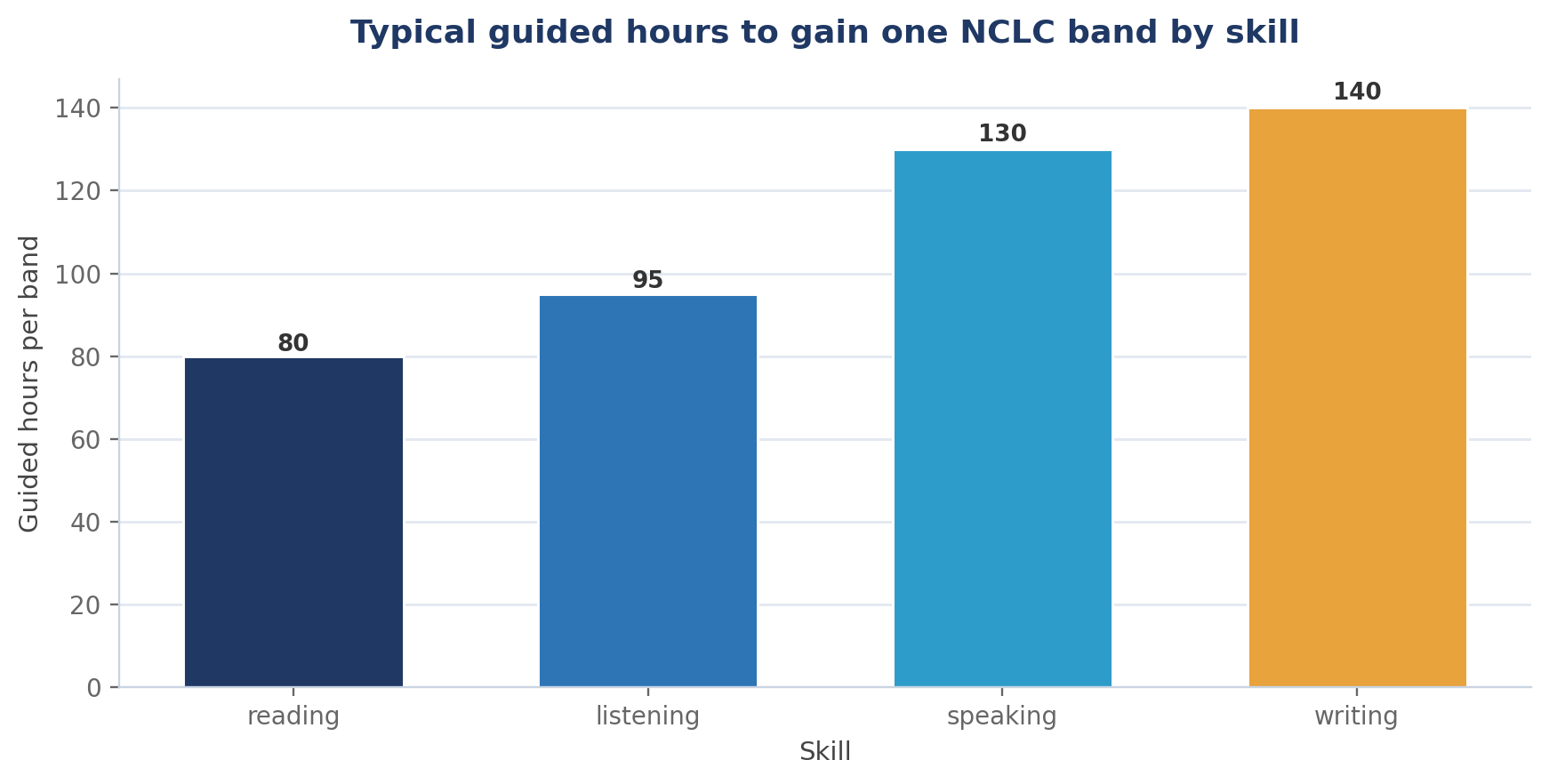
Each Skill Costs a Different Amount
Candidates almost never budget per skill, and that is exactly why they run out of time on the two expensive ones.
Reading and listening are inputs, and inputs are cheap. Speaking and writing require someone to correct you, which means they cannot be accelerated by volume alone.
Modelling a Realistic Week
An estimate becomes useful only when it turns into a weekly number. This table converts a target total into a schedule without pretending you have unlimited evenings.
Twelve hours a week is the practical ceiling for most people working full time. That puts the realistic window for a two-band climb at four to five months of consistent work — not six weeks, and not two years.
What Actually Counts as Study
Not every hour is worth the same, and this is where most estimates quietly break down.
A learner with eight "real" hours a week beats a learner with fifteen low-value hours, almost every time. When you count your hours, count only the top three rows.
Hours that actually move your NCLC band
Our French Course Pass is built on self-paced lessons with a personal AI voice tutor and speaking practice with AI feedback — activities that convert study time into measured level, with progress tracked skill by skill. Explore the French Course Pass →
Start the French course →Create a free accountYour Starting Point Beats Your Plan
Before you estimate anything, get a real baseline. Guessing your level is the most expensive mistake in TEF Canada preparation, because a candidate who believes they are B1 when they are A2 will plan half the hours they need.
Sit one timed mock, in one sitting, and read the results per skill. That single data point will change your schedule more than any study technique.
The Five Things That Distort an Estimate
The last row has its own cost, because TEF Canada results are valid for two years. Sitting before you are consistently ready means paying twice.
Turning Hours Into a Plan
Eighteen weeks at eight to ten hours is under two hundred hours — and it is enough for a one-band climb when every hour is an active hour.
A plan with a number attached to it
Self-paced guided lessons from A1 to B2, speaking practice with AI feedback, and printable study materials that help you see which band each skill currently sits at, and what to fix first. Start your French Course Pass →
Start the French course →Create a free accountFrequently Asked Questions
How many hours do I need for NCLC 7 in the TEF Canada? From B1, budget 180 to 250 guided hours; from A2, budget 350 to 450 — reading and listening cost less than speaking and writing.
Is three months enough to prepare for the TEF Canada? It is enough to gain roughly one band at eight to ten active hours a week, but two bands in three months is usually unrealistic.
Which TEF Canada skill needs the most study time? Writing, followed closely by speaking. Both require a person to correct you, so they cannot be accelerated by volume alone.
Do passive hours count as study? Only lightly. Podcasts and subtitled shows build input, but feedback and output are what raise an NCLC band.