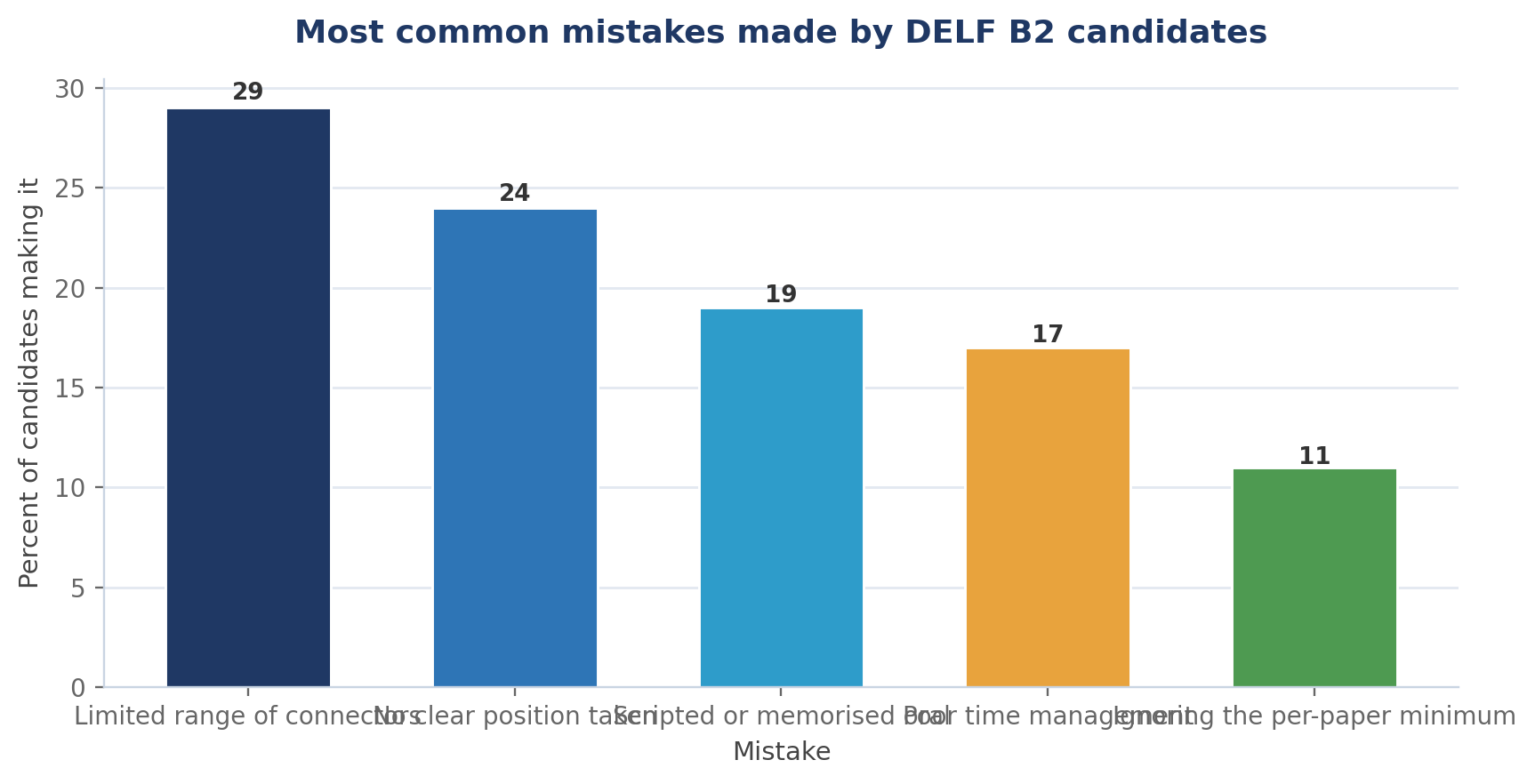
Preparation for DELF B2 usually focuses on what to do. It is just as useful to know what not to do, because the same handful of errors recurs across every exam session, and every one of them is avoidable.
These are not knowledge gaps. Most candidates who fail DELF B2 know enough French. They lose marks to habit: repeating mais and donc twelve times, summarising instead of arguing, reading a prepared script aloud, running out of time, or collapsing one paper entirely and failing despite a strong total.
Here is each mistake, why it costs marks, and the correction.
Mistake One: Writing Without a Position
The single most common failure in the writing paper is producing a well-written text that never actually argues anything.
A safe structure is: introduction stating the position, two developed arguments, and a conclusion that restates and opens out. The examiner is not looking for originality — they are looking for a coherent stance supported by reasons.
Mistake Two: Connector Poverty
Range of connectors is an explicit criterion, and candidates routinely write an otherwise good essay using only mais, et, donc and parce que.
Mistake Three: Reading a Script in the Oral
The speaking paper assesses spontaneous speech. A memorised script delivered fluently scores lower than a less polished delivery that responds to the moment.
The preparation period should produce a page of bullet points: thesis, two arguments, one example each, conclusion, opening question. Nothing else.
Mistake Four: Losing the Debate
The debate is longer than the monologue, and candidates most often sink their own position by agreeing with everything the examiner says.
You can concede partially and still hold your position. That combination — acknowledge, qualify, reassert — is exactly what the B2 interaction criterion is designed to measure.
Mistake Five: Ignoring the Per-Paper Minimum
This is a structural mistake and it fails otherwise strong candidates.
A candidate with 73 points can fail. A candidate with 56 points passes. Balance beats excellence, and the correction is simple: diagnose your weakest paper and spend the largest block of preparation on it, even if it is the least enjoyable.
Mistake Six: Poor Time Management
Three fixes cover nearly all of it. In reading, skim first and answer the easy questions before returning. In writing, plan for ten minutes, write for forty, and reserve ten to check agreement, tenses and connectors. In listening, accept that you will miss something and move on immediately.
Find your weakest paper before the examiner does
Our AI voice tutor gives you structured speaking and listening practice, and printable study materials help you target your weakest area at your own pace. Explore the French Course Pass →
Start the French course →Create a free accountMistake Seven: Register Slips at B2
B2 requires control of formal register, and informal vocabulary in the writing paper is expensive.
One informal word in an otherwise formal essay will not sink you. A pattern of them signals that you have not understood what B2 writing requires.
Mistake Eight: Preparing Grammar Instead of Skills
This is the meta-mistake behind several of the others. Grammar study feels productive and is easy to do alone. Writing timed essays with marking, and defending a position under pressure, feel uncomfortable and require a partner. The exam tests the uncomfortable things.
A Correction Checklist
Six yeses and you are ready. Any no is your next two weeks of work.
Turn the checklist into a plan
A diagnosed weakness and two weeks of targeted self-paced practice is usually all that separates a strong candidate from a pass. Our Course Pass gives you guided lessons, speaking practice with AI feedback, and printable study materials. Start your French Course Pass →
Start the French course →Create a free accountFrequently Asked Questions
What is the most common reason candidates fail DELF B2? Losing one paper entirely. The per-paper minimum of 5 out of 25 fails candidates who scored comfortably overall, so balance matters more than excellence in a single skill.
How important are connectors in DELF B2 writing? Very. Range of connectors is marked explicitly, and essays that rely on mais and donc throughout lose marks on a criterion that is easy to fix.
Should I memorise answers for the DELF B2 oral? No. Memorised content is penalised because the paper assesses spontaneous speech. Prepare a structure and memorise transitions instead.
Is it better to be accurate or fluent in the DELF B2 oral? Both are marked, but interaction and argument carry more weight. A fluent candidate with small errors scores higher than a hesitant, technically accurate one.