Most TCF advice tells you what to study. Very little tells you how long it takes, which is the question that actually determines whether you can register for the May session or should wait until the autumn.
The honest answer has three parts: how many hours your target band costs in French competence, how many additional hours test technique requires, and how much of the total you can realistically spend each week. Get those three numbers and you can date your exam rather than hoping.
Here is the arithmetic, band by band, with a realistic split across the sections.
The Two Components of Your Total
TCF preparation is not one job. It is two, and they have very different price tags.
The second component is the one candidates underestimate. It is also the cheaper one — test technique can be trained substantially in twenty to thirty hours, whatever your level. A candidate at B1 competence plus solid technique often outperforms a B2 candidate who has never sat a timed section.
Hours to Reach Each Band
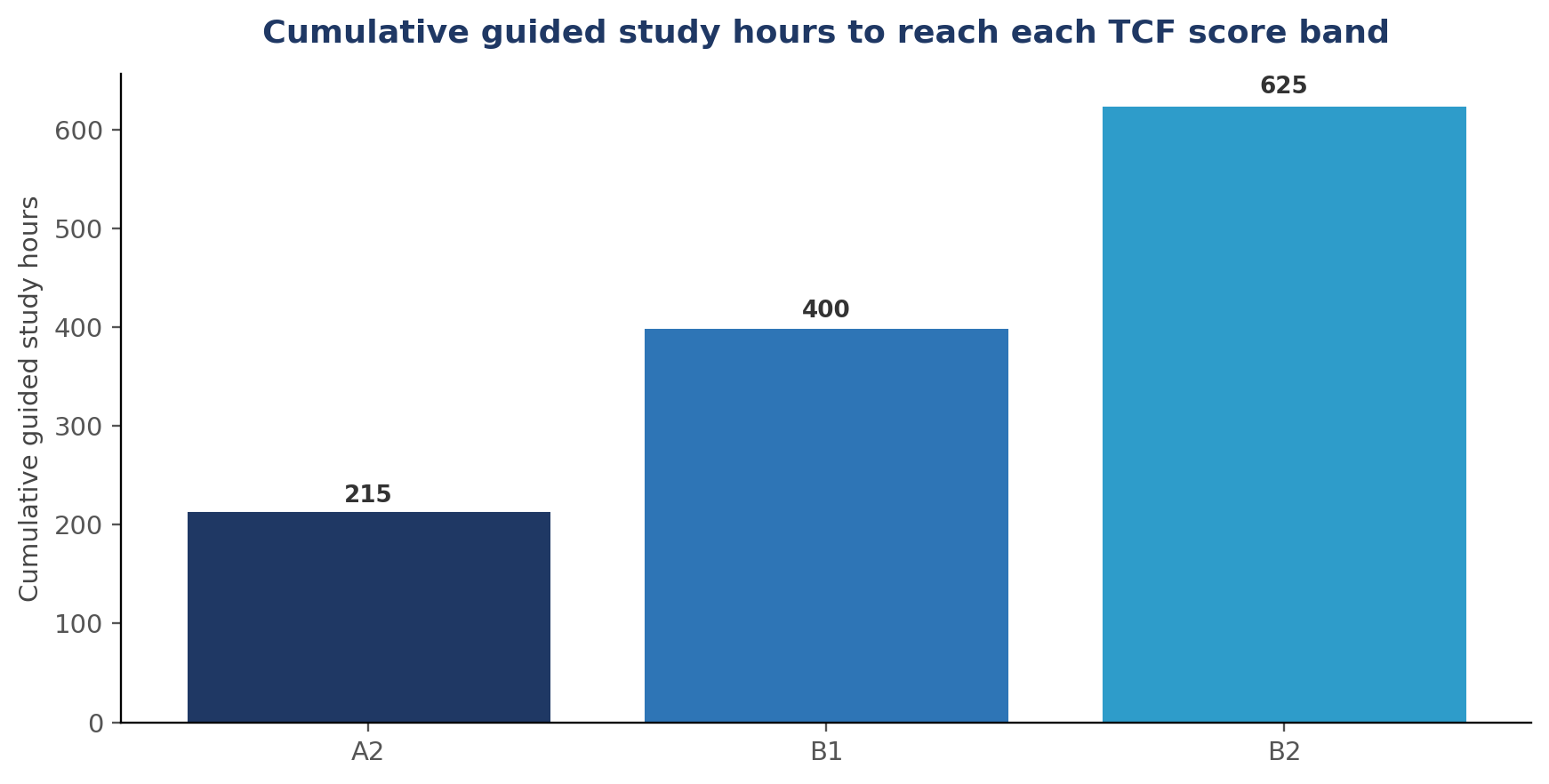
The chart contains the single most important planning insight for the TCF: the cost of each band rises steeply. Moving from A2 to B1 costs about 185 hours. Moving from B1 to B2 costs about 225, and each of those hours is harder to earn than the last.
Preparation Time Is the Gap, Not the Band
This table is the one to actually use. Find your starting band on the left and your target on the top.
Read the B2 row carefully, because it explains why some candidates can prepare in a month and others need a year. A candidate already at B2 who needs a B2 certificate is buying technique, not competence — that is a thirty to sixty hour project, and four to eight weeks of focused work does it comfortably.
How to Split the Hours
Those breakdowns assume you take the optional productive sections. If you do not, redistribute the writing and speaking hours into listening and reading — the two sections that carry the 699-point total.
Converting Hours into Weekly Reality
The last column is the practical takeaway for confident candidates: thirty hours of focused technique work is a fortnight of evenings. If you are already near your target band, do not buy a six-month course — buy a fortnight of intensity and two practice exercises.
What an Hour Should Look Like
Not all hours are equal. This split is what produces progress rather than motion.
That last row matters. Candidates routinely count a year of subtitled French cinema as preparation. It is not; it is entertainment with a French soundtrack, and it produces the illusion of progress without the substance.
A Six-Month Plan That Adds Up
Two hundred and twenty hours over six months is about eight or nine hours a week — a heavy but entirely normal commitment for someone with a deadline, and far more effective than an hour a day for two years.
Turn hours into band movement
Our French Course Pass builds a schedule around your starting band, with self-paced AI voice-tutor lessons, timed practice and printable study materials that show exactly where your hours are going. Explore the French Course Pass →
Start the French course →Create a free accountWhere Hours Get Wasted
The sixth row is the cheapest fix available. An error log — a running list of the mistakes you personally keep making — converts study time into targeted correction, and it costs nothing but a notebook.
Realistic Scenarios
That first row is worth repeating: a candidate already at the required level may need only forty to sixty hours. Sit a diagnostic before buying anything, because the difference between a forty-hour project and a five-hundred-hour one is a single test.
Know your number before you book the exam
Our French Course Pass starts with a diagnostic that places your band and estimates your preparation hours — then delivers them in self-paced AI voice-tutor lessons that track your progress. Start your French Course Pass →
Start the French course →Create a free accountFrequently Asked Questions
How many hours do I need to prepare for the TCF? It depends on the gap. Moving one CEFR band costs around 200 hours of French plus 20 to 30 hours of test technique.
How long does it take to prepare for TCF B2? From B1, roughly 200 to 280 hours — about six to eight months at eight hours a week. From B2, only 30 to 60 hours.
Is 100 hours enough for the TCF? Only if you are already at or near your target band. Otherwise 100 hours is a solid start rather than full preparation.
Should I count passive listening as study time? Count it at half rate, and do not count subtitled viewing in your own language at all — it does not build the skill the TCF tests.