Your German is fine. That is the maddening part. You can read a newspaper article about a tax reform, and yet the moment a barista says Was darf es sein? your mouth locks and something small and apologetic comes out.
Confidence is not a personality trait. It is a byproduct of repetition under mild pressure. Here is how you manufacture it.
What you will get from this guide
- Why German feels harder to speak than it looks on paper
- Five drills that build confidence faster than vocabulary lists
- The pronunciation habits that make natives stop switching to English
- How to recover when you freeze mid-sentence
The Real Villains: Case, Order and Clusters
German punishes improvisation. When you speak English, you can throw words at a sentence and it mostly survives. German will not cooperate.
The fear is rational: German has more decisions per sentence than English does. But that is exactly why confidence comes from patterns, not grammar theory. You do not want to think about the dative. You want Ich gebe ihm to arrive pre-assembled.
Drill One: Shadowing, Properly
Shadowing means playing native audio and speaking along with it, one beat behind. Not repeating after a pause — speaking simultaneously.
It sounds absurd. It works because it forces your mouth to match speed, rhythm and stress without giving your inner critic time to intervene. Ten minutes daily with Deutsche Welle's slow-news audio or a German podcast is enough to start.
Rules: pick audio slightly above your level, keep the volume low enough to hear yourself, and do not stop when you stumble. Sailing past the stumble is the entire point.
Drill Two: Chunks, Not Words
Fluent speakers do not build sentences. They deploy units they have said a thousand times.
Learn thirty chunks and you gain a scaffolding that holds up when grammar wobbles. This is the single fastest confidence hack in the language.
Drill Three: Record Yourself, Then Be Kind
Nobody enjoys hearing their own voice. Do it anyway. Once a week, record ninety seconds on a set topic, then listen back with a specific question: where did I hesitate?
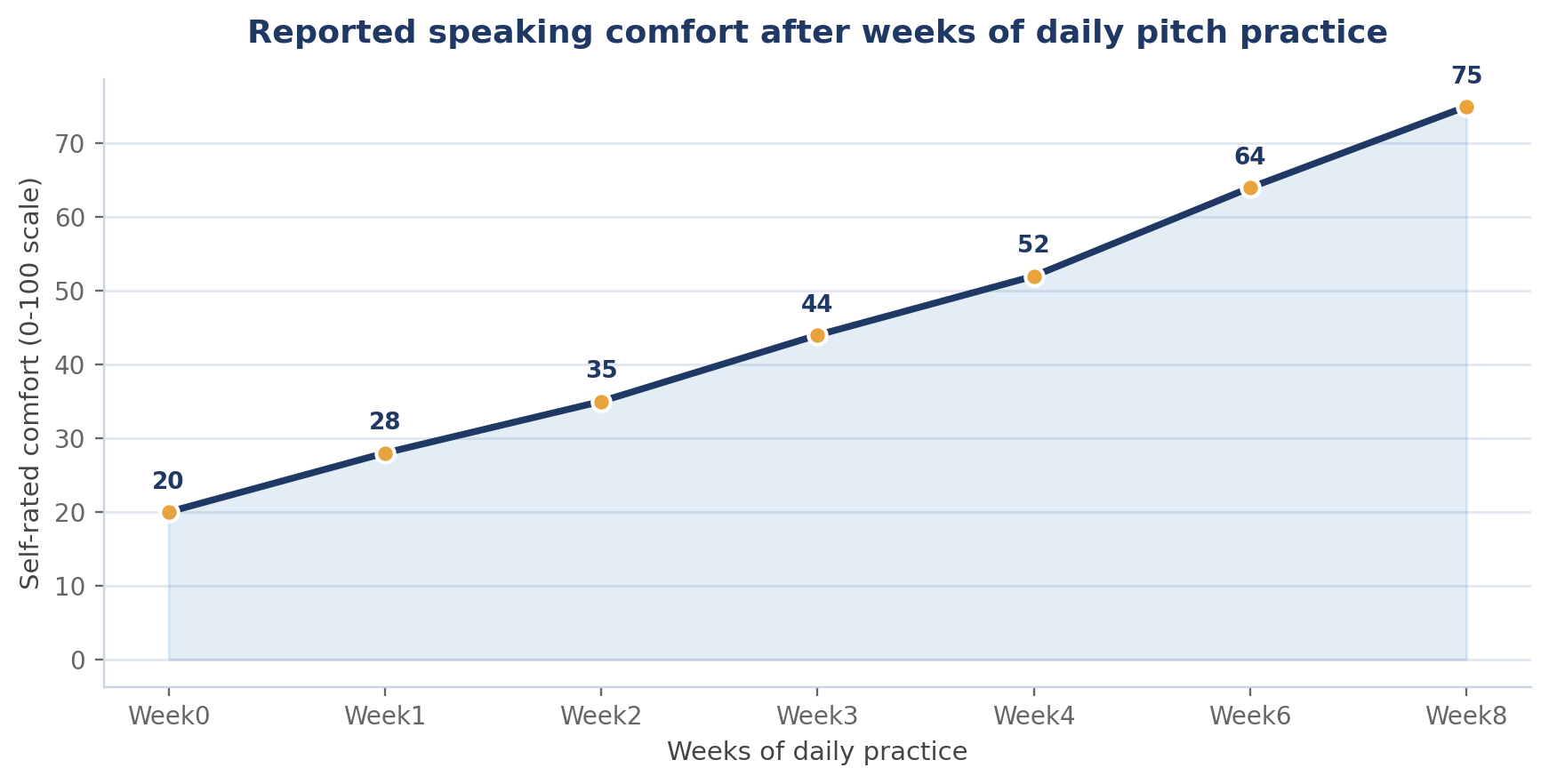
The number rises for a simple reason: hesitation points shrink when you name them. Guessing at your weaknesses feels bad and changes nothing.
Find out exactly where your German stalls
Ready to turn reading into real German? Start your self-paced course today.
Start the German course →Create a free accountGuessing at your weak spots wastes months. A short AI speaking assessment pinpoints the exact patterns that trip you — cases, verb position, or plain speed — and gives you a drill plan built around them. Button: Take a speaking assessment →
Why Natives Switch to English (and How to Stop Them)
It is not judgement. It is efficiency. Germans switch when they sense your struggle is costing them time. Two habits change the calculus.
Own the pause in German. Say Moment, ich überlege kurz instead of going silent and looking panicked. A controlled pause reads as fluency. A terrified silence reads as a rescue request.
Nail the sounds English speakers skip. German pronunciation is unforgiving in four places:
Get these four and you sound dramatically more competent than your vocabulary suggests.
Drill Four: Talk to a Human, Weekly
Apps cannot give you this. Shadowing builds rhythm; only a real person builds nerve, because only a real person can surprise you.
One scheduled conversation per week outperforms five hours of solo study for confidence. Thirty minutes, a tutor, a topic you actually care about. No notes, no script, permission to make forty mistakes.
Drill Five: The Two-Minute Recovery Rule
When you freeze — and you will — do this:
Confidence is not the absence of freezing. It is knowing you have a procedure for it. The people who sound fluent are not the ones who never stumble. They are the ones who stumble and keep the floor.
Practise speaking with an AI voice tutor that never switches to English
Ready to turn reading into real German? Start your self-paced course today.
Start the German course →Create a free accountOur self-paced German course is built for exactly this: guided speaking practice with immediate AI feedback, zero judgement. You will rehearse the frozen moments in a safe space until they stop being frightening. Study any time, at your own pace. Button: Start German speaking practice →
Frequently Asked Questions
How long does it take to feel confident speaking German? Most learners notice a real change after four to eight weeks of regular speaking practice paired with short daily drills. The daily work builds rhythm; the speaking practice builds nerve. Doing only one of the two usually stalls.
Is it normal to freeze mid-sentence when speaking German? Completely. It happens because German front-loads grammatical decisions — case, gender, word order — that English defers. The remedy is chunk learning and a rehearsed recovery phrase, not more grammar study.
Should I practise speaking before I know enough grammar? Yes. Waiting until your grammar is "ready" is the most common way learners lose a year. Speaking early exposes which grammar you actually need, and you will learn those structures faster because they suddenly matter to you.
Do apps help with German speaking confidence? Partly. Apps build vocabulary and listening, and some offer speech recognition, but they cannot replicate the unpredictability of a real conversation. The CEFR's action-oriented approach treats real interaction as the core of language ability for a reason.