You say "Ich habe ein Buch gelesen" perfectly. Then a Berliner answers, and you hear your own voice echo back — flat, careful, unmistakably foreign. The grammar was flawless. The accent gave you away in four syllables.
Here is the good news: a german accent is not a mystery you were born without. It is roughly six habits. Fix them and strangers stop switching to English.
What you will get from this guide
- The five sounds that carry most of a foreign accent
- Why word stress matters more than any single vowel
- A self-test you can run today with your phone
- How long realistic accent work takes
The German Accent Is Built From Six Habits
Most learners chase individual letters. Native speakers hear patterns. These six habits do the heavy lifting.
Nail habits one through four and you sound "clear". Add five and six and you sound "German".
Umlauts: Round Your Lips, Not Your Jaw
The umlauts are where English speakers panic. Here is the mechanical fix.
The trick for ü and ö: hold your tongue in the English "ee" shape, then round your lips without moving the tongue. Do it in a mirror. Ten reps, twice a day, and your mouth learns the geometry.
Final Devoicing: The Rule Nobody Warns You About
German has a hard rule called Auslautverhärtung. A voiced consonant at the end of a word or syllable turns voiceless.
This matters for comprehension, not just beauty. Say "Rad" with a soft d and a listener may hear "Rat" — advice. The devoicing rule was never optional furniture. It is grammar wearing a costume.
The Glottal Stop: German's Invisible Punctuation
German speakers separate words that start with a vowel using a small catch in the throat — the Knacklaut. English glides straight through.
Try it: say "uh-oh" the way you would if you dropped a glass. That tiny catch is the sound. Now plant it in front of every vowel-initial word. Suddenly your speech has edges, and edges are what make German sound like German.
Where the Accent Actually Lives: Stress and Melody
Two learners can pronounce every vowel correctly and still sound different. Stress placement and sentence melody decide the verdict.
That last row is the reason stress is not cosmetic. Separable verbs shift stress and swap meaning. In German, the beat is information.
How Long It Takes to Sound Native — Honestly
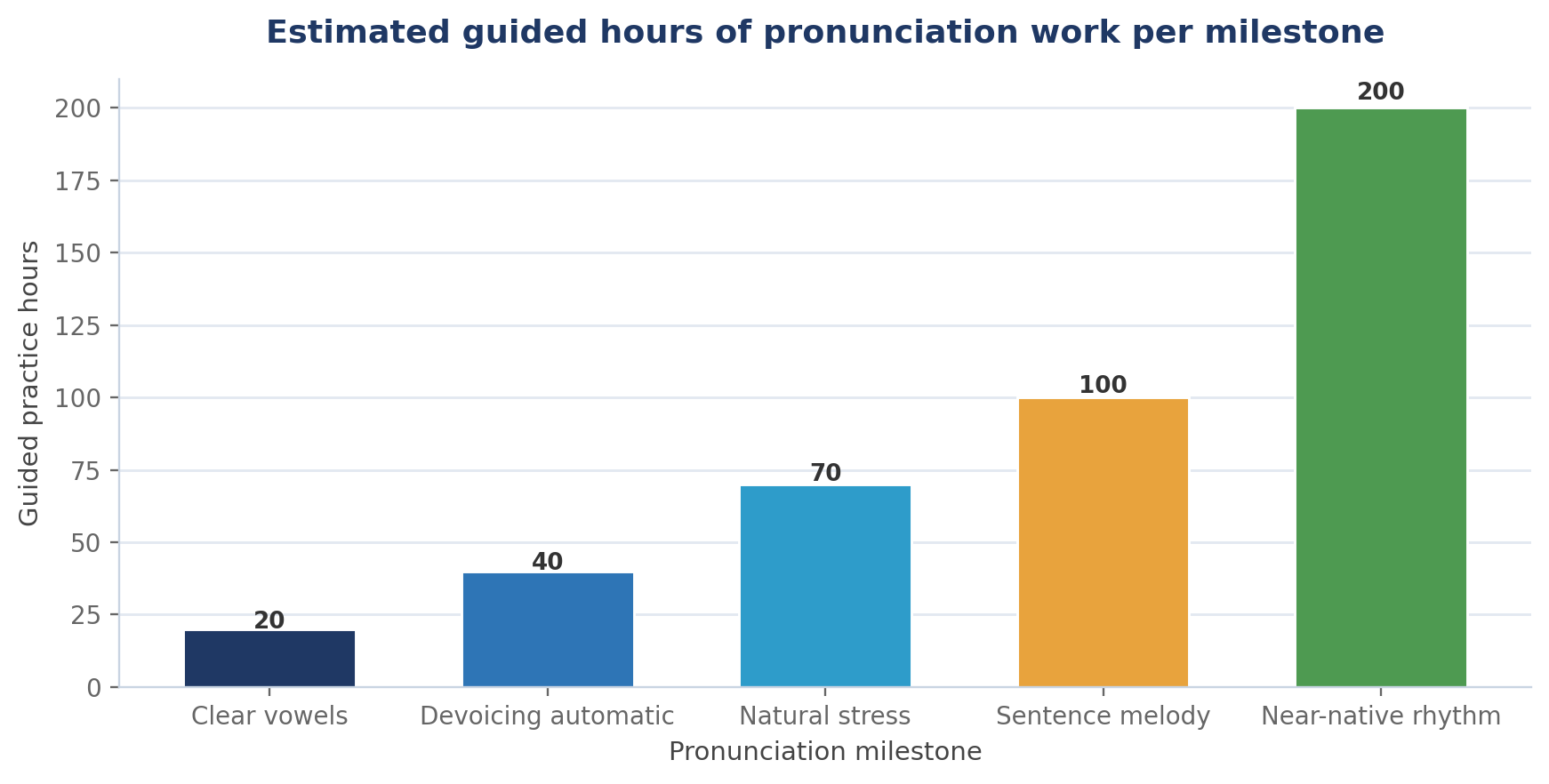
Nobody reaches zero accent. The goal is "understood, unstrained, unhurried". Here is a realistic picture of guided practice.
Notice the shape: the first gains arrive fast, the last gains crawl. That curve is why learners quit around week four — exactly when the easy wins run out.
A Self-Test You Can Run in Five Minutes
Record yourself on your phone. Read this paragraph once, naturally: "Ich habe über ein altes Buch gesprochen und der Hund hat gebellt." Play it back and listen for four things only.
Fail three or more and you have your syllabus. One or two and you are polishing, not rebuilding.
Hear Your Accent Through German Ears
A recording can only tell you so much. A personal AI voice tutor hears the exact syllable you are drifting on and drills it with you in real time — the vowels, the stress shifts, the melody.
Book a speaking assessment →Create a free accountThe Three-Week Practice Plan
Short, daily, specific. That beats a two-hour Sunday marathon every time.
Shadowing is the highest-return drill in the list. Play one sentence from Deutsche Welle's Langsam gesprochene Nachrichten, pause, imitate the melody — not just the words. Do it for a hundred sentences and your ear starts correcting your mouth without permission.
The Mistakes That Keep You Foreign
Four habits extend the accent's life far beyond its natural one.
And the biggest one: waiting until you are "good enough" to work on accent. Accent work is not the dessert. It is part of the main course, and it gets harder to change at month eighteen than at month two.
Frequently Asked Questions
Can adults really lose their accent in German? Adults rarely reach zero accent, but they reliably reach "nearly native" on the sounds that matter. Umlauts, final devoicing and the glottal stop are mechanical and learnable at any age. Melody is the last habit to go and the one that needs the most ear training.
Is a German accent in English a bad sign for learning German? No. Your first language's sound system filters everything. The filter is there for everyone; awareness is what reduces it. The learners who improve fastest are simply the ones who listen to their own recordings.
Should I learn a specific regional accent? Standard German (Hochdeutsch) first — it is what courses, news and exams use. Regional colour comes later, naturally, and often by accident once you live somewhere. Do not try to fake Bavarian before you can hear the difference.
How do I practice without a partner? Shadowing, mirror drills and monthly recordings cover most of it. What you cannot self-assess is whether a native ear finds you clear. That is where a personal AI voice tutor or a language partner earns their keep.
Stop Practising Sounds Nobody Corrected
You have been repeating the same three vowels for a year. One AI-tutor session tells you which ones, and the next twelve weeks fix them. Small, specific, permanent.
Start speaking German properly →Create a free accountReferences & Further Reading
- Goethe-Institut — Fit in Deutsch and pronunciation guidance for German learners: https://www.goethe-institut.de
- Deutsche Welle — Langsam gesprochene Nachrichten, slow-news shadowing material: https://learngerman.dw.com
- Duden — Das Aussprachewörterbuch, the standard reference on German pronunciation: https://www.duden.de
- Council of Europe — Common European Framework of Reference for Languages companion volume: https://www.coe.int/en/web/common-european-framework-reference-languages
- Institut für Deutsche Sprache (IDS Mannheim) — research on German phonetics and prosody: https://www.ids-mannheim.de