Say Bach out loud. If the back of your throat felt nothing, you just found the wall between you and sounding German. Every learner hits it. Nobody explains that German pronunciation is not a pile of exotic sounds — it is a small set of rules you can drill in a fortnight.
What you will get from this guide
- The five sounds that actually matter, ranked by payoff
- The vowel-length rule that fixes half your accent
- A 20-minute daily drill you can start tonight
- Realistic timelines for sounding intelligible vs. sounding native
The Five Sounds That Do All the Work
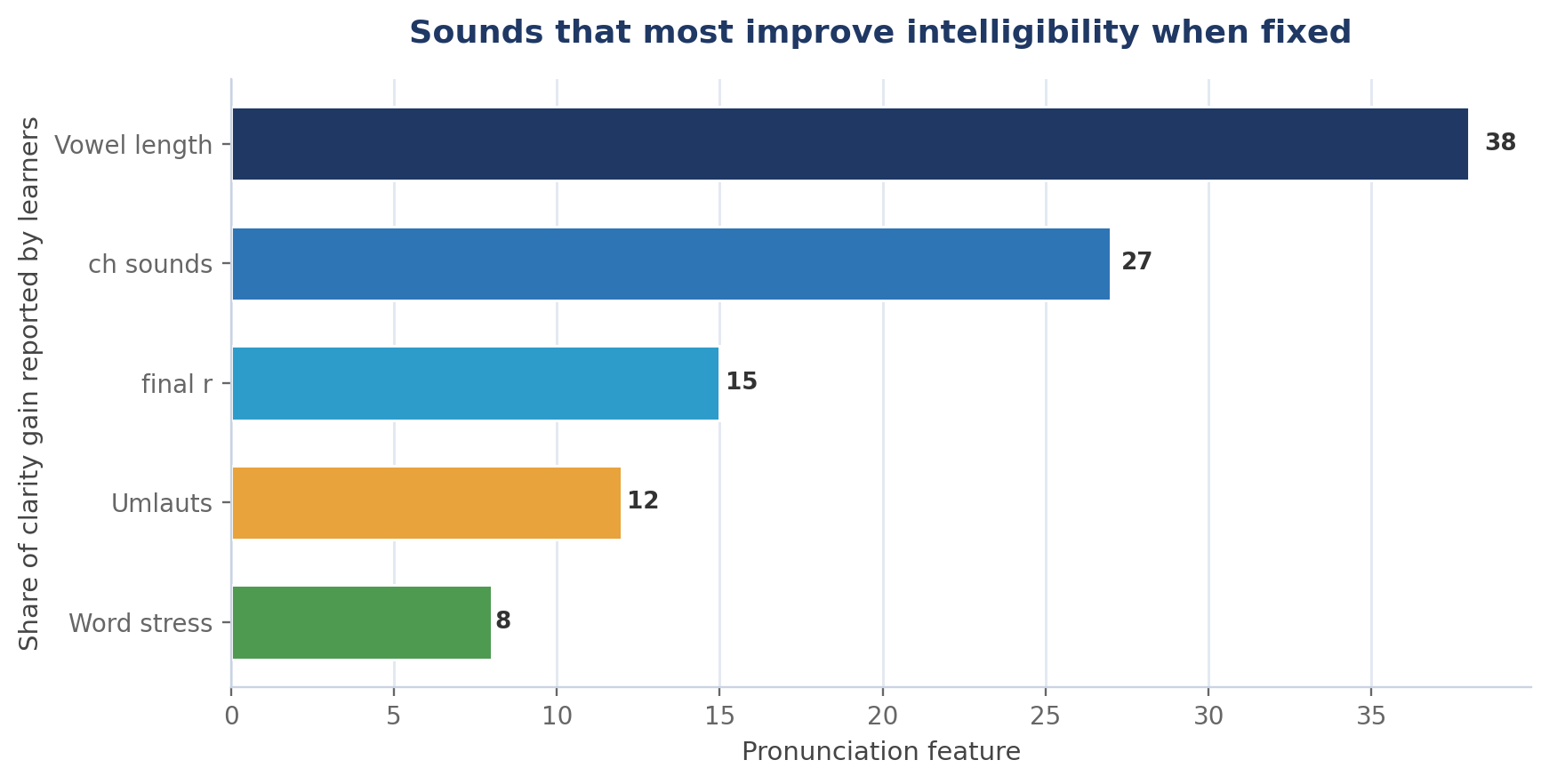
You do not have two hundred pronunciation problems. You have five. Fix these and listeners stop translating you.
Now the harder truth: the German r at the start of a word is a different animal from the r at the end. Rot gets a throaty scrape. Bier gets a soft vowel. Learners who roll both sound theatrical. Learners who do neither sound American.
The Vowel-Length Rule Nobody Teaches You
Here is the cheapest upgrade in the whole language. German vowels are either long or short, and length changes meaning.
Compare Stadt (city) with Staat (state). Same consonants in spoken form, opposite vowel length, entirely different meanings. English speakers flatten both into the same muddy middle. Do that and you are technically saying a different word.
The practical fix: when you see a doubled vowel or an h after a vowel, physically stretch it. Count one beat. Bahn is not "bahn" — it is "baaaahn". It feels ridiculous. It works.
Listen Before You Speak
You cannot produce a sound your ear has never separated. Before any drill, do five minutes of shadowing.
Shadowing means playing eight seconds, then copying the speaker's melody before the meaning lands. Do not translate. Do not read along. Just chase the tune. Your mouth learns rhythm faster than your brain learns grammar.
Where Your Stress Goes
German word stress has patterns, not chaos.
Get stress wrong and Germans will still understand you, but they will wince. Get it right and your grammar mistakes get forgiven. That is not a small trade.
Stop guessing which sound is broken
Record a two-minute sample and our AI voice tutor names your exact three problem sounds — with drills for each. It is the fastest feedback loop in language learning, and it takes one session.
Start my speaking practice →Create a free accountA 20-Minute Daily Routine That Actually Sticks
Four blocks. No app subscription required.
Minimal pairs are the sharpest tool you own. Bahn/Bann. Hüte/Hütte. Biss/Bisschen. Say both, hear the difference, then say them again until your mouth stops lying to you.
Listen back to that recording. Yes, your own voice sounds strange. Everyone hates their recording. Do it anyway — the gap between what you think you said and what came out is where the improvement lives.
How Long Until It Sounds Better?
Honest numbers, based on CEFR-aligned planning estimates. Pronunciation is the one skill where early returns are dramatic.
Six weeks is the sweet spot. That is roughly 40 guided hours — the same order of magnitude as the jump from A1 to A2 in structured courses. You are not chasing a native accent. You are chasing the moment a Berlin baker answers you in German instead of English. That moment arrives sooner than you think.
The Accent You Should Not Want
Some teachers sell accent erasure. Be suspicious. A slight accent is not damage. German listeners care about clarity, vowel length and rhythm — not whether your r sounds like Munich. Chase intelligibility. Native-ness is a hobby, not a requirement.
Your accent is one coach away from clear
AI voice tutor, structured lessons, and correction the moment your vowels collapse. The German Course Pass puts an AI ear on your speech every single week.
Start German with an AI voice tutor →Create a free accountFrequently Asked Questions
How long does it take to improve German pronunciation? Most learners report noticeable clarity gains after 6-8 weeks of daily 20-minute practice. The ch sounds and umlauts usually click within two weeks. The final-r and vowel length take longer because they need to become automatic.
Can adults still fix their accent? Yes. Adults lose some phonetic flexibility, but they gain something better: the ability to understand rules and self-correct. Structured drills beat childhood immersion for targeted sounds.
Do I need to learn the rolled Bavarian r? No. Standard German uses a uvular r in the throat, and after a vowel it weakens to a vowel-like sound. Regional variants exist, but nobody fails to understand you for choosing the standard one.
Is it worth practising with a native speaker or can apps do it? Apps are fine for repetition, but they cannot tell you why your ü drifted into an oo. An AI voice tutor hears the error, names it, and hands you the fix in one sentence.
References & Further Reading
- Deutsche Welle Langsam gesprochene Nachrichten — daily slow news with full transcripts, ideal for shadowing.
- Goethe-Institut, German Pronunciation Practice materials aligned to CEFR levels A1-B2.
- Duden, Das Aussprachewörterbuch — the standard reference for German pronunciation.
- Council of Europe, Common European Framework of Reference for Languages — official level descriptors.
- LanguageSkills.net German courses — self-paced AI voice tutor lessons with recorded feedback.