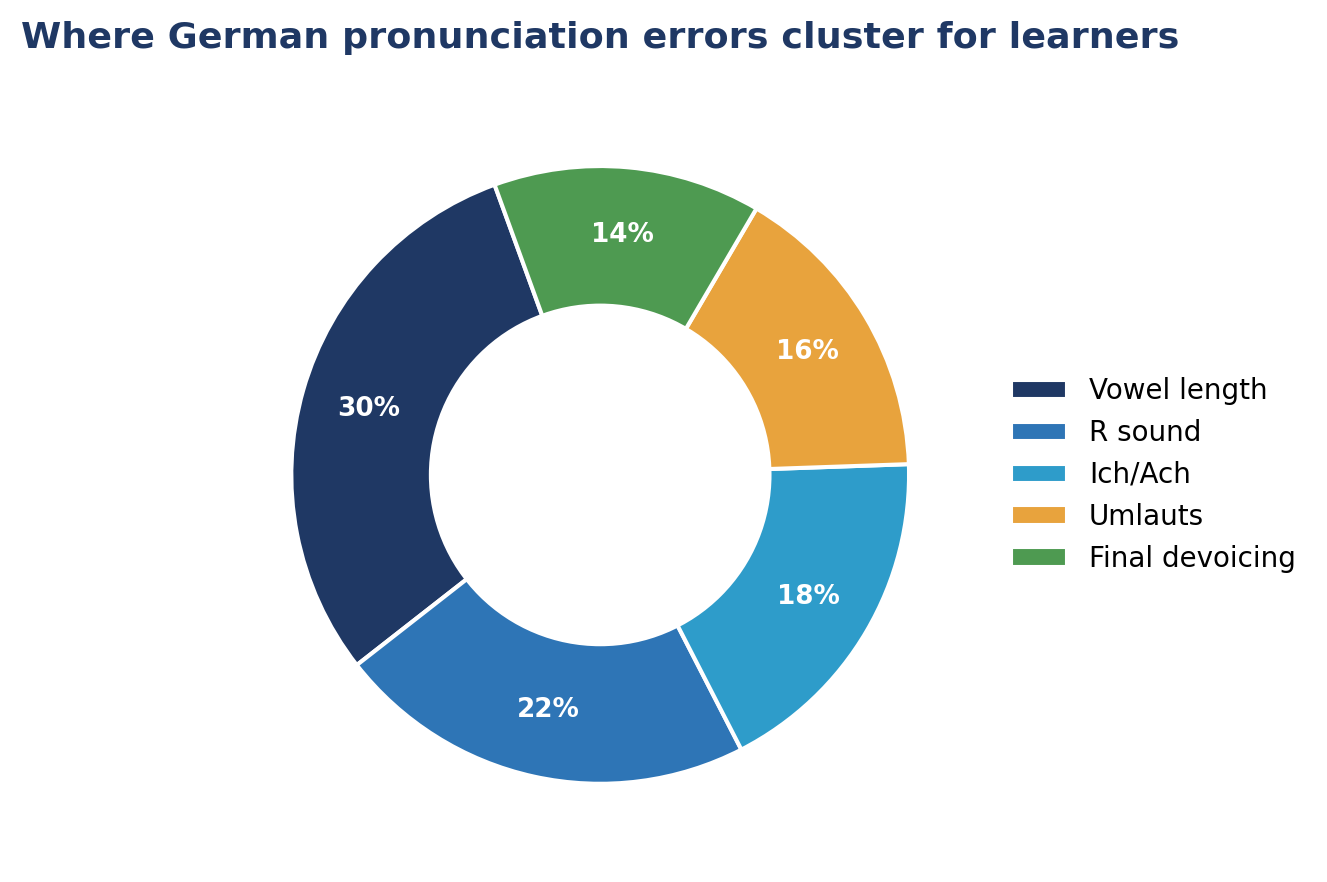
Nobody expects a foreign accent. What they do notice is the difference between Stadt and Staat — and one of those will get you a confused look at a train station. German pronunciation is highly regular, which means most mistakes are a small, fixable list. Here are the ones that matter, in order of how much they cost you.
What you will get from this guide
- The six error families behind almost every foreign accent in German
- Precisely where the ich and ach sounds live in your mouth
- Drills you can run in five minutes a day, no equipment needed
Mistake 1: Treating Ich and Ach as One Sound
German ch has two versions, and the choice is not random — the vowel before it decides.
The ich-Laut is not a hard "k" and not an English "sh". Say a long "ee" and hold your tongue there, then push air through the gap without moving it. English speakers have it in the opening of "hue" and "huge".
Mistake 2: The German R Has Three Personalities
English speakers default to the American rhotic r — tongue curled back. German has none of that.
Do not roll the tongue tip. The German r is made where you would clear your throat gently, and in final position it almost disappears. Vater is roughly "FAH-tuh", not "VAH-ter".
Mistake 3: Umlauts Become Vowel Soup
The trick is sequence. Say the unrounded vowel, freeze your tongue, then move only your lips. That is the whole method, and it works within about twenty repetitions.
Mistake 4: Vowel Length Treated as Decoration
In German, long and short vowels change meaning. This is not a subtle accent issue — it is a comprehension issue.
Two signals tell you the length, and both are visible in spelling. A vowel followed by a double consonant is short. A vowel followed by h or doubled is long.
Vowel length is the quiet champion of the list. Learners ignore it because it feels minor, and it produces the most misunderstandings.
Mistake 5: Missing Final Devoicing
German hardens consonants at the end of a word or syllable. A written b, d, g becomes p, t, k in sound.
Then plural or inflected forms switch it back: Tag /taːk/ but Tage /ˈtaːɡə/. Yes, it moves. German does that.
Mistake 6: W, V, Z and S at the Start
You cannot hear your own accent
Recordings lie less than ears do, but an AI voice tutor gives you instant feedback on the exact moment your tongue drifts. Self-paced speaking practice catches in minutes what passive listening misses for a year.
Get AI speaking feedback →Create a free accountA Five-Minute Daily Drill
Shadowing — playing a native speaker and speaking along half a second behind — is the fastest route to German rhythm. Deutsche Welle's slow-news broadcast is ideal material because the delivery is deliberately unhurried.
Three Quick Wins for This Week
- Aspirate your p, t, k. English speakers already do; keep doing it. German Tag has a puff of air.
- Use a glottal stop before initial vowels. German separates words cleanly: ein Apfel should not blur into "einapfel".
- Slow down. German vowels are held longer than English ones. Rushing flattens them and undoes every other fix.
Sound German, not just speak German
Pronunciation is a physical habit, and habits need regular practice. Study at your own pace with an AI voice tutor, get diagnosed, and fix the three sounds that are actually holding you back.
Start pronunciation training →Create a free accountFrequently Asked Questions
Is the German r rolled like Spanish? No. It is a uvular fricative made at the back of the throat, and in final position it softens into a vowel-like sound. Bavarian and Austrian speakers do roll it, but that is dialect.
How do I know if a vowel is long or short? Spelling tells you most of the time. A doubled consonant or two consonants after the vowel means short; an h after the vowel or a doubled vowel means long.
Is the ich-Laut hard for English speakers? It is unfamiliar but not hard. Start from the middle of the word "huge" and add a little more friction. Ten minutes of daily practice usually settles it.
Should I worry about my accent at all? Only in as far as clarity. Understandable German beats perfect German, and nobody is grading your vowels in a bakery. Fix what causes misunderstanding first.
References & Further Reading
- Duden, Das Aussprachewörterbuch, Dudenverlag — standard German pronunciation
- Deutsche Welle, Langsam gesprochene Nachrichten for shadowing practice — dw.com/deutschlernen
- Goethe-Institut, A1–B1 pronunciation guidance in the level syllabi — goethe.de
- International Phonetic Association, Handbook of the International Phonetic Association, Cambridge University Press
- Hall, C., Modern German Pronunciation: An Introduction for Speakers of English, Manchester University Press