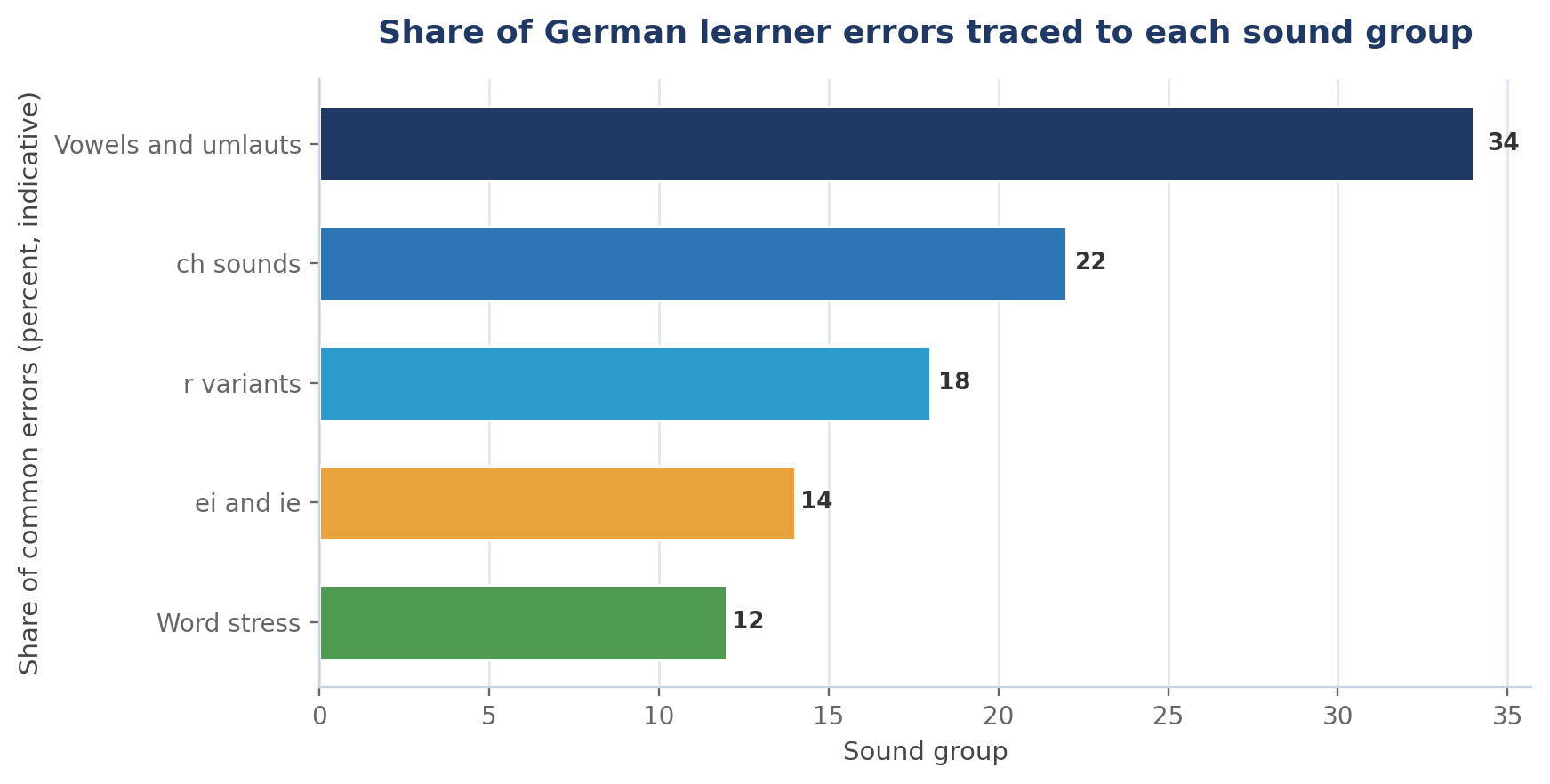
German looks like English with a bad haircut, so beginners read it like English — and then wonder why nobody understands them. The spelling is actually your friend here. Once you learn the rules, German is one of the most predictable languages in Europe to pronounce.
Here is the whole system, in the order your mouth needs it. No IPA lectures, just the sounds and the traps.
What you will get from this guide
- The Umlauts and the vowels that change meaning
- The two German ch sounds and when each appears
- The r, the z, and the letter swaps (ei/ie, v/w)
- A practice routine you can run in ten minutes a day
The Big Promise: German Is Spelled How It Sounds
Unlike English, German spelling is highly regular. The Deutsche Rechtschreibung rules mean a written word predicts its sound in almost every case. Spanish and Italian learners feel at home instantly. English speakers have the hardest start, because English spelling has taught you to distrust letters.
Umlauts: Not Decoration, New Vowels
The dots change the word, not the mood. Mutter is mother, Mütter is mothers. Schwul and schwül are two entirely different adjectives. Skip the umlaut and you have said a different word.
The trick for ö and ü is physical: build the vowel you know, then move only your lips. Your tongue stays put. That is the entire secret.
The Two German ch Sounds
This is the sound English speakers fear most, and it is genuinely two sounds.
The soft ch has a shortcut. Whisper the word "huge" and freeze your tongue where it touches. That is roughly the ich sound. The hard ch is the sound you make fogging a mirror, with a bit of friction.
The German r and the -er Ending
German r is not the English one. At the start of a syllable it is made at the back of the throat — a light gargle, similar to French. At the end of a word it collapses into a vowel.
Say Vater as "FAH-tah" and you already sound German. Say it as "VAH-ter" and you sound American. Same word, different passport.
Word Stress and the ei/ie Trap
German stress usually lands on the first syllable of native words, but shifts on words borrowed from Latin and Greek, and on verbs with separable prefixes.
And the trap that bites hardest: ei says "eye", ie says "ee". So Wein is wine and Wien is Vienna. Swap them and you have ordered a glass of Austria.
Hear yourself the way a native does
Our AI voice tutor runs a short speaking assessment, points at the exact sounds you are missing, then drills them in structured lessons. Ten minutes of feedback saves months of guessing.
Book a speaking check →Create a free accountThe Ten-Minute Daily Routine
Pronunciation is muscle memory, and muscles respond to repetition, not reading. This routine fits in a coffee break.
The recording step is non-negotiable. You cannot hear your own accent while you are speaking — your brain filters it out. The microphone does not.
How Fast Can Pronunciation Improve?
Beginners usually hear their own improvement within a few weeks of focused work, because the target sounds are few. The vowels settle first, the r takes longer, and intonation — the melody of a sentence — is the last piece to lock in.
The honest timeline looks like this. Basic clarity in two to four weeks. Comfortable rhythm in two to three months. Accent that no longer slows a listener down in about six months of steady practice.
From "what?" to "wie bitte?" only when you mean it
Self-paced AI voice tutor, pronunciation drills built into every lesson. Create a free account and take the placement check first.
Start free →Create a free accountFrequently Asked Questions
Do I have to roll my German r like a Spanish r? No. The German r is a soft uvular friction, closer to a French r than a Spanish trill. Many native speakers reduce it to a vowel after another vowel, so Uhr sounds close to "oah".
Why do Germans spell my name back with a different letter? Because German maps letters to sounds consistently, and your English vowels do not fit that map. Spell your name using German letter names (A, Be, Ce...) and the confusion vanishes.
Is it true German has no silent letters? Mostly, with a few exceptions. H after a vowel often just lengthens it, as in Zahl, and some loanwords keep foreign spellings. The general rule holds far more reliably than in English.
Can I learn pronunciation from reading alone? Almost never. Sounds need audio reference and feedback. Read, listen, and record yourself in the same session.
References & Further Reading
- Duden — Die deutsche Rechtschreibung, current edition, spelling and pronunciation notes
- Goethe-Institut — pronunciation materials within the A1 and A2 course framework
- Deutsche Welle — Nicos Weg and Deutschtrainer audio series for listening and shadowing
- International Phonetic Association — IPA chart for German consonants and vowels
- Forvo — crowd-sourced native recordings of individual German words
Start with the free speaking assessment at languageskills.net/register and find out which sounds are cheating you.