You have the words. You know the grammar. Then a barista in Berlin says "Sonst noch was?" and your entire German vocabulary walks out of your body without saying goodbye.
That is the fear of speaking German. It is not shyness and it is not stupidity. It is a retrieval problem wearing an anxiety costume — and it is fixable with drills, not affirmations.
Here is the ladder out.
What you will get from this guide
- Why your German vanishes exactly when you need it
- The graded exposure ladder, from whispered to full speed
- Ten filler phrases that buy you three seconds of thinking time
- A 30-day speaking drill plan that does not require a single native speaker
Why Your German Disappears Mid-Sentence
Speaking is the only language skill performed in real time. Reading lets you linger. Writing lets you delete. Speech gives you roughly 150 milliseconds before silence starts feeling like failure — and silence is what your brain is really afraid of, not grammar.
Natives do not audit your declension. They wait for the verb. Give them the verb.
The Exposure Ladder
Fear shrinks with repetition at a level slightly above comfortable. Not a cliff jump — a staircase.
Rungs 1 to 3 are free and can start tonight. Rungs 6 and 7 are where the fear actually dies — and they need real speaking practice.
Ten Filler Phrases That Buy You Time
Silence is the enemy. Fillers are armour. Germans use these constantly — you can too.
The 30-Day Drill Plan
Notice week two deliberately ignores mistakes. Accuracy improves fastest after you can produce a sentence at all.
Find out what your German actually sounds like
Thirty days of guessing whether you sound right is thirty days wasted. Get an honest read on your pronunciation, fluency and level with AI speaking feedback — then fix what it finds.
Start your German speaking practice →Create a free accountThree Habits That Keep the Fear Alive
Learning in silence. If every German word you own has only ever been read, it has never been spoken. Reading and speaking are different tracks.
Waiting for perfect. Learners who speak at 70% accuracy improve faster than learners who wait to reach 100%. There is no 100%.
Practising only with the same person. One patient friend becomes a comfort blanket. Rotate partners, tutors and situations until novelty stops spiking your heart rate.
What to Actually Say When You Freeze
Announce it. "Ich brauche kurz." Seconds, not shame. Nobody in the history of Germany has been annoyed by a learner asking for a moment — they have only ever been confused by silence.
Then downgrade the sentence. Long clause collapsing? Say the short version. "Ich fahre morgen nach München" beats a beautiful Konjunktiv II sentence you never finish.
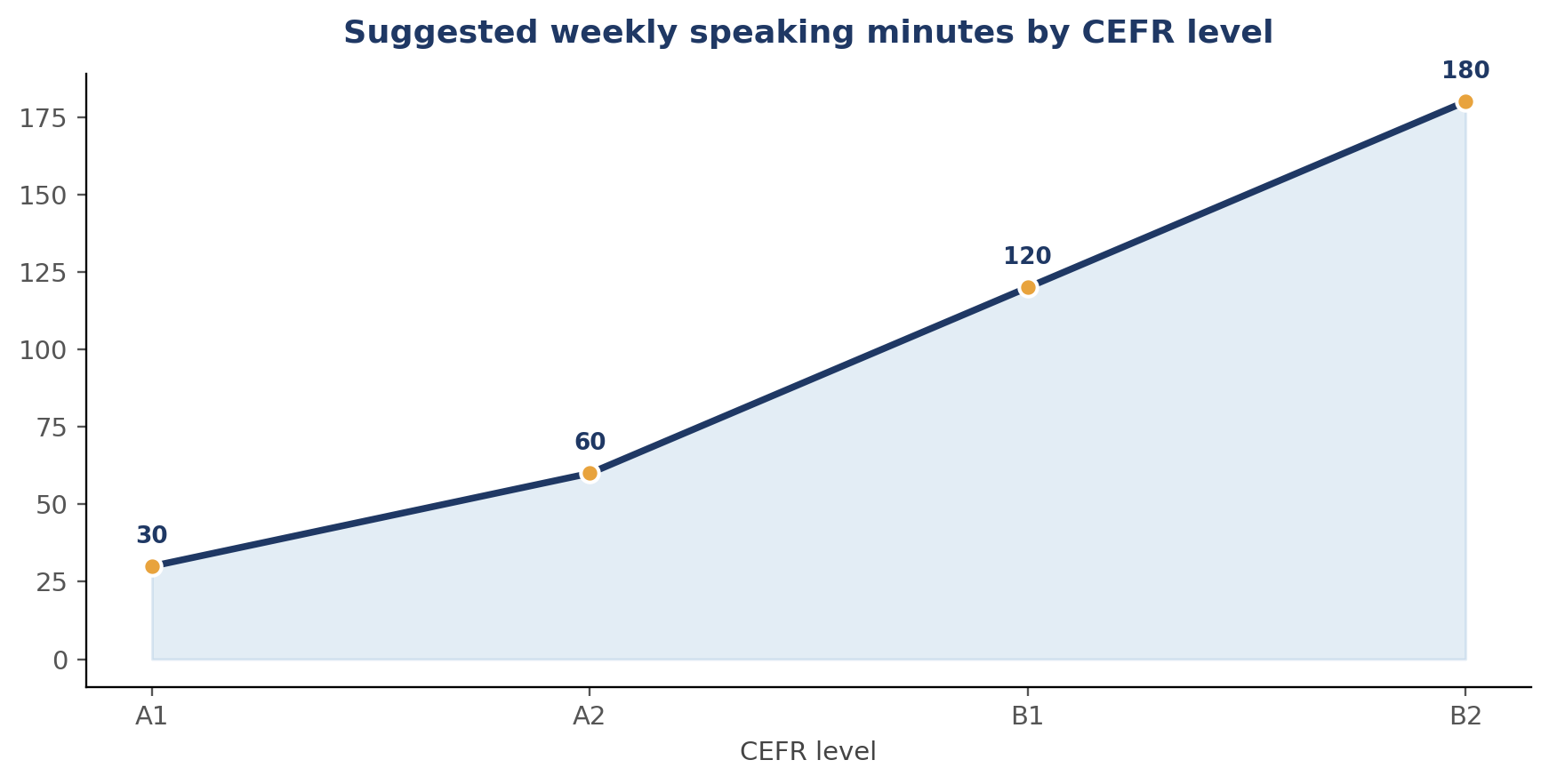
How Fast Does It Get Better?
The pattern predicts the outcome almost perfectly. Volume plus regular speaking practice beats willpower every single time.
Stop practising in a vacuum
A course pass at LanguageSkills.net gives you a personal AI voice tutor, speaking-heavy guided lessons and regular feedback — the exact rungs your ladder is missing.
Start speaking German this week →Create a free accountFrequently Asked Questions
Why can I understand German but not speak it? Because comprehension and production are separate skills with separate speed limits. You have built one and not the other. Start producing out loud, daily, even badly.
Is it normal to forget everything when a native speaks fast? Completely normal, and it fades. Familiarity with real speed is a trainable skill — shadowing audio clips at native pace is the fastest route.
How long until the fear goes away? For most learners, 4 to 8 weeks of regular speaking practice produces a real shift. The fear rarely vanishes entirely; it just stops deciding what you say.
Do I need to live in Germany to fix this? No. Twenty minutes of speaking practice twice a week beats six months of shyly overhearing strangers in a supermarket.
References & Further Reading
- Goethe-Institut, German language course levels and speaking descriptors — official A1 to B2 expectations (external exam body levels, not LanguageSkills.net course levels).
- Council of Europe, Common European Framework of Reference for Languages — spoken production and interaction scales.
- Deutsche Welle, Deutschtrainer and Nicos Weg — free audio and video for pronunciation shadowing (dw.com/deutschlernen).
- Duden, Die Grammatik — standard reference for register and spoken usage.
- Institut für Deutsche Sprache (ids-mannheim.de) — research on spoken German and colloquial patterns.