Your German is fine until you open your mouth. Then the dative hides, the verb runs to the end of the sentence without permission, and you produce a sentence you would never have written. Speaking is a physical skill, and nobody trains it by reading.
So let's train it — alone, out loud, starting today.
What you will get from this guide
- Five drills that build real speaking fluency with zero partners
- A pronunciation routine aimed at German's hardest sounds
- How to get free speaking practice with real people
- The recording habit that exposes what textbooks hide
Why Solo Practice Works — and Where It Stops
Speaking is motor memory. Your mouth needs repetitions the same way a pianist's fingers do. Solo drills give you volume, safety and zero embarrassment. What they cannot give you is surprise — the unscripted turn a real conversation takes.
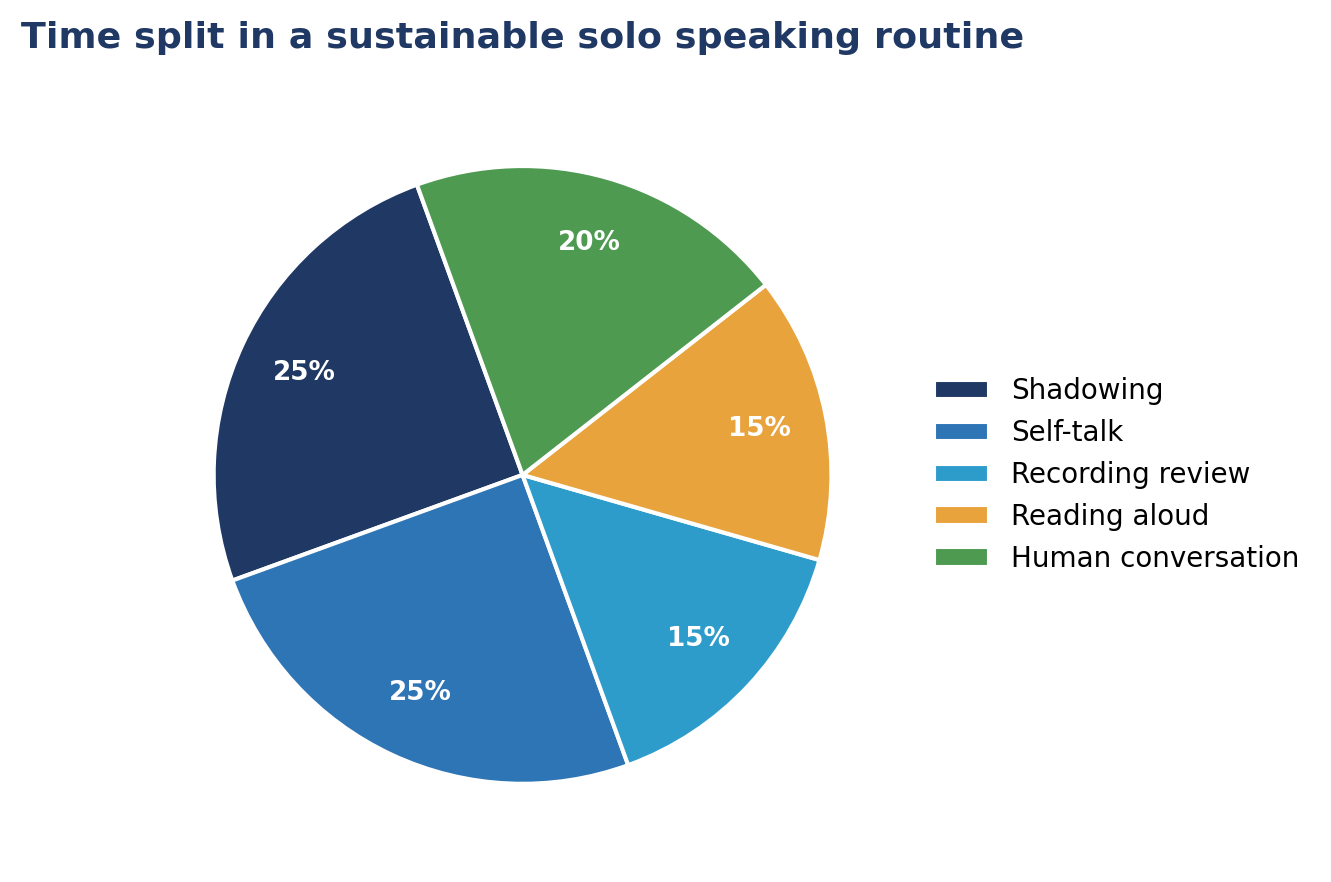
So use solo work for 70 per cent of your practice and human conversation for the other 30. That is the whole strategy.
Drill 1: Shadowing (the Highest-Return Five Minutes You Own)
Shadowing means playing native audio and speaking along with it, half a second behind, matching rhythm rather than worrying about meaning. Do it with a German podcast, a Deutsche Welle clip, or any interview you enjoy.
Do this daily for two weeks and your sentence rhythm changes before your vocabulary does. That is not a bug — rhythm is what makes you sound like a speaker rather than a translator.
Drill 2: Self-Talk With a Job
Narrate what you are doing. Verbally. Out loud. Ich koche jetzt Nudeln. Der Topf ist zu klein. Ich sollte einen größeren nehmen. Ugly, repetitive, enormously effective.
Give the monologue a job so it does not stall:
- Describe your commute in past tense for two minutes.
- Give an opinion on a news headline with a weil-clause reason.
- Explain your job to an imaginary colleague who has never heard of it.
- Complain, politely, about the weather, a delayed train, a loud neighbour.
Drill 3: The Record-and-Replay Loop
Most learners never hear themselves. Record sixty seconds on one topic, listen back, and mark three things: any verb that landed in the wrong position, any word you swallowed, and any sentence you abandoned halfway.
The Sounds Worth Obsessing Over
German pronunciation is regular. Four sounds repay focused work because they cause the most misunderstandings.
Ten minutes, four sounds, every other day. That is the entire pronunciation budget.
Some errors only a trained ear can catch
Recordings tell you something is off. An AI voice tutor tells you which muscle to move. That feedback loop is where fluency accelerates.
Take a speaking assessment →Create a free accountWhere to Find Real Humans (Free)
Solo practice has a ceiling. Break through it with these routes.
The Habit That Holds It All Together
Attach speaking to something you already do daily. Coffee brewing = shadowing. Walking to the station = self-talk. Kitchen clean-up = recording and reviewing. Three anchors, twenty minutes total, and you have built a speaking habit that survives a busy week — which is precisely when most learners quietly stop.
Turn daily monologues into real conversations
You have done the reps. Now point them at an AI voice tutor who will push back, correct and speed up — and watch comprehension follow.
Book a speaking session →Create a free accountFrequently Asked Questions
Can you really learn to speak German alone? You can build pronunciation, rhythm and sentence patterns alone — genuinely well. What you cannot build alone is spontaneity. Use solo drills for fluency mechanics, then test them with real speakers.
How long should I practise speaking each day? Fifteen to twenty focused minutes daily beats a two-hour weekend session. Consistency trains motor memory; bursts do not.
Is talking to yourself in German weird? It is the standard technique used by near every successful self-taught speaker. Do it while walking, cooking or commuting, and the weirdness disappears within a week.
What if I have no one to speak with? Start with shadowing and self-talk for four weeks, then add one free tandem exchange and one AI voice tutor session per week. A small amount of real interaction amplifies everything else.
References & Further Reading
- Goethe-Institut — Speaking skills and CEFR level guidance: https://www.goethe.de
- Deutsche Welle — Deutsch lernen, audio and video for shadowing: https://learngerman.dw.com
- Council of Europe — CEFR descriptors for spoken interaction: https://www.coe.int/en/web/common-european-framework-reference-languages
- Duden — Pronunciation and phonetic guidance: https://www.duden.de
- Forvo — Native German pronunciation recordings: https://forvo.com/languages/de/