You know the words. You have read them a hundred times. Then someone says bonjour and your throat locks. French speaking confidence is not a personality trait — it is a training loop, and you have been running the wrong one.
What you will get from this guide
- Why your passive French is huge and your active French is tiny
- The five-minute daily loop that closes the gap
- The correction style that builds confidence instead of destroying it
- A realistic weekly speaking budget, in minutes
The gap nobody warns you about
There are two vocabularies inside your head. One recognises. One produces. They are not the same size, and for most learners the first is roughly three times the second.
Reading and listening build the recognition pile. Speaking is the only thing that moves words into the production pile. So a learner who has spent two years reading can feel fluent and speak like a beginner — and then conclude, wrongly, that they lack talent.
You do not lack talent. You lack hours of output. Every minute you spend speaking physically rewires which words are reachable under pressure.
Why you freeze: the real mechanics
Freezing is not fear of French. It is fear of a specific thing: being seen making a mistake with liaisons, gender, or the subjonctif. French punishes small errors loudly — le instead of la is audible in a way that English mistakes are not.
Three villains, named honestly:
The fix for all three is the same: lower the stakes and raise the volume of attempts.
Find out exactly where your speaking breaks down
Guessing is expensive. A 30-minute speaking assessment with our AI voice tutor shows you the precise sounds, tenses and structures that stall you — and what to fix first.
Book your speaking assessment →Create a free accountThe five-minute loop
Confidence is a by-product of repetition, not of motivation. This loop works because it is short enough to survive a bad day.
The "note one gap" step is the one people skip and the one that compounds. Five gaps a week is 260 words a year, all of them words you personally needed.
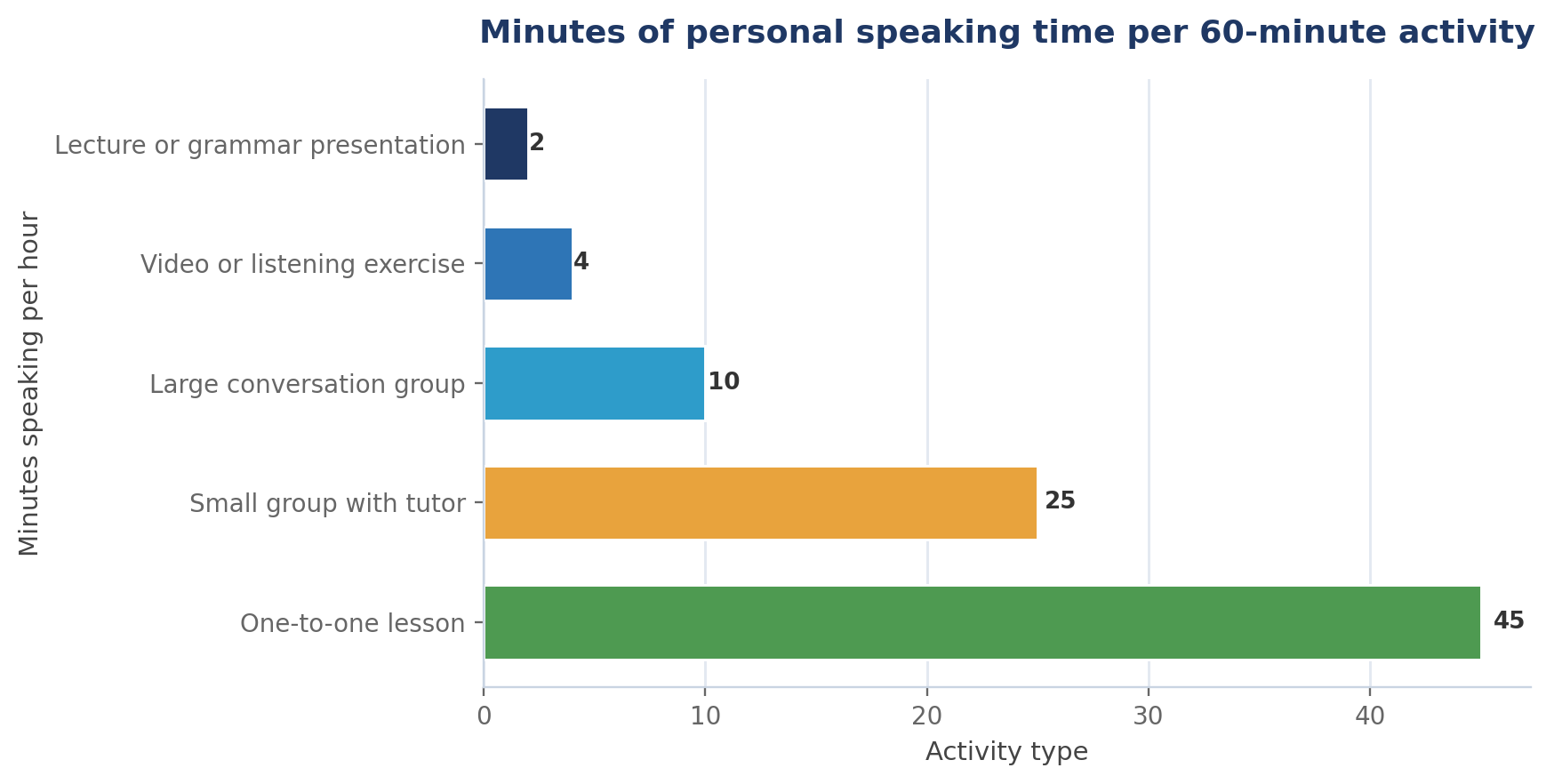
Where the minutes actually go
Classes differ enormously in how much you personally speak. That variation is what determines how fast your confidence grows.
Look at the top bar and the bottom bar. Same hour of your life — twenty times more output. For confidence specifically, output per hour is the only metric that matters.
Correction: the style that helps and the style that hurts
Correction is not the enemy. Badly timed correction is.
A good tutor lets you finish the sentence, joins the conversation, and then notes the mistake down for later. You feel fluent while speaking and accurate afterwards. That combination is what guided speaking practice buys you.
The three stages of speaking confidence
Confidence is not one thing. It arrives in layers, and knowing which layer you are on stops you from feeling stuck.
The jump from survival to conversational is the one that feels like a wall. It is not — it is a volume problem, and volume is bookable.
A weekly plan that actually fits
Total: roughly 90 minutes a week. That is under two hours. Nobody needs a sabbatical.
Frequently Asked Questions
How long does it take to feel confident speaking French? Most learners notice a real change after twenty to thirty hours of guided speaking practice, spread over a few months. Confidence tracks hours of actual speech, not total study time.
Is it bad to speak with mistakes? No. Mistakes are the raw material of progress. The learners who improve fastest are the ones willing to sound wrong in public for a few months.
Should I learn French pronunciation before speaking? Learn enough to be understood, then start speaking immediately. Waiting for a perfect accent is the most common reason people never begin.
Can I build confidence alone? Partly. Recording yourself and shadowing helps. But the specific skill of talking to another person under mild social pressure only develops with another person.
Talk, get corrected, repeat — that is the whole method
Our French course is self-paced and built around speaking time with a personal AI voice tutor. You will leave each session having said more French in one hour than you said all week.
Start speaking French →Create a free accountReferences & Further Reading
- Alliance Française, DELF/DALF and course information — the reference institution for French learners worldwide: alliancefr.org
- CEFR level descriptors, Council of Europe — what "spoken interaction" means at each level: coe.int
- Swain, M., Output hypothesis research on second-language production, widely cited in applied linguistics.
- France Éducation International, official DELF and DALF exam resources: france-education-international.fr
- TV5MONDE, Apprendre le français — free audio, video and exercises at every level: apprendre.tv5monde.com