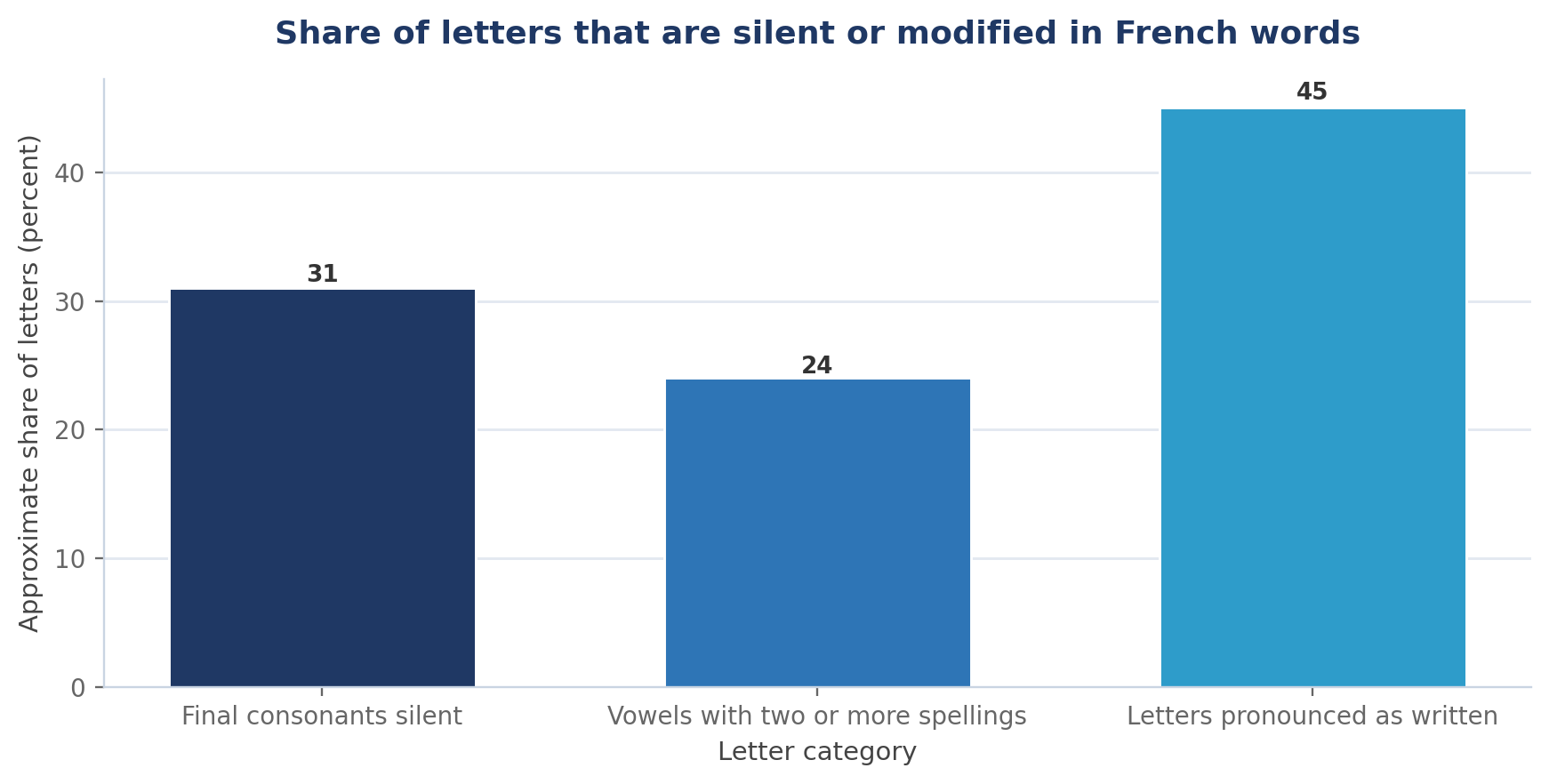
French spelling is not lying to you. It is following rules from the 1300s and refusing to renovate.
That is the whole mystery. English spelling drifted with the Great Vowel Shift; French spelling froze and kept its old furniture. Once you stop expecting letter-by-letter logic and start hearing sound groups, French becomes one of the most predictable languages in Europe.
What you will get from this guide
- The four nasal vowels, decoded with English anchors
- How to make the French R without shredding your throat
- The silent-letter rule that removes a third of your worries
- Liaison, élision, and the rhythm that makes you sound French
Rule One: Final Consonants Usually Go Silent
This is the master key. In French, a final consonant is normally not pronounced. Not whispered. Not softened. Silent.
But French loves an exception, and it has one: CaReFuL. The consonants C, R, F, L are often pronounced at the end of a word.
Remember the word CaReFuL and you have covered most of the exceptions in one stroke.
The Four Nasal Vowels
These are the sound French is famous for, and the sound beginners most often replace with an English n. The trick: do not close your mouth. The air goes through your nose while your mouth stays open. There is no separate n at the end.
That last row is honest news: in Parisian French, un and in have largely merged. Learners who fight to keep them separate are chasing a distinction many natives no longer make.
The French R
Forget the Spanish trill. Forget the English R. The French R is made at the back of the throat, soft and almost like a gentle gargle.
Say the English word "aha" — that little vibration where your throat closes? That is the region. Now push air through it while voicing. Keep it light. If your throat hurts, you are pressing too hard.
The Vowels English Does Not Have
French has clean, tense vowels that English rounds off into diphthongs. English "say" glides into say-ee. French é stays flat.
The /y/ sound is the one that separates tourists from learners. Practise tu versus tout until your mouth can tell them apart without thinking.
Liaison: When Words Hold Hands
French does not pause between words the way English does. It runs them together, and sometimes a silent letter wakes up to bridge the gap.
Rules of thumb: liaison is required after a pronoun and a verb (vous avez), after a short article or determiner (les, des, un), and before a vowel. It is forbidden after et, and after a singular noun (un chat et... — no bridging).
Élision: Dropping a Vowel for Beauty
When a short word ending in a vowel meets a word starting with a vowel, French drops the vowel and adds an apostrophe. This is not optional, and it is the reason you write l'ami and not le ami.
Rhythm: Stress the End, Not the Start
English stresses the first syllable of a word. French stresses the last syllable of a group. This one habit changes how French people hear you more than any individual vowel.
And the overall rhythm is far flatter. French rises gently at the end of a phrase and holds it there — which is why French sometimes sounds like it is asking a question when it is not.
Your Seven-Day Pronunciation Drill
Reading alone will not fix your accent, because you cannot hear what you cannot yet produce. Recording is the fastest mirror you own.
Your ear needs feedback, not just a video
Pronunciation is the one skill where feedback beats effort. With a personal AI voice tutor, you get speaking practice with instant feedback — it catches the /y/ you are flattening and the liaison you are missing, and helps you fix it as you go.
Start French speaking practice →Create a free accountThe Five Mistakes That Mark You as a Beginner
Pronouncing every final consonant. Vous is not vouss. Petit is not petitt.
Replacing nasals with n. Bonjour is not bon-jour with a hard n. It is bo(n)zhoor with the nasal on the inside.
Hitting the first syllable like a drum. Fight the English instinct. The beat lands at the end.
Skipping liaison because it looks wrong. Les amis said as lay ah-MEE sounds broken to French ears.
Making /y/ into /u/. Tu is not too. Round the lips, keep the tongue forward — that is the whole move.
Where to Hear Real French
Listen to France Inter or RFI's Journal en français facile, whose speakers slow down slightly and articulate clearly. The Institut français and the Alliance Française network also publish listening material graded by level, and DELF A1 listening samples give you exam-paced speech at the level you are actually working at. Hearing is the input; speaking is the output. Do not expect one to build the other on its own.
Sound French, not like someone reading French
Ten minutes of corrected speaking beats an hour of silent reading. Start a self-paced beginner course and let an AI voice tutor help you shape your accent before it hardens.
Start speaking French with an AI voice tutor →Create a free accountFrequently Asked Questions
Why are so many French letters silent? French spelling preserves older pronunciations that the spoken language dropped. Final consonants vanished from speech over centuries while the written form stayed frozen, so the gap widened.
Is the French R hard to learn? It is unfamiliar, not difficult. Most learners produce a convincing French R within a few weeks of daily practice at the back of the throat. Light and breathy beats loud and forced.
What is liaison in French pronunciation? Liaison is when a normally silent final consonant becomes pronounced before a word starting with a vowel: vous avez becomes voo-zah-VAY. Some liaisons are required, some optional, and a few are forbidden.
Can I learn French pronunciation from reading alone? No. French spelling hides the sound system, and you cannot self-correct what you have never heard correctly. Listening to native audio and recording yourself are essential from day one.
References & Further Reading
- France Éducation International — DELF A1/A2 listening samples and examiner materials: https://www.france-education-international.fr/en/diplome/delf-tout-public
- Alliance Française — French courses and pronunciation resources worldwide: https://www.fondation-alliancefr.org/
- Institut français — French language and culture programmes abroad: https://www.institutfrancais.com/en
- RFI — Journal en français facile, clear slow-news audio: https://www.rfi.fr/fr/podcasts/journal-en-fran%C3%A7ais-facile
- Council of Europe — CEFR descriptors for phonological control: https://www.coe.int/en/web/common-european-framework-reference-languages