You say beaucoup with a hard "p". You pronounce every letter of vous avez separately. A French waiter smiles politely and answers you in English. That is the whole problem in one moment: your grammar may be B1, but your mouth is still reading French like Spanish.
French spelling is a history book, not a sound map. The fix is not more vocabulary. It is retraining about eight specific habits.
What you will get from this guide
- The six french pronunciation mistakes that mark you as a learner, ranked
- Nasal vowels, silent endings and liaison explained with real example words
- A ten-minute daily drill you can run without a teacher
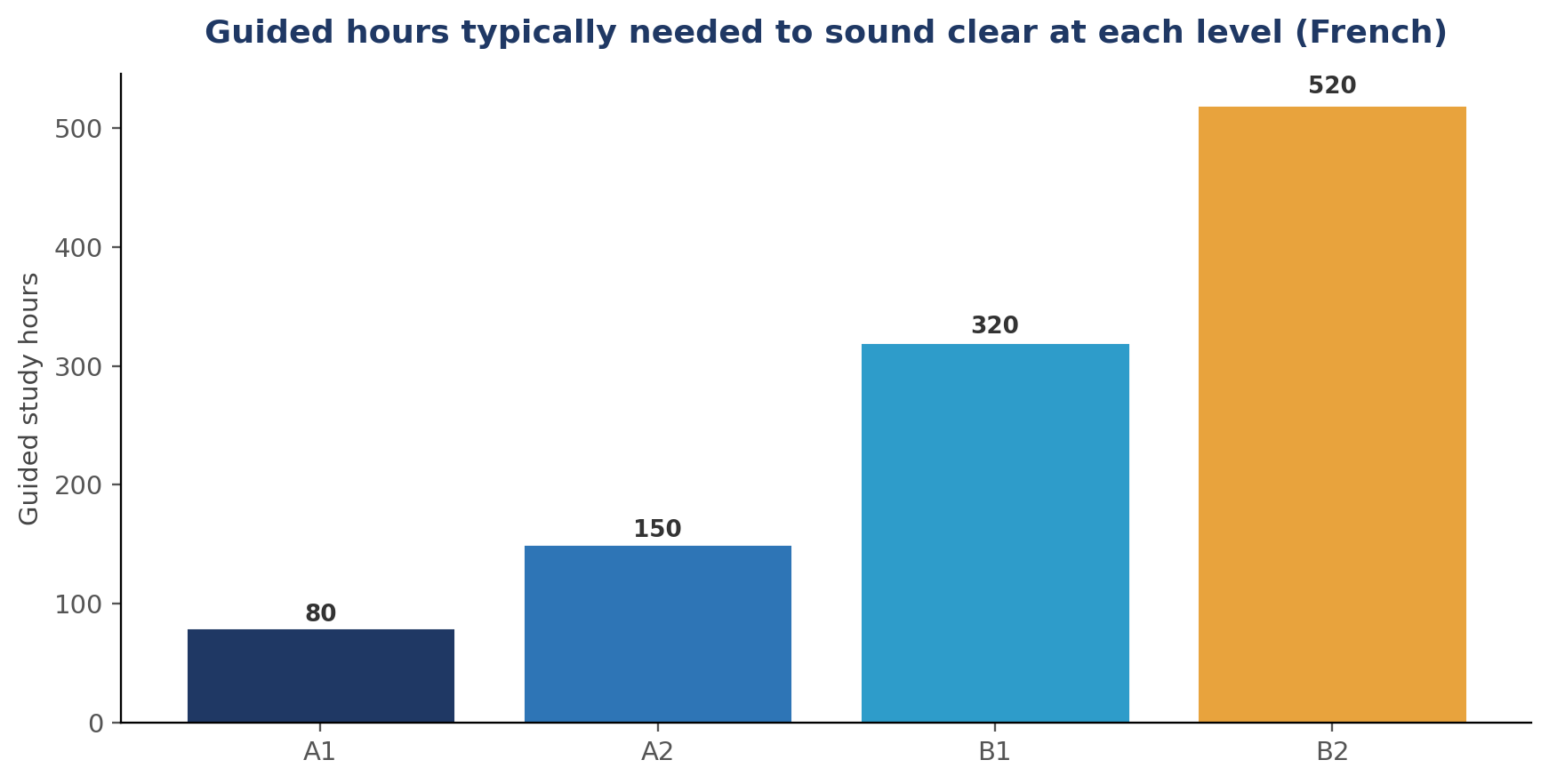
- Honest hour estimates for sounding clear at each CEFR level (A1 to B2)
The Six Mistakes That Give You Away
These are the errors a native ear catches within two sentences. Ranked by how much they hurt your intelligibility.
Get the first three right and people stop switching to English. That is the whole game.
Nasal Vowels: Four Sounds, One Nose
French has four nasal vowels and no English equivalent for any of them. Learners usually collapse all four into one. That is like saying "ship" for "sheep" four times in a row.
The classic test pair is beau versus bon, and vin versus vent versus vont. If those three blend into each other, drill them on their own before you ever use them in a sentence.
The Silent Ending Trap
Written French keeps letters that spoken French threw away centuries ago. You cannot reason your way out of this. You memorise it.
Here is the shape of the real work. Guided hours are the ones with a teacher or a structured course, not passive listening.
Get a real ear judging your French, this week
Recordings do not correct you. A personal AI voice tutor does. Start a speaking assessment and get instant feedback that names your three worst sounds and drills them with you.
Take the French speaking assessment →Create a free accountLiaison: The French Art of Gluing Words
Liaison is where a normally silent final consonant wakes up because the next word starts with a vowel. It is not decoration. Les‿amis and les amis with no liaison sound like two different levels of French.
The trap is enchaînement, which is different: a pronounced consonant simply slides into the next vowel with no change. Une‿amie keeps its real /n/ sound. Un‿ami turns that silent n into /n/. Same music, different mechanism.
The Ten-Minute Drill That Works
Fancy apps will not fix a motor habit. Repetition with feedback will.
Do this five days a week for a month and the nasal vowels stop scaring you. For free native audio, TV5Monde's learning section and RFI's Journal en français facile are both excellent, and both are built around natural speed.
How Long Until It Sounds Right?
If you are aiming at the DELF B1 oral, examiners are listening for clear sounds and decent rhythm, not a Parisian accent. Compare exam formats and level descriptors on the France Éducation International DELF page, and check your starting level with a quick placement test.
Stop rehearsing alone. Start being corrected.
A personal AI voice tutor hears the mistake you cannot hear yourself. Self-paced French courses give you speaking practice with AI feedback and a plan that targets your accent instead of wasting hours on things you already know.
Start a French course →Create a free accountFrequently Asked Questions
Can I fix my accent as an adult? Yes. You may keep a trace of your first language, but nasals, silent endings and liaisons are learnable at any age with deliberate practice and feedback.
Do I need to learn phonetic symbols like /ɑ̃/ and /ɔ̃/? No. They are a shortcut, not a requirement. Listening to minimal pairs and imitating a native recording works just as well.
Is French pronunciation harder than Spanish or Italian? For English speakers, yes. Spanish and Italian mostly read as written. French has silent letters, nasals and liaison, so it takes more correction cycles.
Should I learn one accent, like Parisian French? Pick one model voice and copy it. Mixing Quebec, Belgian and Parisian features in the same sentence confuses listeners more than any single accent would.
References & Further Reading
- France Éducation International, official DELF and DALF diploma information: https://www.france-education-international.fr/diplome/delf-tout-public
- TV5Monde, Apprendre le français exercises and native audio: https://apprendre.tv5monde.com
- Institut français, French language and culture network worldwide: https://www.institut-francais.fr
- Le Robert online dictionary with audio pronunciations: https://www.lerobert.com
- Académie française, language usage and spelling notes: https://www.academie-francaise.fr