Here is the uncomfortable truth about your french accent: it is almost never the r. Listen to a fluent foreigner and you will hear the real tell — flat rhythm, swallowed vowels, and a missing liaison. French is a language of music, and most learners are still reading notes instead of playing them.
What you will get from this guide
- The four features that actually mark you as non-native
- Nasal vowels decoded with mouth positions
- Liaison and enchaînement, minus the academic fog
- A daily 15-minute shadowing routine that works
The Four Tells That Give You Away
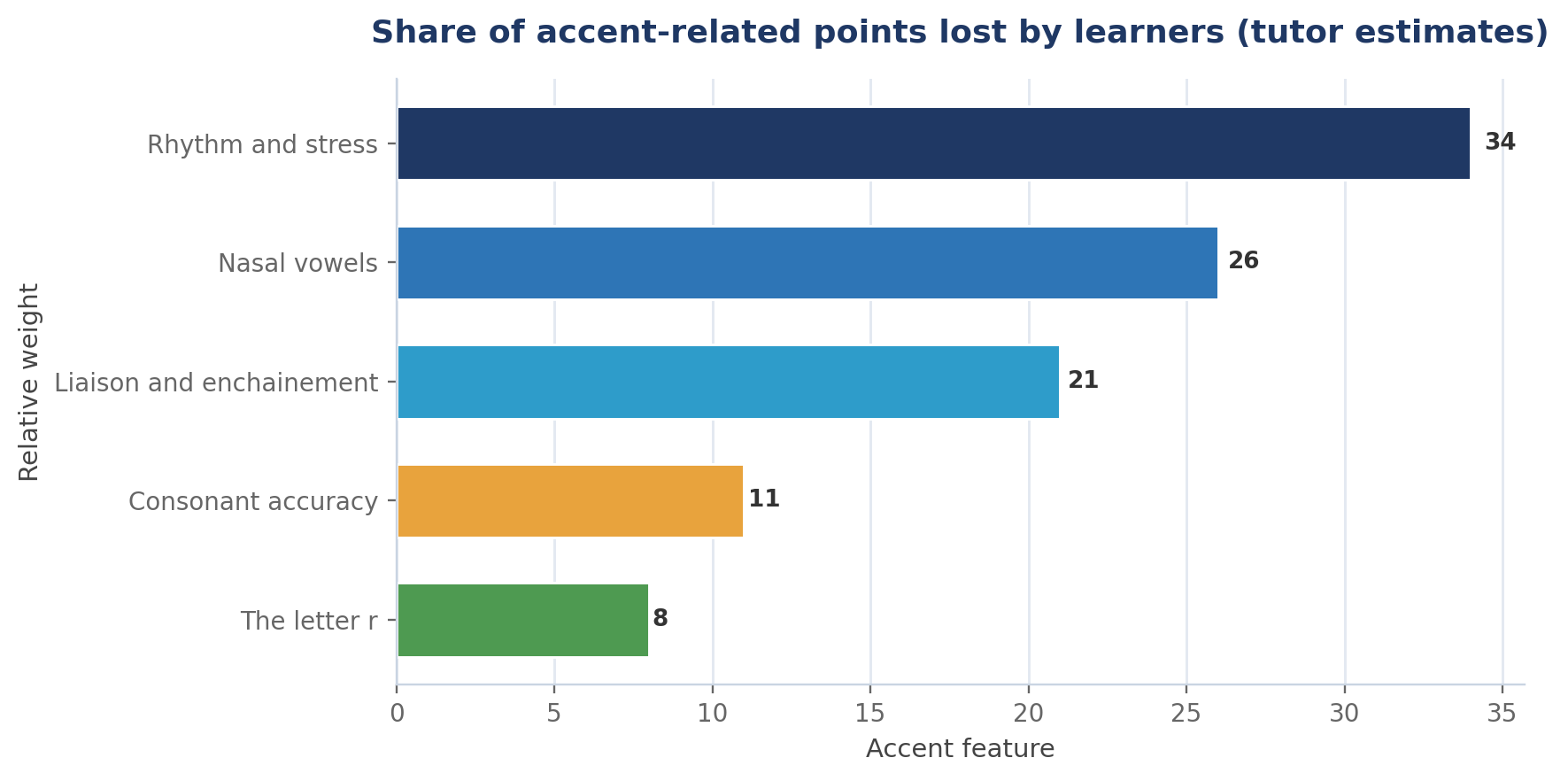
Your accent is a fingerprint. Examiners and native speakers hear four things, in this order.
Notice the ranking. Learners obsess over the r and ignore rhythm, which is the single loudest signal in French. Fix the music first.
Rhythm: French Has No Stress, It Has a Beat
English bounces. French glides. In French, stress lands on the last syllable of a rhythmic group, not on individual words. un petit café is not four equal words — it is one pulse ending on -é.
Accent groups typically run two to seven syllables. Everything inside flows at a constant speed, like beads on a wire.
Try this tonight: read a paragraph aloud while tapping the table on the last syllable of each group. It feels absurd. It also rewires your ear in about a week.
Nasal Vowels: Four Sounds, One Mouth Shape
French has four nasal vowels: an/en, in/ain, on, un. English has none, which is why they collapse into one mush.
The trick: air goes through the nose, but the tongue never touches the roof of the mouth. No n sound is pronounced at the end. bon is not "bonn" — it is a vowel with a nasal hum.
Hold your nose while saying them. If the sound stops entirely, you were blocking the airflow. If it buzzes, you are doing it right.
Liaison and Enchaînement: The Glue of Spoken French
Two different tricks, constantly confused.
Liaison means a normally silent final consonant wakes up before a vowel: les amis → lay-z-ami, vous avez → voo-z-avay. It is obligatory in fixed phrases, forbidden in others, and optional in the middle.
Enchaînement means a pronounced consonant slides onto the next vowel, whether or not the word allows liaison: une amie → ü-nami.
Over-liaising sounds as foreign as under-liaising. Learn the obligatory list first, and let the rest arrive with listening hours.
Want to hear exactly what you are missing?
Record two minutes of French and our AI voice tutor will map your accent feature by feature — rhythm, vowels, liaisons. Then you drill what matters at your own pace.
Get your French speaking assessment →Create a free accountThe Silent Letters You Are Still Pronouncing
French spelling is archaeology. Half the letters are ruins.
Final consonants are silent unless a vowel follows. That single rule cleans up dozens of words overnight.
The 15-Minute Shadowing Routine
Shadowing means speaking along with a native recording, half a beat behind, copying melody rather than words. It is the fastest accent work there is, and it costs nothing.
Use real speech: France Inter news, InnerFrench, radio interviews. Textbooks speak a French that no one on the street speaks.
Practise daily for a month and the difference is not subtle. Your ear sharpens before your mouth does — that is normal, and it is the sign that it is working.
What Your Level Actually Requires
Not every stage of learning demands the same accent work. Focus where the return is highest.
The DELF-DALF speaking criteria reward clarity and coherence far more than a perfect accent. Even at B2, examiners are not hunting for a Parisian twang — they are checking whether listening to you is easy.
Accent is trainable.
Nothing fixes pronunciation faster than immediate feedback on your speaking. Our self-paced French course uses an AI voice tutor that corrects rhythm, vowels and liaison as you practise, any time.
Start your French course →Create a free accountFrequently Asked Questions
Can an adult still lose a foreign accent? You can get remarkably close. Adults rarely erase every trace, but rhythm, vowels and liaisons are all trainable — and those three carry most of the "sounds native" effect.
Is the French r really not important? It matters, but less than rhythm and nasals. A clear, well-paced sentence with a slightly English r sounds far more native than perfect r with flat stress.
How long does accent work take? Most learners hear clear progress in four to six weeks of daily 15-minute shadowing. Full comfort in spontaneous speech takes months, not days.
Should I learn IPA? A little goes a long way. Knowing the four nasal symbols unlocks every dictionary and textbook pronunciation guide. You do not need the full chart.
References & Further Reading
- Institut français — French courses and DELF/DALF certification: https://www.institut-francais.fr/
- France Éducation international — DELF and DALF official exam information: https://www.france-education-international.fr/en/delf-dalf
- Radio France — France Inter live and podcast audio for shadowing: https://www.radiofrance.fr/franceinter
- Académie française — language notes and usage guidance: https://www.academie-francaise.fr/
- LanguageSkills.net — French self-paced AI voice tutor for pronunciation and speaking practice: https://languageskills.net/french