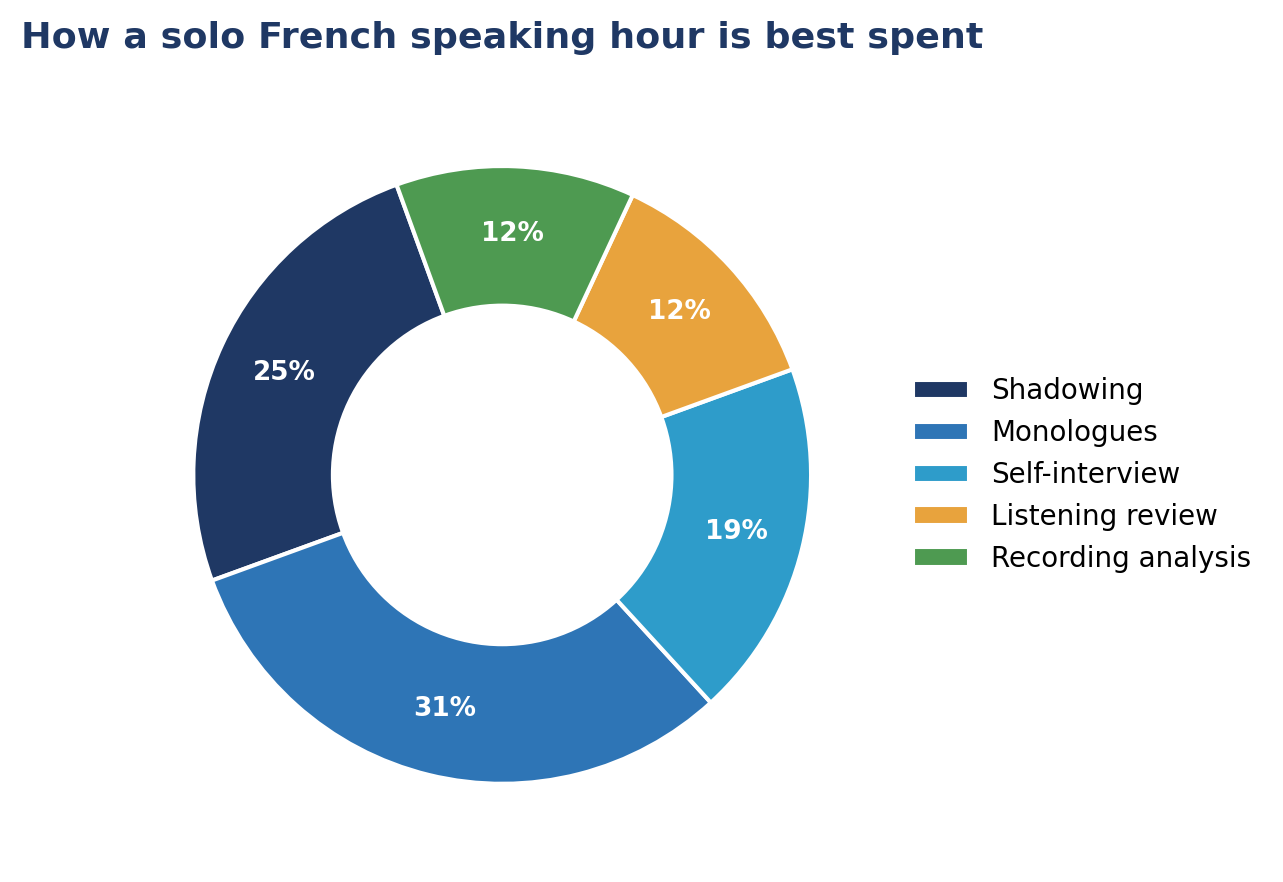
Nobody is coming to speak French with you. Not tonight, not tomorrow morning, not during the twenty free minutes between meetings.
So you have two options: wait for a partner who never appears, or learn to practise alone without lying to yourself. The second one works. Here is how to practise speaking French when the only person in the room is you.
What you will get from this guide
- Four solo drills that produce real speaking gains
- A weekly schedule with time boxes
- How to test yourself honestly, and when solo practice stops being enough
Why Solo Practice Usually Fails
Most people's solo practice is reading French silently while moving their lips. That is not speaking — it is reading with extra steps.
Speaking has four demands at once: retrieving words, assembling grammar, controlling pronunciation, and managing timing. Reading aloud hits one of the four. The drills below hit all of them.
Drill 1: Shadowing
Shadowing means playing a short audio clip and speaking along with it, half a second behind, copying rhythm and melody — not just sounds.
French is a rhythm language. The beat lands on the final syllable of a group, and everything else compresses. Shadowing teaches your mouth to compress — something no grammar table can do.
Drill 2: The One-Minute Monologue
Pick a prompt. Speak for sixty seconds without stopping, badly if necessary.
Record it. Then listen and write down every place you paused for more than two seconds. Those pauses are your actual syllabus — they show you exactly which words and structures you cannot yet retrieve under pressure.
Drill 3: Self-Interview
Sit with a list of twelve questions and answer each one out loud, in full sentences, no notes.
This is the drill that exposes grammar gaps fast. The moment you cannot say it out loud is the moment you know what to study next.
Drill 4: Speak to Something That Answers
Modern tools changed solo practice permanently. Speech-capable chatbots will hold a slow French conversation with you at 2 a.m. Use them deliberately: set the topic in advance, forbid English, and ask for corrections after every five exchanges. They are patient, tireless, and — crucially — they never let you finish a sentence in silence.
What they cannot do is judge you against a CEFR standard. That is what a human examiner is for.
Find out what your French actually sounds like.
Solo drills build fluency but not calibration. A personal AI voice tutor gives you structured speaking practice with instant feedback and shows which gaps to work on next. Start your French course →
Start the French course →Create a free accountThe Weekly Plan
Solo practice works when it is boring and scheduled.
The Friday slot is the one people skip and the one that matters. Listening to your own old recording is the only honest progress meter you own.
Pronunciation Fixes Worth Ten Minutes Each
Record yourself saying tu and tout, then bon and banc. If they sound identical to your own ear, they sound identical to a listener's — and that is a fixable, ten-minute problem.
When Solo Practice Is Not Enough
Solo practice has a ceiling. It polishes fluency but cannot correct an error you do not know you are making. You can say the wrong thing beautifully for six months.
The last row is the real signal. Prepared French is solo French. Reactive French needs another person in the room.
Ten minutes of guided feedback beats a month of guessing.
A personal AI voice tutor catches what recordings cannot reveal — the patterns you repeat and never notice. Get structured speaking practice with instant feedback. Start speaking French properly →
Start the French course →Create a free accountFrequently Asked Questions
Can you really learn to speak French alone? You can build fluency, rhythm, and vocabulary alone. You cannot reliably catch your own errors, so plan for some human feedback — even occasionally.
How long should I practise speaking French daily? Twenty focused minutes daily beats two hours on Sunday. Consistency is what moves speech from effortful to automatic.
Is talking to myself in French useful? Yes, if it is out loud and full sentences. Silent inner French does not train pronunciation or timing, which are muscular skills.
What is the single best solo drill? Shadowing. It is the only drill that trains rhythm, liaison, and listening at the same time, and it costs nothing but a short audio clip.
References & Further Reading
- Institut français — French courses and speaking practice: https://www.institutfrancais.com/en
- TV5MONDE Apprendre le français — free audio and video exercises by level: https://apprendre.tv5monde.com/en
- France Éducation International — DELF/DALF speaking format and criteria: https://www.france-education-international.fr/en
- Common European Framework of Reference for Languages — spoken production descriptors, Council of Europe: https://www.coe.int/en/web/common-european-framework-reference-languages
- LanguageSkills.net French courses (A1–B2) with a personal AI voice tutor: https://languageskills.net/french