You can order a coffee, write an email, pass the grammar quiz. Then a Parisian says one short word and you understand nothing — because your ear and your mouth never learned the sounds.
French pronunciation is not harder than English pronunciation. It is simply different, and it follows rules with very few exceptions. Here is the full toolkit to fix it, from the two vowels that betray most learners to the rhythm that makes you sound French in five seconds.
What you will get from this guide
- The handful of sounds English speakers never produce
- Why your final consonants keep disappearing — and where they survive
- Liaison explained in three simple categories
- A weekly plan that moves the change from your head to your mouth
The Real Obstacles, Ranked
Most of a French accent comes from four places, not four hundred.
Fix those four and listeners stop translating you. Ignore them and every other improvement hides behind them.
Vowel Sounds English Does Not Have
English has roughly twelve vowel sounds. French has more, and several sit in places your mouth has never visited.
The famous pair: tu versus tout. Same English instinct, two completely different French words. Say "tea" and then round your lips without moving your tongue: that is tu. Now purse your lips fully and say "too": that is tout.
Drill these five pairs out loud, ten times each, before you touch a full sentence. Ten seconds a pair, and your mouth learns a distinction English never gave it.
Nasal Vowels: Do Not Close the Door
A nasal vowel happens when air escapes through your nose and the final n or m is not pronounced as a consonant. English speakers always add the "n". That is the entire error.
Test yourself: put a finger lightly under your nose and say bon. You should feel vibration, and your tongue should never touch the roof of your mouth at the end.
The French R: Soft, Not Dramatic
The French R is made at the back of the throat, like a gentle gargle with no water. It is not rolled, not Scottish, not Spanish. English speakers usually push it too far back and press too hard.
Two drills that work fast. First, say the word Paris slowly — the R is barely a flicker. Second, put a pencil horizontally between your teeth and say rue, rat, merci, encore. The pencil stops your tongue from taking over and forces the sound into the throat.
Silent Letters and the CaReFuL Rule
Final consonants in French are usually silent. Petit, grand, trois, vous, temps — the last letter vanishes.
Then four consonants resist: C, R, F, L. Remember them as CaReFuL. Words ending in these sounds keep them: avec, cœur, neuf, sel.
The final silent e is a gift: adding it wakes up the consonant. Petit has a silent t. Petite rings it out clearly.
You cannot hear your own accent. That is the whole problem.
Every learner believes they are saying tu. A twenty-minute diagnostic with your AI voice tutor tells you which sounds are actually landing, then drills the two or three that matter for you. No guessing, no wasted months.
Get your French speaking assessed →Create a free accountLiaison: Three Kinds, One Goal
Liaison is when a normally silent final consonant wakes up and joins the next word's vowel: les amis becomes "lay-zah-mee".
Do not memorise lists of mandatory liaisons. Learn the blocks: pronouns plus verbs, articles plus nouns, and the tiny words un, les, des, dans, chez, très. Everything else follows your ear.
Rhythm: The Secret Ingredient
This is the part nobody teaches in textbooks, and it changes your accent more than any single vowel.
French stress falls on the last syllable of a rhythmic group, not on the first syllable of a word. English hammers the front: COMfortable. French glides to the end: con-for-TA-ble.
Practise by reading a sentence aloud and marking only the phrase-final syllables: je voudrais un café› s'il vous plaît›. Two lifts, not eight. That instant lightness is what makes learners sound suddenly French.
A Six-Week Practice Loop
Shadowing means playing a short audio clip and speaking along a half-second behind. Free resources: TV5MONDE's Apprendre le français and RFI's Journal en français facile. Both are graded, both are authentic, both are free.
For exams, the DELF and DALF speaking papers reward intelligibility and confidence, not perfection. If a French listener understands you first time, you are already at the level that counts.
Six weeks, one accent, real conversation.
Guided self-paced lessons turn a pronunciation plan into a habit, with an AI voice tutor that models each sound, hears yours, and refuses to let tu slide into tout ever again.
Start your French course →Create a free accountFrequently Asked Questions
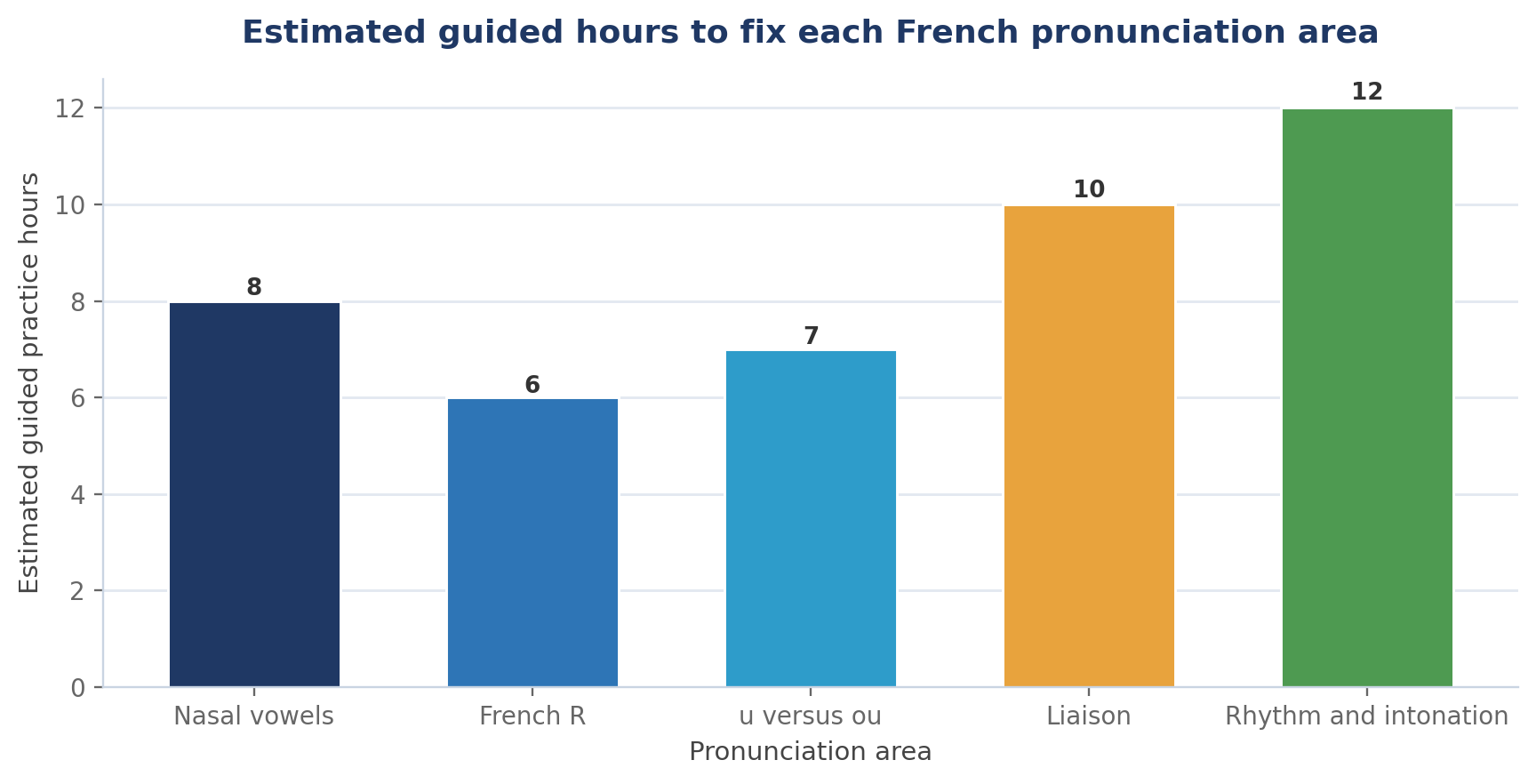
How long does it take to improve French pronunciation? Individual sounds often click within a few sessions. Making them automatic in fast speech takes about six to twelve weeks of regular speaking — see the estimate chart above, which is a planning figure rather than a study result.
Should I learn the International Phonetic Alphabet? It helps, but only after you can hear the difference. Start with minimal pairs and recordings; add IPA symbols once your ear knows what it is looking at.
Why can I not hear my own mistakes? Because you compare what you said to what you meant. Record yourself, then compare your recording with a native model audio. The gap appears immediately — and hearing it is half the fix.
Is a Parisian accent the only correct one? No. Québécois, Belgian, Swiss and African French are all standard French with their own rhythms. Aim for consistency and intelligibility, not a particular postcode.
References & Further Reading
- Institut français — cultural and language programmes, including pronunciation workshops.
- Alliance Française — global network with conversation classes and pronunciation coaching.
- TV5MONDE — Apprendre le français — free graded exercises with native audio.
- France Éducation International — DELF/DALF — official exam formats and speaking criteria.
- Council of Europe — CEFR — descriptors for spoken production and interaction.