Six hours on Sunday. Nothing until next Sunday. Repeat for three months. Result: you can still barely order a coffee.
Language learning is not a bank where you deposit hours. It is a garden. Water it daily or watch it die. A German study routine works the same way — small, frequent, boringly consistent beats heroic and rare.
What you will get from this guide
- A full daily routine with timings
- A 20-minute emergency version for terrible days
- Weekly and monthly review structure
- What to cut when life gets loud
The Rule That Beats Every Hack
Frequency beats duration. Two 25-minute sessions on consecutive days outperform one 60-minute marathon, because memory consolidates between sessions, not during them. German verbs you met yesterday are still warm today. German verbs you met last Sunday are strangers.
So the design principle is simple: every day, something. Minimum barrier, maximum repetition.
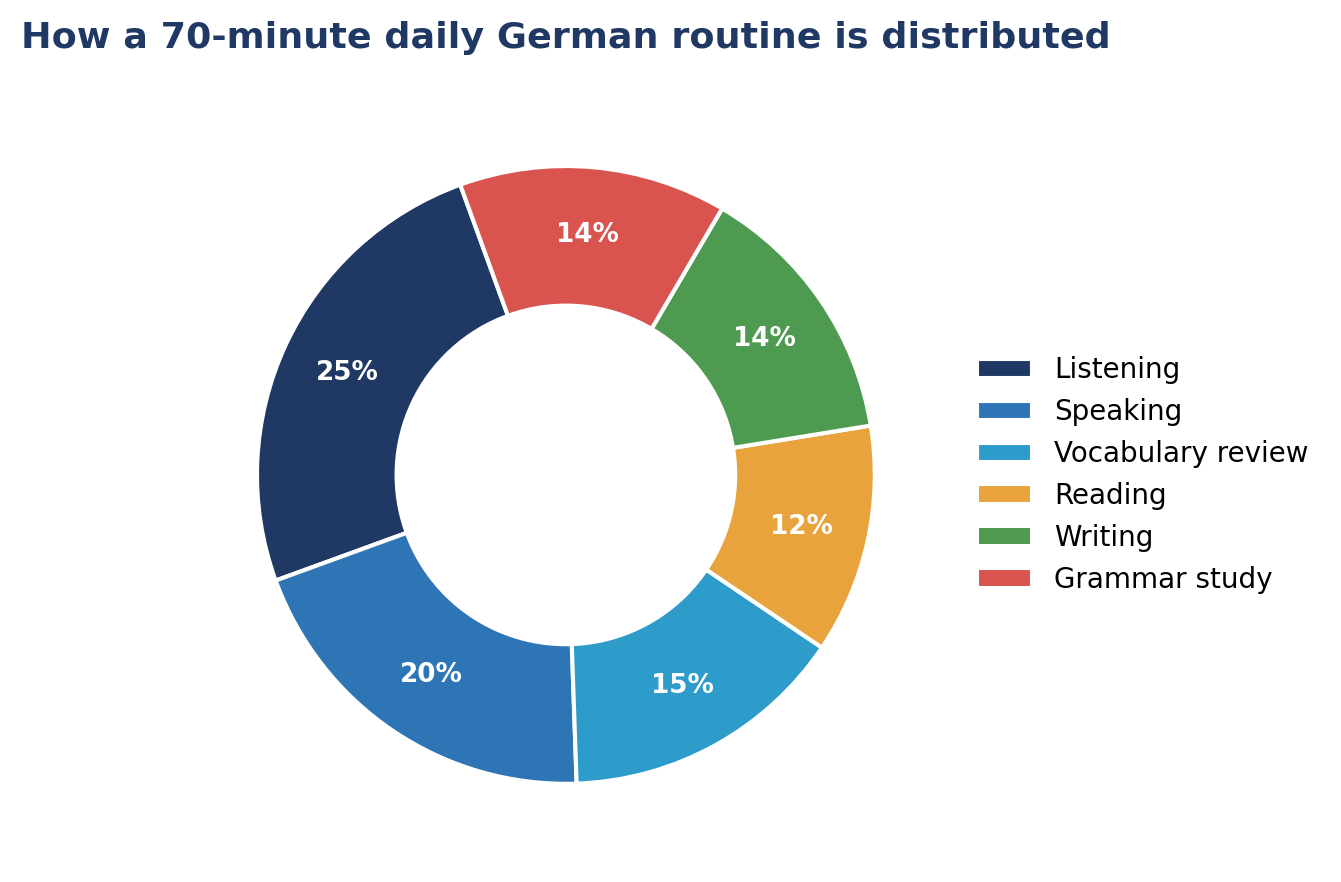
The Full Daily Routine
This is a 70-minute version for a motivated learner. Adapt it — do not worship it.
Two blocks matter more than all the rest: morning review and evening speaking. Review locks memory. Speaking locks nerve.
The 20-Minute Emergency Routine
Bad day? Work screamed, kids screamed, you are running on fumes. Do this instead of nothing.
Nothing was skipped, only shortened. Listening, speaking and vocabulary all got a touch. A streak of 20-minute days beats a perfectionist collapse every single time.
Why Speaking Goes Last (and Never Gets Skipped)
Everybody skips speaking. It is uncomfortable and there is nobody watching. That is exactly why it matters.
Six minutes alone in a room, narrating your day, activates the production circuits that reading never touches. Ich habe heute... three sentences, out loud, no script. You will feel ridiculous for a week. Then you will notice that words arrive faster when you actually talk to a person.
Once a week, replace solo speaking with a real conversation — a language partner. Solo reps build the muscle. A real partner shows you where it is weak. That is the moment a structured German course earns its keep.
The Weekly Layer
Daily reps handle memory. The weekly layer handles structure and diagnosis.
Sunday off is not laziness. It is consolidation. Brains file things when you stop shoving.
The Monthly Reality Check
Every four weeks, measure. Not your feelings — your output.
If the numbers stall for two months running, the routine is wrong — not you. Usually the culprit is that you stopped speaking to humans, or stopped increasing difficulty.
Fitting German Into a Real Life
You have a job. You have a family. You have a phone that wants your attention. German has to squeeze in.
Anchor German to something that already happens every day — the coffee, the commute, the walk. Habits stick to existing rails. A new habit floating in empty space dies by Thursday.
Structure beats willpower
A routine gets you reps. A structured course gives it a spine. A self-paced AI voice tutor keeps your streak honest and catches the mistakes your flashcards never will.
Start your German course →Create a free accountThe Mistakes That Kill Routines
These are the ones that end German learning for real people, every day.
Perfectionism is the deadliest. Learners who "restart properly on Monday" restart forever. Learners who do the 20-minute version on a terrible Tuesday keep going.
Frequently Asked Questions
How much time a day do I need for German? Twenty minutes daily keeps you moving. Sixty to ninety minutes daily is where visible progress happens. Consistency matters more than the total.
Is studying German every day too much? No, if sessions are short and include rest. Burnout comes from long, joyless sessions, not from daily contact.
What is the best time of day to study German? Whatever time you can protect daily. Morning suits memorisation; evening suits speaking practice. The best slot is the one you never miss.
Should I study grammar every day? No. Two or three focused grammar sessions a week is plenty. Spend the rest on input and speaking.
References & Further Reading
- Council of Europe — CEFR level descriptors and hours: https://www.coe.int/en/web/common-european-framework-reference-languages
- Goethe-Institut — learning tips and course structures: https://www.goethe.de/en/spr/kup.html
- Deutsche Welle — free graded German learning: https://learngerman.dw.com/
- Duden — German grammar and spelling reference: https://www.duden.de/
- Goethe-Institut — German exams overview: https://www.goethe.de/en/spr/kup/prf.html
Your routine is one course away from working
Twenty minutes a day builds the habit. One conversation a week builds the language. Start a self-paced course and let your routine finally pay off out loud.
Start your German course →Create a free account