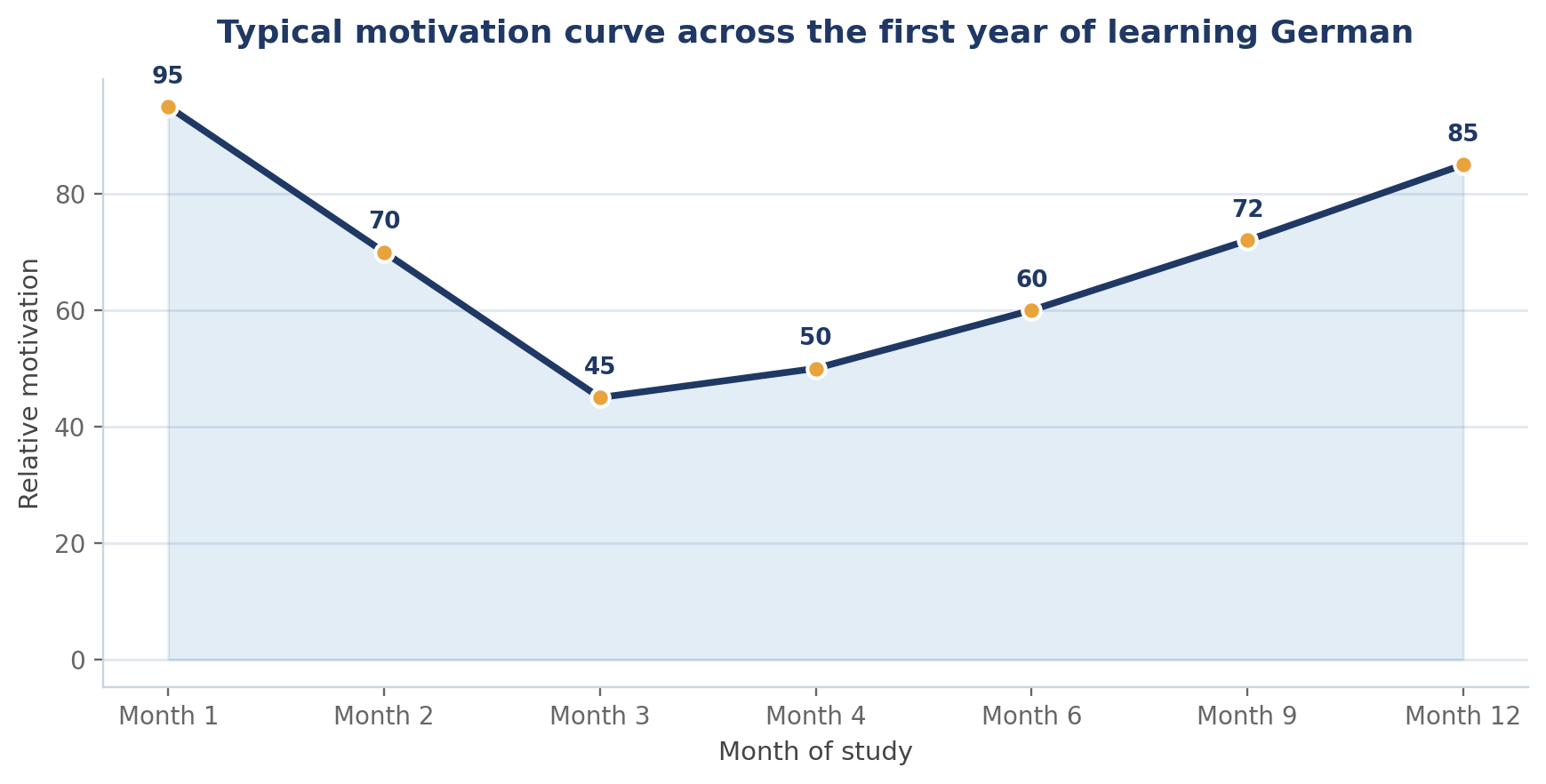
Week three is where German learners go to die.
Not week one, when everything is shiny and Guten Tag feels like a superpower. Not week ten, when you are finally reading signs at the train station. Week three. The novelty has evaporated, the grammar has arrived, and you have just discovered that every noun in this language carries a gender, an article and possibly a grudge.
Every guide on how to stay motivated learning german tells you the same hollow thing: be consistent, set goals, celebrate progress. Thank you. Inspiring. Useless when you are staring at der, die, das at 22:40 with a headache.
So here is the real version. Motivation is not a mood you wait for. It is a system you build, and then you protect that system on the days your feelings file a complaint.
What this guide gives you
- The real reason motivation dies around week three, and the fix that costs nothing
- A study-routine template built for 20-minute and 60-minute days
- How to survive the B1 plateau, the listening wall and the Der Die Das swamp
- A chart of the emotional curve, so you stop mistaking normal for failing
Motivation Is a Terrible Fuel
Imagine trying to run a car on enthusiasm. It burns hot, it burns fast, and it leaves you stranded on the motorway.
Motivation is a starting fuel, not a running one. The learners who reach B1 are rarely the most passionate people in the room. They are the ones who arranged their lives so that German happens whether or not they feel like it. A class at 19:00 on Tuesdays. A podcast on the commute. Flashcards while the kettle boils.
Here is the emotional curve of almost every successful learner:
See that dip at month three? That is not a personal failing. That is the standard shape of the journey. Knowing it is coming is half the defence, because a dip you expect is a dip you can plan around.
The Four Enemies, Named Properly
Motivation does not just evaporate. Something eats it. Usually one of these four.
Deal with all four and motivation stops being a daily struggle. Deal with none and you will blame yourself for a systems problem.
Fix One: Make Progress Visible
Your brain is a terrible judge of your own improvement, because it compares today to yesterday, and yesterday's gains were tiny.
Try this on Sunday: speak for one minute about your week. Save it. Do it again in four weeks. That single habit has rescued more learners than any productivity app.
Progress you can actually hear
It is hard to believe you are improving when the only voice in the room is your own. With a personal AI voice tutor, you get instant feedback on your speaking and clear guidance on what to fix next, at your own pace.
Start learning German →Create a free accountFix Two: Tame the Grammar Swamp
German grammar is not infinite. It is just front-loaded, which is unfair and undeniably true.
The trick is to stop treating all of this as one mountain. You climb one ridge at a time. One case per fortnight. One rule per week, applied in ten real sentences you write yourself.
Fix Three: Break the Listening Wall
The wall is real and it is not about vocabulary. It is about speed, reduction and the way Germans swallow the ends of words.
Two rules. First, listen to something you mostly understand, not something that flattens you. Second, re-listen. Comprehension on the second pass is where the learning lives.
Fix Four: Kill the Loneliness
You cannot motivate yourself into a social skill. Speaking is a social act, and it needs a partner. This is the single most common gap in self-study routines.
The cheapest option is not the fastest. Free tandem partners cancel. A scheduled weekly speaking slot is, oddly, the most reliable social structure you can build.
The Plateau Nobody Warns You About
Around B1, something cruel happens: you stop noticing progress while still doing the work.
At B1 you can already say most of what you need. Your brain stops flagging every small improvement because the survival pressure has eased. That is success wearing a disguise.
Two things break the plateau: reading a full book in German, and speaking weekly with someone who corrects you. Both are uncomfortable. That is precisely why they work.
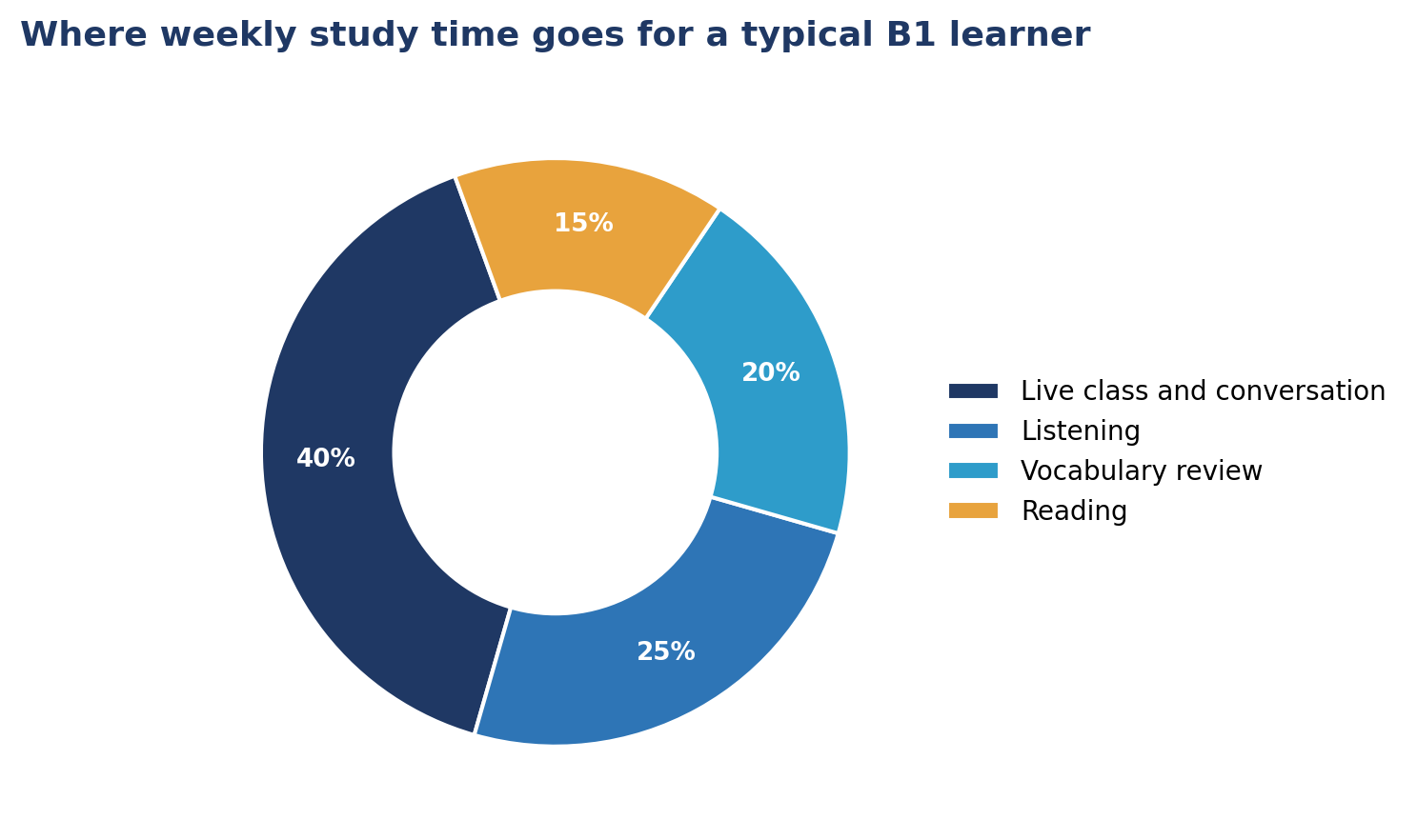
Notice reading gets the smallest slice. It is usually the fastest fix available, because a novel gives you thousands of repetitions in context while being genuinely enjoyable.
Build Your Own Motivation System in Six Steps
The "shrink" step is the one people skip and the one that saves them. A 10-minute floor means a bad day does not become a broken week.
Stop relying on willpower alone
A scheduled session does what a streak counter cannot: it makes showing up a fixed appointment too. Self-paced German lessons with a personal AI voice tutor, available any time you are.
See the German course pass →Create a free accountWhat to Do on the Days You Cannot Be Bothered
You will have those days. Here is the hierarchy of falling back, in order of preference.
That last row is not laziness. Guilt is the most reliable motivation killer there is, and a clean zero beats a guilty half-hour every single time.
Frequently Asked Questions
Why do I lose motivation around week three of learning German? Because novelty fades exactly when grammar arrives. The fix is structural, not emotional: schedule fixed sessions and add one speaking session so that an appointment, not a feeling, gets you to the desk.
How do I stay motivated learning German when I have nobody to practise with? Use speaking practice with AI feedback or find a Stammtisch. Weekly speaking practice outperforms any solo tactic, because correction and regular expectation do the heavy lifting for you.
Is it normal to feel stuck at B1 forever? Yes, and it is the most reported plateau in language learning. Progress continues but becomes invisible to you, so break it deliberately with a full book in German and weekly corrected conversation.
How many days a week should I study German to keep momentum? Four or five short sessions beat one long one. Consistency matters more than duration, and a 10-minute minimum on bad days protects the habit from collapsing.
Should I learn noun genders with a trick or just memorise them? Do both. Always learn a noun with its article and colour-code them, then accept that true retention takes a year of repeated exposure, not a single clever mnemonic.
Does watching German TV count as studying? It counts as listening practice and it is genuinely valuable at A2 and above, but it is passive. Pair it with speaking practice or the comprehension stays one-directional.
References & Further Reading
- Goethe-Institut — course levels and what each CEFR stage means: https://www.goethe.de/en/spr/kur.html
- Deutsche Welle — free graded German learning content: https://learngerman.dw.com/en/overview
- Council of Europe — CEFR descriptors and self-assessment grids: https://www.coe.int/en/web/common-european-framework-reference-languages
- Duden — German dictionary, grammar and spelling guidance: https://www.duden.de/
- Goethe-Institut — German exams from A1 to B2: https://www.goethe.de/en/spr/prf.html
- Deutsche Welle — Deutschtrainer and slow news formats: https://learngerman.dw.com/en/deutschtrainer/s-40120842