Here is a hard number that ruins a beautiful lie. Most people who start learning German are still going after three weeks, and most people who are still going after three weeks are still going after three years.
The habit is not the warm-up. The habit is the method.
Nobody quits German because the dative case is hard. They quit because on a Thursday in November they were tired, the streak had already broken twice, and the app icon had become a tiny accusation on their home screen. Fix that Thursday and you fix everything.
What you will get from this guide
- Why streak-based motivation collapses, and what replaces it
- The two-minute minimum session that keeps the chain alive
- A habit-stacking map for commute, coffee, and kitchen time
- A weekly structure, a tracking sheet, and repair rules for missed days
Why Most German Study Habits Die in Week Three
The failure is boringly predictable. It is not laziness. It is design.
Look at the last two rows together. A habit needs a stable cue and a stable core. Novelty is the enemy of automation, and you are trying to automate German.
The Two-Minute Rule for German
This is the single most useful idea in this article. Your daily German session has a floor, not a target.
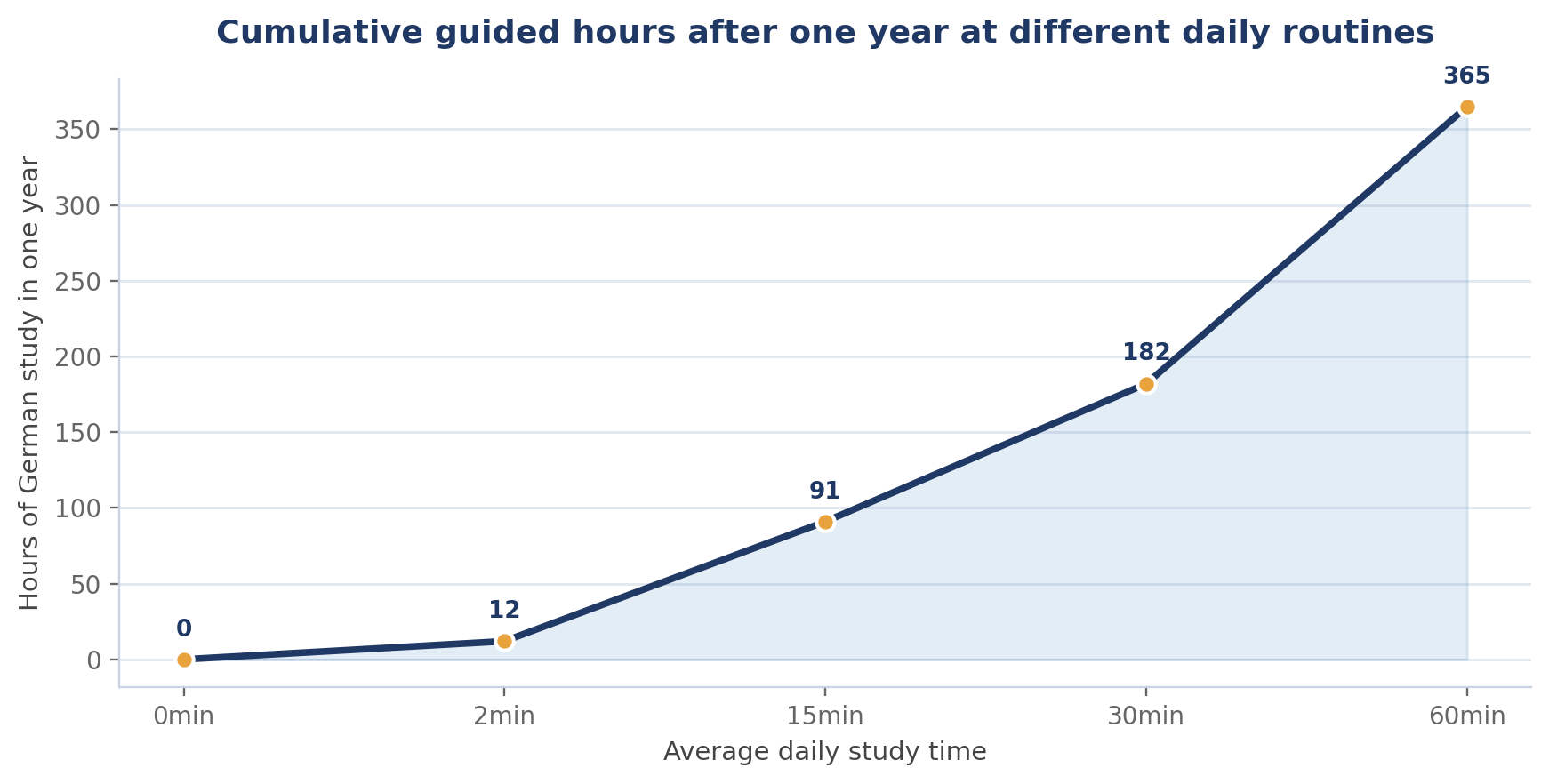
The two-minute version is not a cheat. It is protection. Two minutes of German — say five flashcards, one sentence read aloud, one word written on your hand — keeps the neural cue intact so that tomorrow's fifteen minutes still feels like the thing I do daily rather than a restart.
The mistake is thinking a short session does not count. A short session is the only reason the long sessions still exist.
Twelve hours versus 365 hours. Same person, same year, one different habit.
Habit Stacking: Attach German to Things You Already Do
New habits survive by parasitising old ones. Do not find time for German. Steal it from a routine that already runs without thinking.
Do not adopt all seven. Pick two. A habit built on seven stacks collapses the first time your morning goes sideways.
Design Your Weekly Rhythm
Daily does not mean uniform. Give each day a job.
Notice Sunday. Review days are where retention is actually created, and they are the first thing learners skip.
Two fixed appointments a week beat seven vague intentions
Ready to turn reading into real German? Start your self-paced course today.
Start the German course →Create a free accountA daily habit keeps German alive. A structured course makes it grow, because there is a clear next step waiting for you and feedback on your speaking. LanguageSkills.net German courses give your week a spine — a personal AI voice tutor and structured lessons your other habits can hang from.
Button: Build your German routine →
The Tracking System That Keeps You Honest
You need a record you cannot lie to. Paper is better than an app for this because it is visible and unprivate.
Two columns on a sheet of paper. Date, and what you did in one word. That is the entire system, and it outperforms every elaborate tracker because you will actually maintain it.
When You Miss a Day
You will miss days. The habit is not the absence of missed days; it is what you do in the forty-eight hours after one.
There is a rule worth taping to your wall: never miss twice. One miss is an accident. Two is a pattern.
Make It Impossible to Skip, and Easy to Enjoy
Motivation is unreliable, but friction and pleasure are controllable levers.
If German is the thing you do right after coffee, in the chair by the window, with a book already open, you have removed most of the decisions. Decisions are where habits go to die.
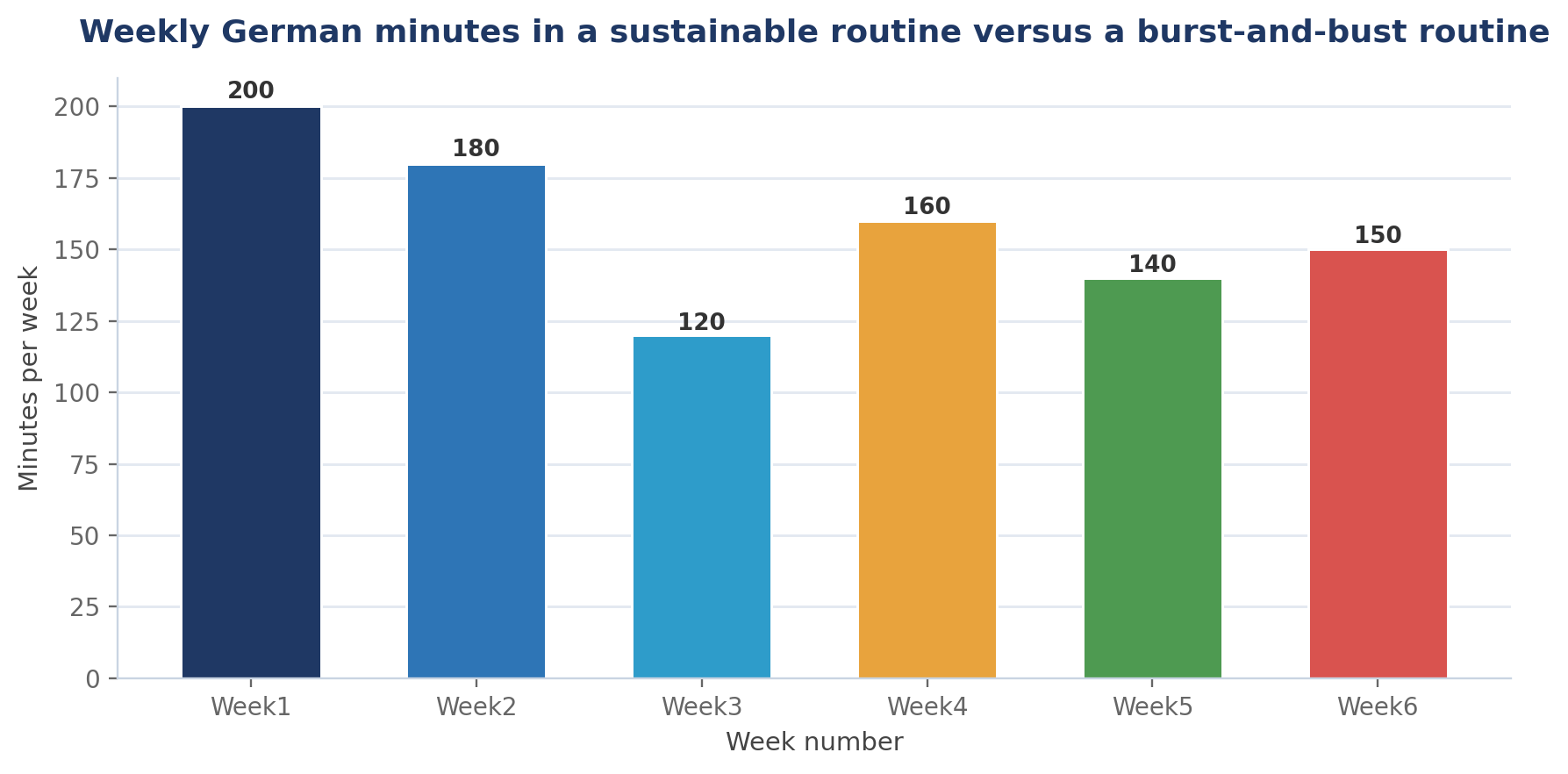
Burst-and-bust routines look heroic in week one and empty by week four. The boring line that never moves is the one that reaches B1.
A Habit Tracker You Can Copy Today
Five rows a week, one page. At the end of a month you have a record of your own German brain, and you will spot your patterns faster than any app can tell you.
Habits love structure
Ready to turn reading into real German? Start your self-paced course today.
Start the German course →Create a free accountThe learners who reach B2 are rarely the ones with the most free time. They are the ones with a fixed weekly slot and a clear next step, studying at their own pace with a personal AI voice tutor. That structure is easier to maintain than willpower.
Button: Start your German course →
Frequently Asked Questions
How many minutes a day should I study German? Fifteen to thirty minutes daily beats two hours twice a week, because language memory rewards frequency. If you are new, start with ten minutes and grow the session only after three clean weeks.
Is a streak tracker helpful or harmful? Helpful if a broken streak is allowed to continue. Harmful if it becomes all-or-nothing. Track presence rather than perfection, and add a repair rule so a missed day never becomes a missed month.
What if I genuinely have no time? Stack German onto time you already spend: commuting, cooking, walking, waiting. Listening during a commute is free German. Ten minutes of real practice plus fifteen minutes of listening is a functioning routine.
Should I study grammar every day? No. Rotate: vocabulary, listening, grammar, writing, and speaking across the week. Daily grammar drills get efficient fast, then stop paying rent. Keep grammar to one or two days weekly at beginner level.
How long before the habit feels automatic? Most people report that a small daily German session stops feeling like a decision after four to eight weeks, provided the cue and the time of day stay stable. Big inconsistent sessions take far longer to automate.
What is the fastest way to make the habit stick? Attach it to one existing ritual, keep a two-minute minimum for bad days, never miss twice, and add one weekly structured commitment — a guided lesson with your AI voice tutor. That last piece is what turns a habit into steady progress, and you can set it up here.
References & Further Reading
- Deutsche Welle — DW Learn German, free courses, audio, and placement test: https://learngerman.dw.com/en/overview
- Goethe-Institut — German learning resources and CEFR level descriptions: https://www.goethe.de/en/spr.html
- Council of Europe — Common European Framework of Reference for Languages, self-assessment grid: https://www.coe.int/en/web/common-european-framework-reference-languages
- Duden — German dictionary, spelling, and grammar reference: https://www.duden.de/
- Goethe-Institut — Goethe-Zertifikat exam overview and level targets: https://www.goethe.de/en/spr/kup/prf.html
- European Commission — Erasmus+ language learning resources: https://erasmus-plus.ec.europa.eu/