You know the vocabulary. You know the grammar rules. And yet the sentence that leaves your mouth makes a German speaker pause, tilt their head, and carefully ask, "Was meinst du?"
That pause is not a vocabulary gap. It is one of about ten recurring errors — the same ones, in the same order, in almost every learner's timeline. Find yours here and you can retire it this month.
What you will get from this guide
- The mistakes that survive longest, ranked by damage
- False friends that quietly wreck your meaning
- Why word order errors scream "beginner"
- A monthly self-audit that catches errors before they set
The Big Ten: Ranked by How Long They Survive
Every learner's error list looks roughly the same. Here is the ordered version, with the fix that actually works.
Ranks one and two cause the most damage because they infect everything. Ranks nine and ten cause the most social damage — sounding rude, or not sounding at all.
Mistake One: Learning Nouns Without Gender
Der, die, das. Learners treat gender as decoration and learn the noun alone. Then every adjective ending, every pronoun and every case collapses downstream.
That fourth row is the trap that catches everyone. Mädchen means girl and is grammatically neuter — the diminutive ending -chen forces it. Learn nouns in colour-coded cards, with the article attached. Never store a noun naked.
Mistake Three and Four: Word Order
English word order is your default, and German punishes it in two places: the main clause and the subordinate clause.
The trick for verb-second: think of position two as a reserved parking space. Something occupies it, always — a subject, an adverb, a phrase. The verb is the parking attendant. It never leaves.
False Friends That Change Your Meaning
False friends are more embarrassing than grammar errors, because the sentence is flawless and the meaning is wrong.
Bekommen is the most dangerous of the eight. "Ich bekomme ein Kind" does not mean you are becoming a child. And Chef will create a wonderful moment when you tell a German friend your boss is a chef.
Why Mistakes Fossilise — and Which Ones Do
Errors do not fade with exposure. Uncorrected errors get comfortable.
The lesson is uncomfortable. The errors that are easiest to ignore are the most expensive to repair. This is why productive correction — such as the AI voice tutor's speaking feedback — beats years of comfortable input.
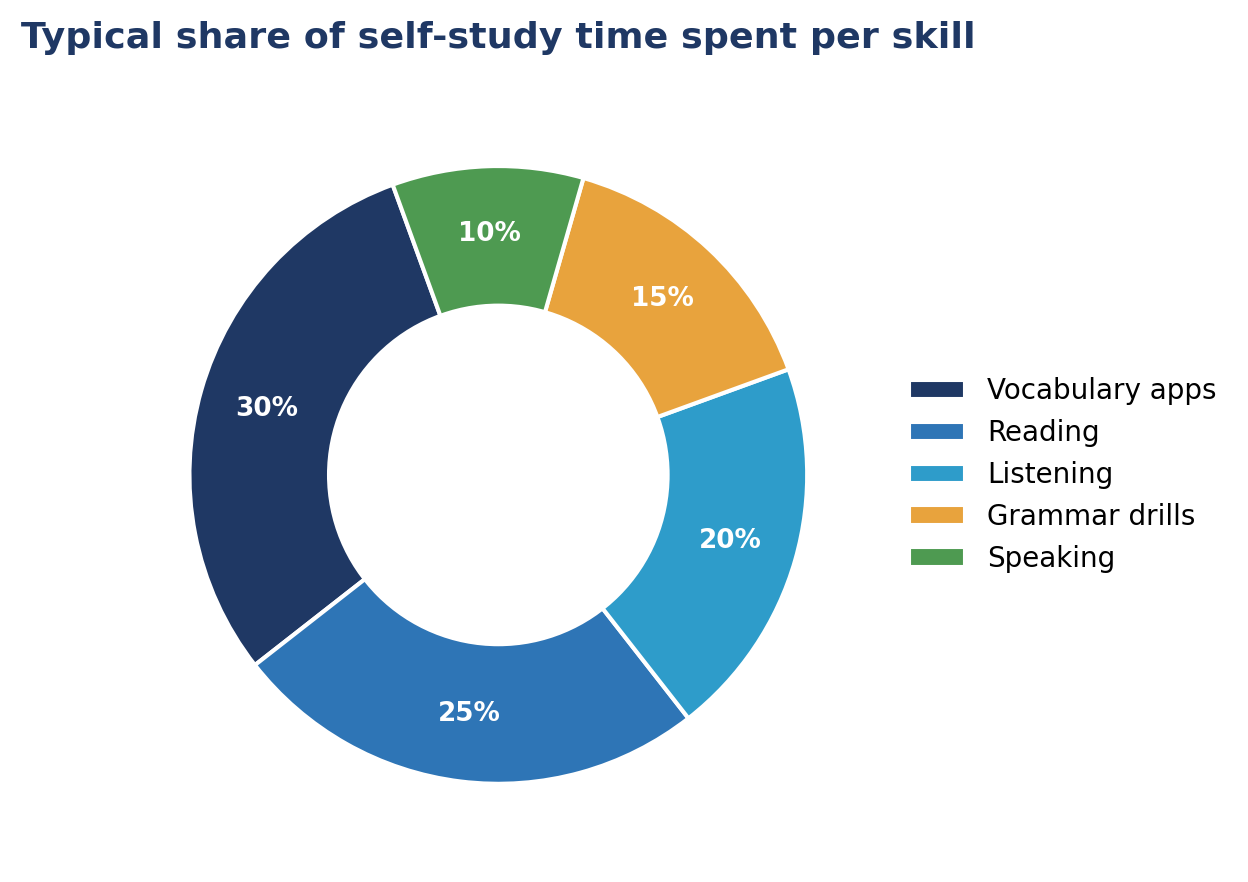
How Learners Actually Spend Their Study Time
An honest look at effort allocation explains why some errors never get touched.
Look at that last slice. Speaking — the skill where errors are visible and correctable — gets the least time. Then learners wonder why their mistakes never change.
The Sie and Du Line
Getting this wrong is not a grammar crime. It is a politeness crime, and Germans feel it sharply.
The offer comes from the senior person, usually phrased as "Wir können uns duzen." Accept it and switch permanently. Switching back is worse than never switching.
Get Corrected Before It Becomes a Habit
Fossilised errors cost three times as much to fix at B2. An AI voice tutor hears the das Tisch in week two and flags it there — while it is still cheap to change.
Start learning German with your AI voice tutor →Create a free accountA Five-Minute Monthly Self-Audit
You cannot fix errors you never see. Once a month, do this.
One error per month, retired permanently. Twelve a year, and by month eighteen your German stops being a list of known problems.
Small Fixes With Outsized Results
A few adjustments compress years into months.
None of these is glamorous. All of them are permanent.
Frequently Asked Questions
What is the single biggest mistake German learners make? Learning nouns without their gender. It is invisible at A1 and ruins adjective endings, pronouns and cases by B1. Add the article and plural to every new noun from day one.
Is it bad to translate from English in my head? As a beginner, it is normal. As a habit past B1, it causes word-order and false-friend errors because German does not map one-to-one. Learn whole phrases instead of assembling them word by word.
How do I stop making the same mistakes over and over? You cannot fix what you cannot see. Record yourself, transcribe, and find your one repeated error each month. Correction feedback accelerates this dramatically, because your own ear filters out your own defaults.
Will Germans correct my mistakes? Often they will not, because it feels rude. That silence is exactly why errors survive. Explicitly ask a patient friend to correct you — otherwise you will keep being understood and keep being wrong.
Retire One Error a Month
That is the whole plan. Structured self-paced lessons with an AI voice tutor, honest correction, and speaking feedback that remembers what tripped you up last week — so progress compounds instead of circling.
Start learning German the right way →Create a free accountReferences & Further Reading
- Duden — grammar and usage reference for cases, word order and article use: https://www.duden.de
- Goethe-Institut — level-based learning materials and exam practice: https://www.goethe-institut.de
- Deutsche Welle — Nicos Weg and grammar explanations for learners: https://learngerman.dw.com
- Council of Europe — CEFR Companion Volume, descriptors for accuracy and fluency: https://www.coe.int/en/web/common-european-framework-reference-languages
- Institut für Deutsche Sprache (IDS Mannheim) — research on German grammar and usage: https://www.ids-mannheim.de