You learned die Entscheidung on Tuesday. On Wednesday it was gone. Not faded — gone, like it never existed. Meanwhile you can still sing a jingle from a 2011 advert you never liked.
Your memory is not broken. It just refuses to store things without a hook.
Here is how to remember German vocabulary so it stays, using the same tricks adverts have been using on you for years.
What you will get from this guide
- The forgetting curve, and why cramming loses
- Gender anchors that stop der/die/das chaos
- The compound-word superpower German gave you for free
- A weekly vocabulary system you can actually keep
Why You Forget German Words (And It Is Not You)
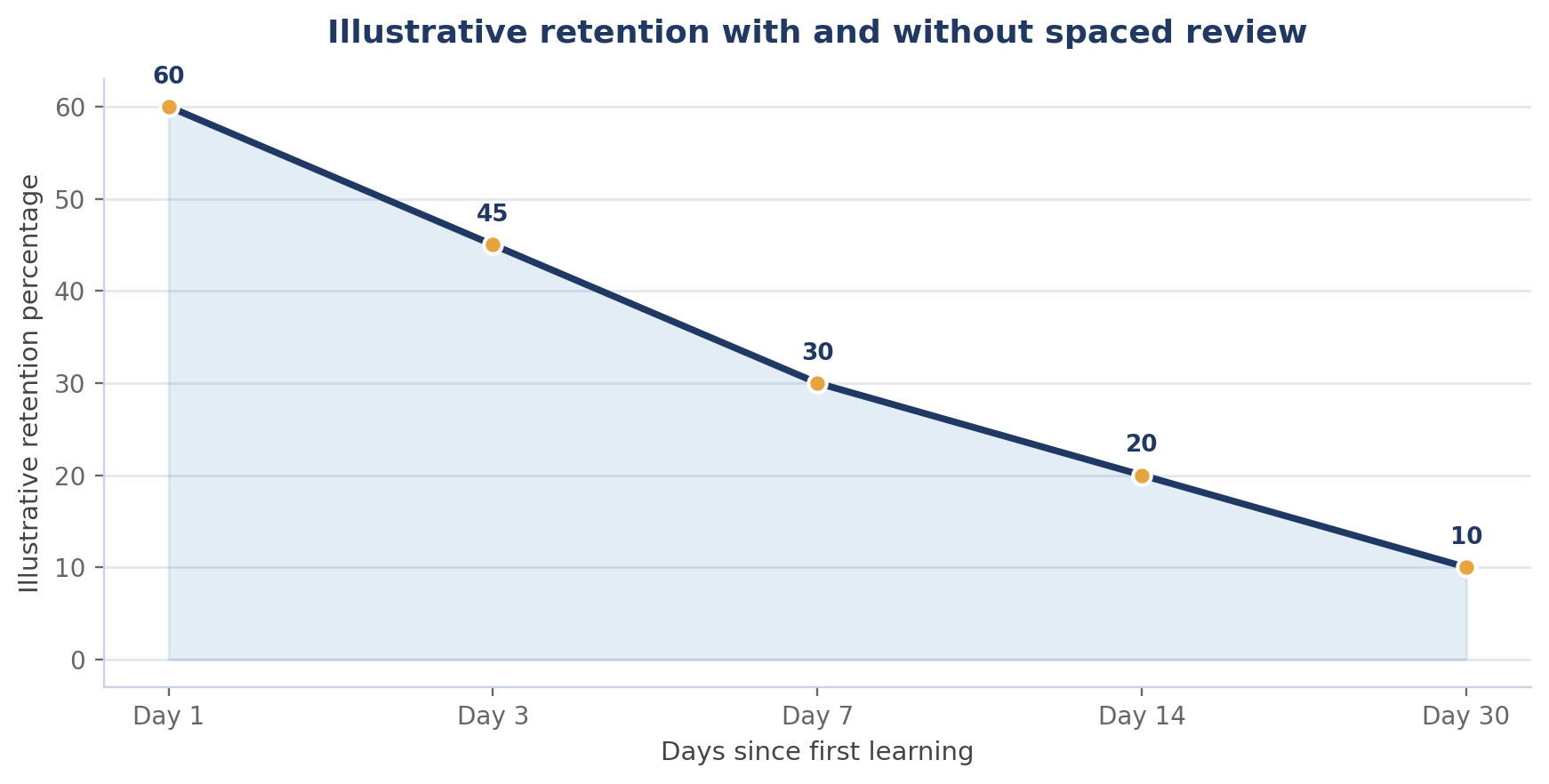
Memory has a decay rate. Learn something once and it drops off a cliff within days. The fix is not more repetition — it is better-timed repetition.
Those percentages are illustrative rather than exact, but the shape is reliable: unrevised vocabulary evaporates fast. Spaced repetition lands each review just before the word disappears.
Rule One: Never Learn a German Noun Alone
A German noun is a package: article, noun, plural. Learn all three or you have not learned the word.
Say the article with the word, out loud, every time. Der Tisch. Die Blume. Your mouth learns the gender before your brain does.
Gender Anchors: Turn der/die/das Into Muscle Memory
Gender is where German learners drown. The trick is to stop learning rules and start attaching gender to something sensory.
Then add the patterns that actually hold. Words ending in -ung, -heit, -keit, -schaft and -ion are overwhelmingly feminine. Words ending in -chen and -lein are always neuter — which is why it is das Mädchen, despite the meaning.
Patterns do not cover everything, but they cover enough to shrink the chaos dramatically.
Rule Two: Learn Chunks, Not Words
Isolated words are hard to remember because they mean nothing yet. Chunks come with context baked in, and context is glue.
Four words per card, one situation each. Slot them into real phrases and your recall rate jumps because you now remember a moment, not a dictionary entry.
Vocabulary sticks when someone uses it back at you
A flashcard gives you a word. A conversation gives you a reason to keep it. With our self-paced AI voice tutor you produce new vocabulary out loud any time, and get instant AI feedback so it lands correctly.
Practise German with real instructors →Create a free accountRule Three: Exploit German Compound Words
German builds nouns like Lego, and this is a gift. Learn the bricks and you get the buildings free.
This is why a decent German vocabulary multiplies itself. Every brick you own unlocks a shelf of compounds you have never seen.
Rule Four: Space It, Test It, Speak It
Passive recognition is not knowing. You need to produce the word, unprompted.
Run all five, in that order, and the word graduates from your screen into your mouth.
A Weekly System That Survives Real Life
Keep it boring and repeatable. Boring systems are the only ones that last.
Fifteen a day beats a hundred once a week. Every time. Consistency is the entire mechanism.
Mistakes That Kill Retention
Learning words from a frequency list with no context. Writing German-to-English only, so you can never produce, only translate. Skipping the article. Studying in silence. Reviewing words you already know because it feels nice.
And the biggest one: learning vocabulary you never use. If a word cannot appear in your life within a month, park it. Priority beats volume.
The Anchor You Will Actually Remember
Test a word three ways: can you say it, can you spell it, can you use it in a sentence? Two out of three means "almost there." One out of three means the word was never really learned.
Turn 15 words a week into 780 a year
Vocabulary is only half the job — retrieval under pressure is the other half. Our self-paced German courses (A1 to B2) give you AI-guided speaking practice any time so the words you learn actually come out when you need them.
Start learning German properly →Create a free accountFrequently Asked Questions
How many German words should I learn per day? Around 10 to 20 new words is a sustainable pace for most learners, with daily review of older material. Volume matters less than consistency — 15 a day for a year is roughly 5,000 words.
Should I learn German noun genders separately? No — learn them together, always. A noun without its article and plural is a half-learned word. Say der Tisch, die Tische as one unit until it feels automatic.
Is spaced repetition better than rereading for German vocabulary? Yes. Rereading creates a feeling of familiarity that fades quickly. Spaced repetition forces active recall at widening intervals, which is what makes words durable.
Do compound words really make German vocabulary easier? They do. Because German builds nouns from smaller units, learning base words like Haus, Buch or krank gives you free access to dozens of compounds you have never studied.
References & Further Reading
- Duden, Die Grammatik — reference on German noun gender and word formation, duden.de.
- Goethe-Institut, German vocabulary and CEFR word lists, goethe.de.
- Ebbinghaus, H., Über das Gedächtnis (1885) — original memory and forgetting research.
- Deutsche Welle, Deutschtrainer vocabulary series, dw.com/deutschlernen.
- Council of Europe, CEFR companion volume and vocabulary descriptors, coe.int.