You studied for two years. You land in Madrid. Someone says ¡Qué guay, tío! and your brain files it under "not Spanish".
Textbooks teach the language of a school exam. Slang is the language of a Tuesday afternoon. If you want to sound like a person instead of a phrasebook, you need a second vocabulary — and a rule for using it.
What you will get from this guide
- Slang by region, so you never mix Madrid with Buenos Aires
- The high-risk words you should understand but never guess with
- A method for learning slang without learning bad habits
Why Slang Is Not Optional
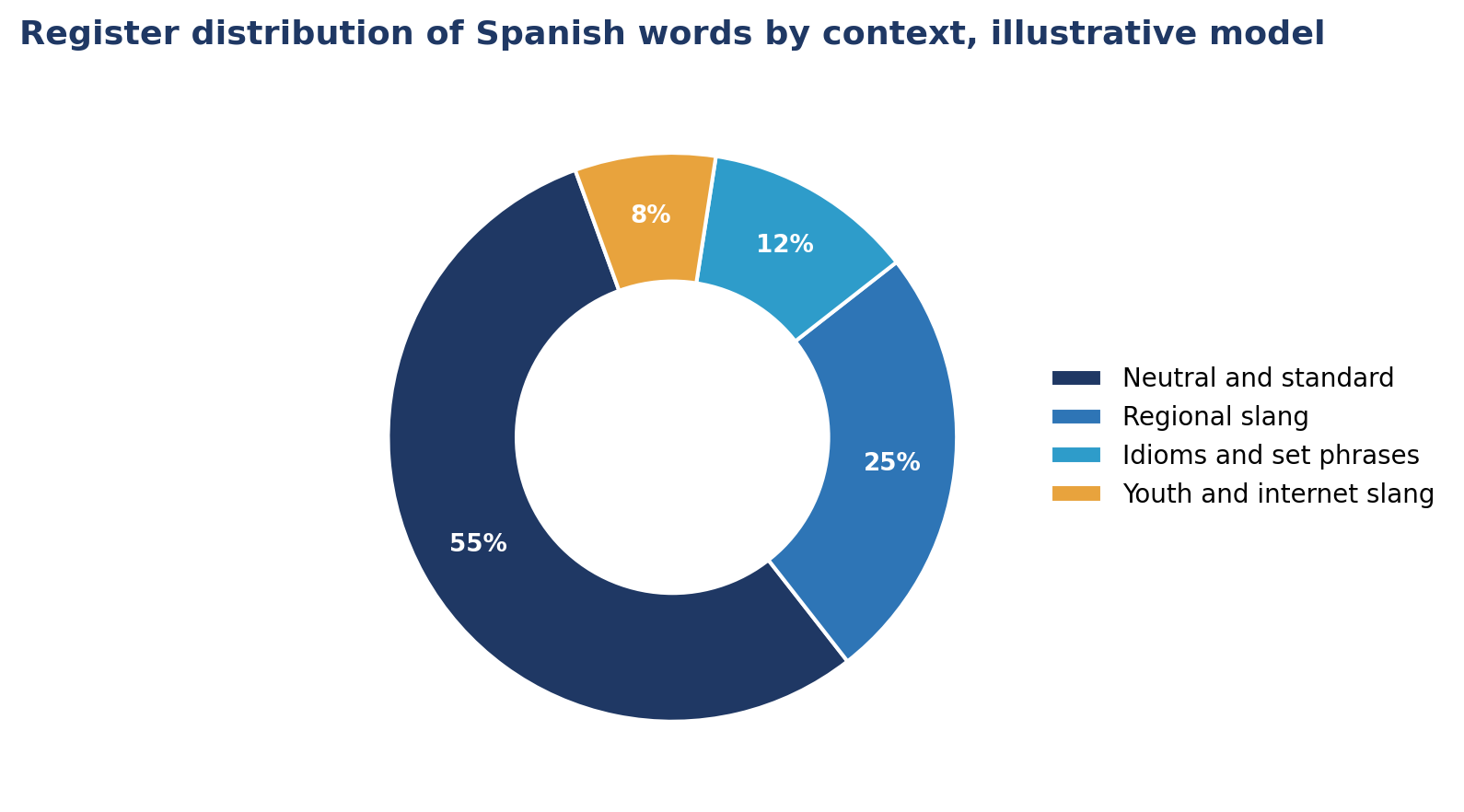
Native speakers use colloquial language constantly in shops, bars, offices and group chats. Standard Spanish gets you understood. Colloquial Spanish gets you included.
There is a second, harder reason. Slang changes meaning by country. Coger means "to take" a bus in Spain and something considerably less polite in parts of Latin America. Learn the map before you use the word.
Spain: The Everyday Arsenal
Peninsular Spanish loves exaggeration and quick intimacy. Strangers become tío and tía within minutes.
Say vale ten times a day and you will sound Spanish within a week. That one word is worth a whole grammar unit.
Latin America: Five Countries, Five Flavours
Regional slang is not decoration. It is identity. Using Argentinian words in Mexico will mark you as a tourist who watched the wrong series.
Notice that chévere travels well through the Andes and the Caribbean while güey stays home in Mexico. Slang has borders, and they are real.
Ten Idioms That Sound Like Magic
Idioms are where slang becomes poetry. Learn them whole; do not translate them word by word.
Use two of these in a conversation and a native speaker will look at you differently. Pleasantly.
The Words You Must Handle With Gloves
Some slang is a minefield. Understanding it is useful. Deploying it wrongly is expensive.
The safe rule: never use a slang word you have not heard a native speaker use with a stranger in front of you. Understand widely, deploy narrowly.
How to Learn Slang Without Learning Mistake
Slang sticks through context, not lists. Four moves get you there.
That last move matters. Slang learned passively evaporates. Slang used once and corrected sticks for good.
Learn the Spanish people actually speak
Self-paced lessons with a personal AI voice tutor that show you what is current in Madrid, Mexico City or Buenos Aires — and what to never say at dinner.
See Spanish courses →Create a free accountSlang and the Exams
A fair warning. DELE exams test standard Spanish. Slang appears in listening extracts for comprehension, but your own writing should stay neutral.
So there is no conflict. Learn slang for life. Write standard Spanish for exams. Slang is listening comprehension with a personality.
Frequently Asked Questions
Which Spanish slang should I learn first? Start with the country you will actually visit or the accent you hear most. Then learn vale, guay and ¿qué tal? as universal openers.
Is Spanish slang rude? Not by itself. Register makes it rude. The same word is friendly between friends and insulting between strangers.
Can I sound native with slang alone? No. Slang on weak grammar sounds like a costume. Build the base, then add the seasoning.
Do textbook and DELE Spanish ever disagree with real speech? Yes, in vocabulary more than grammar. Exams reward clean standard Spanish; daily life rewards regional colour.
From laminated phrases to living language
Self-paced Spanish courses with a personal AI voice tutor put real expressions in real situations, so the words stick where they belong: in your mouth.
Start speaking like a local →Create a free accountReferences & Further Reading
- Real Academia Española — Diccionario de la lengua española, including regional and colloquial usage notes: https://www.rae.es
- Instituto Cervantes — El español en el mundo yearbook on language variation across regions: https://www.cervantes.es/lengua_y_ensenanza/el_espanol_en_el_mundo.htm
- Instituto Cervantes — official DELE diploma levels and exam descriptions: https://www.cervantes.es
- ASALE — Diccionario de americanismos, for regional Latin American vocabulary: https://www.asale.org
- LanguageSkills.net — self-paced Spanish courses with a personal AI voice tutor: https://languageskills.net/register