Spain does not run on your schedule, and that is the whole point. Arrive expecting dinner at seven and you will eat alone in an empty restaurant. Arrive understanding the rhythm — the late meals, the long conversations, the afternoon quiet — and the country opens up like a door you finally found the handle to.
These tips will not just save you from awkward moments. They will get you treated like someone who bothered to learn, which in Spain is a compliment worth having.
What you will get from this guide
- The daily rhythm, hour by hour, so you are never the only one eating
- Social rules: greetings, tipping, invitations and offers
- Practical tips on opening hours, pharmacies and Sundays
- The handful of Spanish phrases that change how you are treated
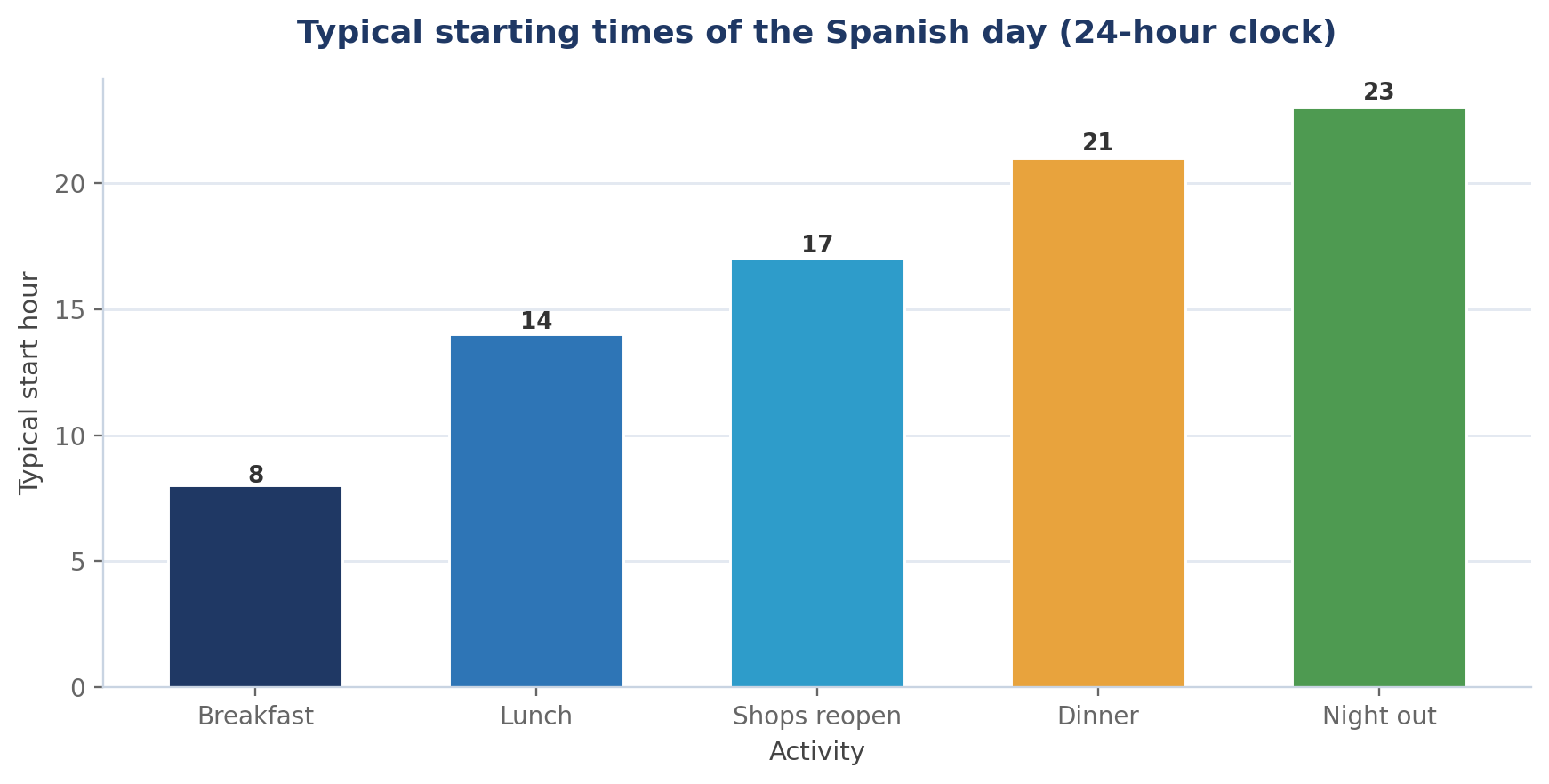
The Spanish day runs late — embrace it
The single biggest culture shock is the clock. Spain's day is shifted, and the shift is not laziness; it is simply a different division of the same hours.
Restaurants that serve dinner at 19:00 exist mostly for tourists. If you want the real thing, eat when locals do and the food will be better.
Greetings and social rules
Spanish social contact is warmer and more physical than in northern Europe or North America. Two kisses on the cheeks is standard between women and between men and women in social settings; men usually shake hands or embrace. In business contexts, a handshake is the safe default.
Small courtesies carry real weight. Por favor, gracias, buenos días and hasta luego are not formalities — they are the price of a warm interaction.
Eating and drinking like a local
Do not rush the table. The long conversation after the meal — la sobremesa — is the point of the meal.
Practical tips that save your day
Thirty phrases turn a good trip into a great one
Travel Spanish does not need grammar — it needs confidence and a few dozen sentences that work. A personal AI voice tutor gives you exactly that, in short self-paced sessions built around real situations.
Learn travel Spanish →Create a free accountPhrases that change how you are treated
That last one, estoy aprendiendo español, is quietly powerful. It signals effort, and effort is respected. Most people will slow down, simplify, or switch to patient English — and you will have made a friend.
Regional differences worth knowing
Spain is not one culture but several, and a little awareness prevents real awkwardness.
Speaking Spanish everywhere is perfectly acceptable. Beginning with buenos días and asking politely is what matters, never which language you assume.
Travel with a teacher, not a phrasebook
A personal AI voice tutor can prepare you for the conversations a phrasebook never predicts — the taxi driver, the pharmacy queue, the dinner invitation. Self-paced AI-guided sessions build the reflexes you will actually use abroad.
Start Spanish for travel →Create a free accountFrequently Asked Questions
Is it rude to eat early in Spain? Not rude, just unusual. Early restaurants are usually tourist-oriented. For better food and atmosphere, eat around 14:00 and 21:00.
How much should I tip in Spain? Tipping is modest and optional. Rounding up, leaving small change, or adding 5–10% in a restaurant is generous and appreciated.
Do I need Spanish to travel in Spain? You can manage without it in major cities, but even a few dozen phrases transform the experience and are warmly received.
Is it safe to drink tap water in Spain? Yes, tap water is safe in virtually all of Spain. Ask for agua del grifo if you prefer it to bottled.
References & Further Reading
- Instituto Cervantes — Spanish language and culture resources
- Turespaña — Official tourism information for Spain
- Real Academia Española — Diccionario panhispánico de dudas
- Instituto Cervantes — Spanish courses and DELE certification
- Council of Europe — CEFR A1–A2 descriptors for practical communication