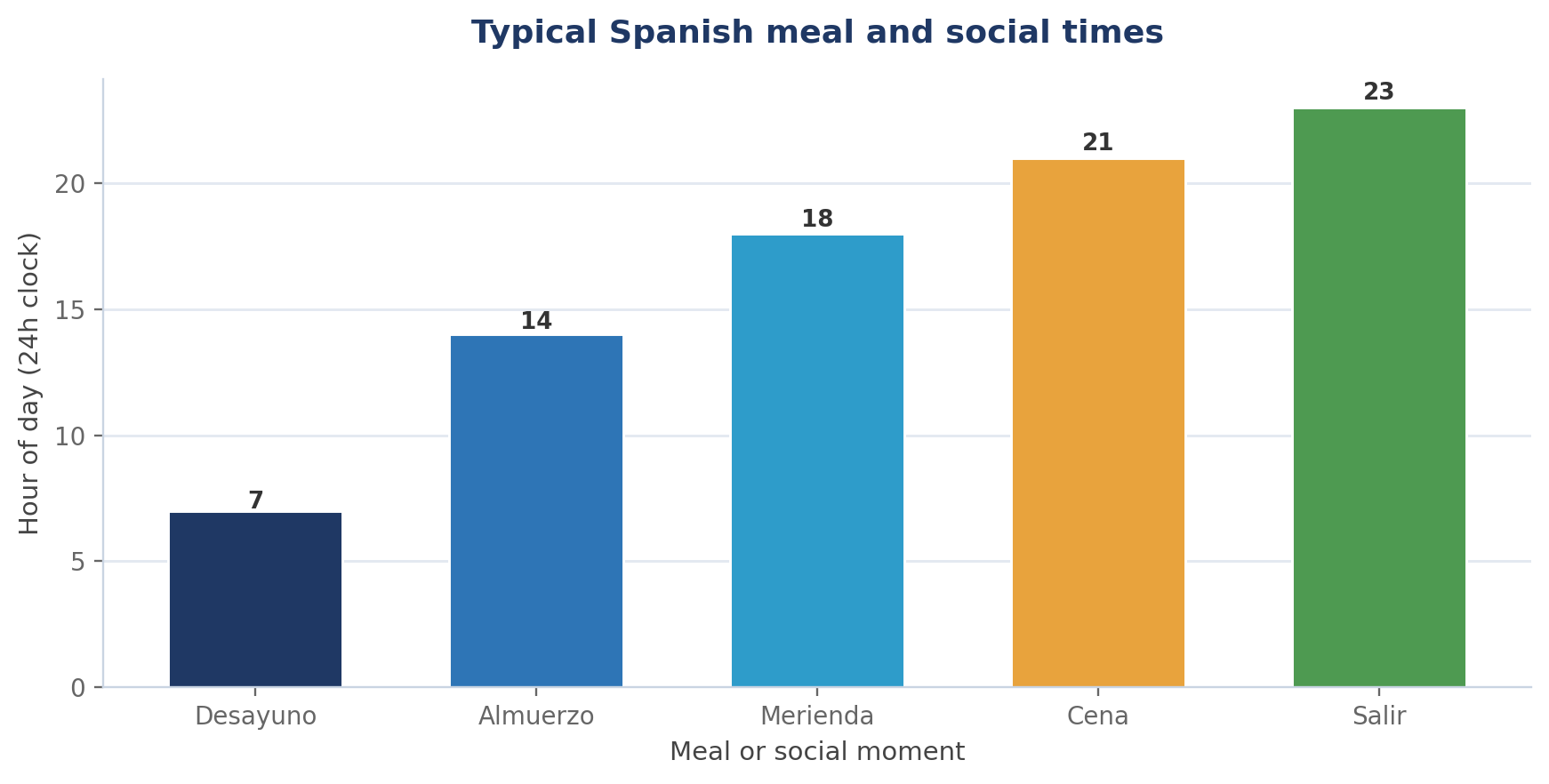
You arrive in Madrid at nine at night. The streets are loud, the bars are full, and children are still playing football under the streetlights. Your host says dinner is at ten. You think it's a joke. It isn't.
Spain etiquette is not a list of rules you memorise like a museum plaque. It is a rhythm — of greetings, of meals, of who speaks first and when. Get the rhythm wrong and nothing breaks. Get it right and doors open.
What you will get from this guide
- The exact greeting to use with strangers, friends and shopkeepers
- Meal timing and table manners that won't mark you as a tourist
- Tipping, queuing and the two-kiss rule, explained without drama
- The phrases that carry every polite Spanish moment
The Greeting Is the Whole Conversation
In Spain, you greet before you ask. Always. Walk into a small shop and skip the buenos días and you will feel the temperature drop. Say it, and the shopkeeper becomes an ally.
Between men: a handshake, or a hug among friends. Between women, or a man and a woman, two cheek kisses — right cheek first — but only if you already know each other. Strangers get a handshake or a nod. Nobody expects a foreigner to nail this on day one, but everyone notices the attempt.
The Clock Runs on Human Time
Spanish punctuality splits into two worlds. Business, trains and doctors' appointments run on the dot. Social life runs on la sobremesa — the long talk after the meal that nobody wants to end.
Dinner at ten is real. Lunch at two is normal. A party invitation for nine means nobody arrives before nine-thirty, and arriving at nine exactly makes you the first guest, standing alone with a glass. Ask your host directly: ¿A qué hora de verdad? — what time, really?
Table Manners Without the Panic
Bread goes on the table, not on your plate. Olive oil goes on everything. Nobody waits for the last person to finish before clearing, and nobody will rush you out.
The two things that genuinely matter: keep your hands above the table, not in your lap, and keep the fork in your left hand if you're not constantly switching. Spanish diners don't switch. The American zig-zag method reads as odd, not rude, but it's easy to drop.
If you're invited to someone's home, bring wine, pastries or flowers. Avoid chrysanthemums — they belong at funerals. And if the host insists on paying, let them. Insisting back is fine once. Insisting three times turns a warm evening cold.
Tipping, Queuing and the Small Wars
Tipping in Spain is modest and optional. You are not in New York. Rounding up is normal, ten percent is generous, and leaving nothing is not an insult.
Queues are real in Spain but looser than in Britain. In a bakery, ask ¿Quién es el último? — who's last? — and you've joined the line without standing in one. In a crowded bar, the queue is the bar counter. Push in and you'll get served eventually, but you'll feel every eye in the room.
The Language Is the Etiquette
Everything above runs on a handful of phrases. Etiquette in Spain is mostly linguistic: por favor, gracias, perdón, and the magic word usted for anyone older or in authority.
One warning: learn tú and usted before you fly. Using tú with a stranger twice your age is the most common accidental rudeness a visitor commits. Spanish learners spend months on the subjunctive and then lose the room on a pronoun.
Sound polite before you sound fluent
Greetings, usted, and the phrases that carry every Spanish interaction are the first things you drill in a self-paced Spanish course — with a personal AI voice tutor that gives you feedback on your speaking, not just your grammar.
Start speaking Spanish properly →Create a free accountRegional Differences You Shouldn't Ignore
Spain is not one culture. Catalonia, the Basque Country and Galicia have their own languages, and greeting someone in Catalan in Barcelona is a gesture, not an error.
In Barcelona, ordering in Catalan when you can, and apologising for your Spanish, earns a warmer reply than assuming. In Andalusia, the opposite: people will happily slow down, but you must ask.
The Three Real Don'ts
Don't treat Spain as a theme park of flamenco and paella. Flamenco is Andalusian, paella is Valencian, and a local will notice if you call both "Spanish".
Don't discuss the Civil War or Franco as light dinner conversation. Generations still disagree, sometimes at the same table.
Don't be loud about being foreign and then complain that nobody speaks English. The effort to greet, order and thank in Spanish buys more goodwill than any amount of vocabulary. Spain etiquette rewards warmth over correctness.
Walk in knowing the rhythm
Self-paced Spanish lessons built around real situations — shops, tables, taxis, first meetings. You study any time, at your own pace, and arrive already confident in the polite part.
See Spanish course options →Create a free accountFrequently Asked Questions
Do you kiss twice or once in Spain? Twice, right cheek first, and only with people you've been introduced to. Men generally shake hands with other men; two women, or a man and a woman, use the two-kiss greeting.
Is it rude to speak English in Spain? No — but it is polite to open in Spanish. A quick perdón, ¿habla inglés? after buenos días lands far better than launching straight into English.
Should I tip in Spanish restaurants? A small tip is appreciated but never expected. Five to ten percent for good service is generous; rounding up the bill is completely normal.
What time should I arrive at a Spanish dinner party? If the invitation says nine, arriving between nine-fifteen and nine-thirty is normal for a social gathering. For a restaurant reservation or a business meeting, arrive exactly on time.
References & Further Reading
- Instituto Cervantes — official Spanish language and culture courses worldwide: https://cervantes.es
- Instituto Cervantes, Saber Hablar — practical sociolinguistic guidance on register and politeness
- Real Academia Española (RAE) — Diccionario de la lengua española: https://rae.es
- Oficina de Turismo de España (Turespaña) — practical visitor information: https://spain.info
- Royal Spanish Academy and ASALE — Nueva gramática de la lengua española, on pronoun and register use
Learn more about self-paced Spanish courses at languageskills.net.