There is no shortage of people who learned English alone with a phone and an internet connection. There is also no shortage of people who studied alone for four years and still cannot hold a ten-minute conversation.
Both stories are true, and the difference between them is not willpower. It is whether the learner happened to build the specific things self-study is good at, and found a substitute for the things it is not.
Here is the honest comparison, with the parts marketing usually leaves out.
The short version
- Self-study is excellent for input: reading, listening, vocabulary
- It is structurally weak at output: speaking, correction, accountability
- Cost per usable hour flips the comparison
- Most learners do best on a hybrid, not a pure route
Self-study: the honest pros
If your goal is comprehension, self-study is remarkably efficient. A motivated learner with good materials can build a large passive vocabulary and strong listening in a year — genuinely, without spending anything.
Self-study: the structural cons
The first is the most consequential. Pronunciation errors made in the first six months are the ones that survive for decades, because nobody is there to hear them.
Guided course: the honest pros
The fourth is underrated. A structured course with a clear sequence and regular practice is one of the strongest commitment devices available to an adult learner — stronger than any streak counter.
Guided course: the honest cons
Nobody should pretend a course is free of trade-offs. The structure is the point, but it is also the cost.
Cost per usable hour
The monthly price is the wrong metric. What matters is cost per hour of usable language — time spent producing English, not consuming it.
Free is free only if you convert it into speaking. Most self-study hours are input hours, and input alone does not produce fluency.
Ready to turn reading into real English? Start your self-paced course today.
Start the English course →Create a free accountGet the half that self-study cannot provide
You have already built the vocabulary and the listening. What is missing is structured speaking practice with feedback. A guided course supplies exactly that — structured practice, AI feedback and a steady routine you keep.
Button: Explore the English Course Pass →
Who each route actually suits
Notice the pattern: self-study wins when the goal is comprehension, and courses win when the goal is production. Almost every learner needs both eventually.
The hybrid that beats both
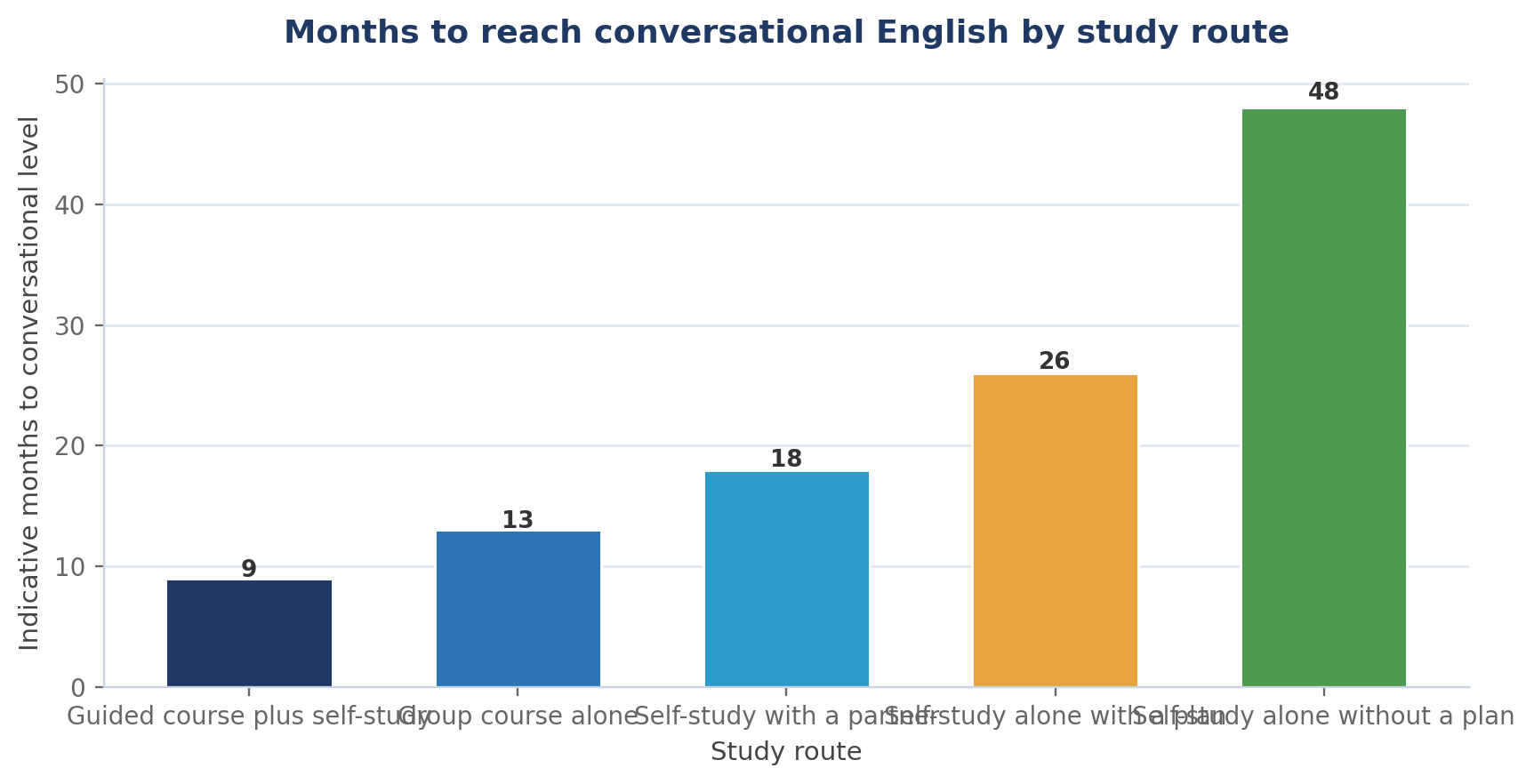
Four to five hours a week, with each hour doing a distinct job. That mix reaches conversational fluency faster than any pure route, and it costs far less than stacking multiple paid courses.
Self-study teaches you about English. A guided course makes you someone who speaks it.
Three signs self-study is no longer enough
That third sign is the diagnostic. When you start choosing the option that requires less English, the problem has moved from your vocabulary to your confidence — and confidence is built only by speaking.
Ready to turn reading into real English? Start your self-paced course today.
Start the English course →Create a free accountTest the guided route for nothing
Create a free account, take a level check, and try a guided lesson before deciding. If self-study is already working, you lose nothing. If it is not, you will know within an hour.
Button: Create your free account →
Frequently Asked Questions
Can I learn English well through self-study alone? For reading and listening, yes. For confident speaking, most learners plateau without conversation and correction.
Is a guided course worth the money? If your goal involves speaking with people, yes — you are buying feedback, structure and accountability rather than information.
What is the fastest route to conversational English? A hybrid: daily self-study for input, plus one or two guided lessons a week for output and correction.
How long does each route take? Self-study alone typically takes two to three times longer to reach conversational level than a guided route, largely because output practice is missing.
References & Further Reading
- British Council — English learning and teaching resources
- Cambridge English — Learning English resources and qualifications
- BBC Learning English — Free lessons, audio and transcripts
- Council of Europe — CEFR levels and spoken-interaction descriptors
- European Commission — Multilingualism and language-learning policy