There is a sentence every German learner produces in week one and regrets in week two: "Wie geht's, Frau Doktor Schmidt?"
Wrong greeting, wrong register, wrong relationship. German politeness is not about adding bitte — it is a social positioning system, and getting it wrong is not grammatically fatal but it is socially loud.
Here is the map: when Sie wins, when du wins, and exactly how the switch happens.
What you will get from this guide
- The Sie/du decision rules that actually hold, including in Berlin and Bavaria
- Real greeting and email formulas, formal and casual
- The politeness ladder for requests, from gentle to devastatingly formal
- How and when Germans switch from Sie to du — and who offers first
Two Words, Two Universes
Sie (always capitalised) and du are not "you" and "you-but-polite". They are different relationship contracts. Sie marks distance, respect and formal equality. du marks closeness, shared identity and informality.
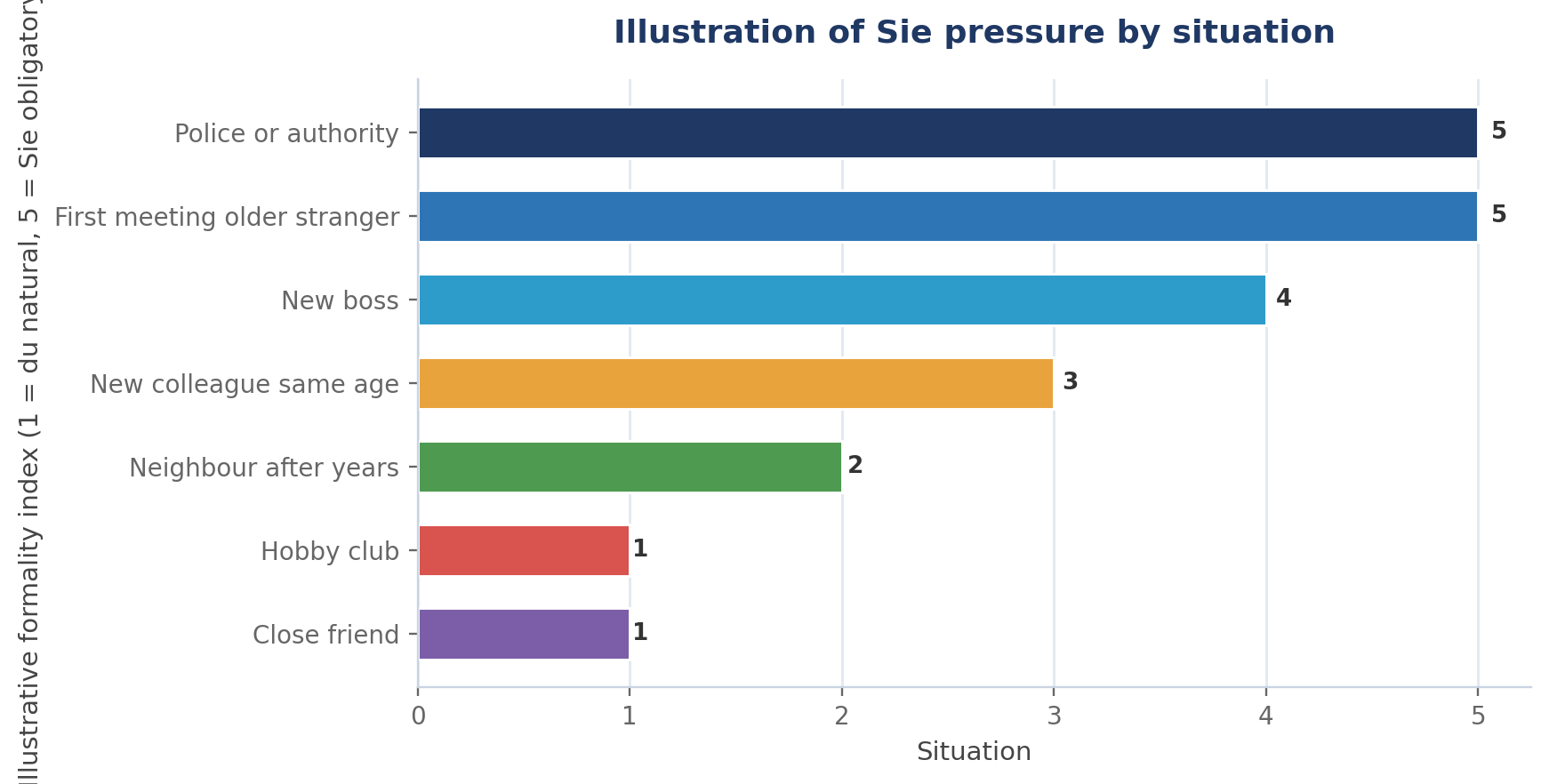
Pick wrong in the polite direction and you sound distant but safe. Pick wrong in the casual direction — du to a 70-year-old stranger, to a police officer, to your new boss on day one — and you sound presumptuous.
**When unsure, use Sie. Germans will invite you to du when they are ready.** The reverse manoeuvre is much harder.
Region and Generation Shift the Rules
Germany is not uniform. The du zone is wider in the west and in cities, narrower in the south and in older generations.
Greetings That Fit the Room
Tschüss is now acceptable almost everywhere, including many offices. Auf Wiedersehen remains the safe formal exit.
The Politeness Ladder for Requests
German has a beautiful escalation ladder. Climb it deliberately.
The Konjunktiv II (könnte, würde, hätte) is the single highest-value politeness tool in German. Learn it once, sound polite forever.
Email German: The Formulas That Never Fail
Two hard rules. First, formal German salutations take a comma, and the next line starts lowercase. Second, Mit freundlichen Grüßen is a full stop, not a flourish — never add warmth after it.
Register is the part textbooks rush past
You can conjugate perfectly and still sound wrong in a meeting. Self-paced German lessons with a personal AI voice tutor give you speaking practice with feedback on tone, not just grammar — from Sie emails to beer-garden du.
See the German course pass →Create a free accountThe Switch: Who Offers, and How
The move from Sie to du is a small ceremony with real rules.
In Austria and southern Germany you may hear "Sagen wir du" preceded by a first name offer. Take both together, or neither.
Where Learners Slip
Translating English tone. "Can you…?" sounds fine in English and blunt in German. Add the subjunctive.
Dropping titles. Herr Doktor Müller is standard in formal German correspondence and appointments. It is not flattery.
**Overusing Sie with peers.** Years of Sie with same-age colleagues can read as deliberate distance. Mirror them and let it collapse naturally.
**Assuming youth means du.** Nice try. A 25-year-old civil servant is Sie.
**Panicking about the first du.** Germans forgive a well-meant wrong guess far faster than a silence. Just aim formal first.
A Quick Calibration Test
Learn German the way Germans actually speak it
Grammar drills will not tell you when to switch. Self-paced speaking practice with an AI voice tutor will — with feedback on register in real situations.
Start German with your AI voice tutor →Create a free accountFrequently Asked Questions
**Is it rude to use du with a stranger in Germany?** It can land as overly familiar, especially with older people or in southern regions. Sie is never wrong; du sometimes is. Default to Sie and wait.
How do I say "you" politely in a shop? You often do not need a pronoun at all. "Ich hätte gern…" plus "Danke schön" carries the politeness without any address form.
**Can I just use Sie forever and be safe?** Grammatically yes, socially not really. Permanent Sie with peers signals distance. Let people promote you to du.
Do Austrians follow the same rules? Broadly, yes, with more formality and different greetings — Grüß Gott rather than Guten Tag, and Servus among friends.
References & Further Reading
- Goethe-Institut, German language course levels and communicative competence — register and interaction descriptors.
- Duden, Richtiges und gutes Deutsch — guidance on greeting and closing formulas in German.
- Duden, Die Grammatik — treatment of Sie and du pronouns and social deixis.
- Deutsche Welle, Deutsch im Beruf / Nicos Weg — workplace register and formal communication practice (dw.com/deutschlernen).
- Institut für Deutsche Sprache (ids-mannheim.de) — research on politeness and address forms in contemporary German.