You arrive at a Berlin bakery and say "Hi, how are you?" to the person behind the counter. Silence. A long one. Nothing is wrong with you — you just used a greeting that reads as intimate to a German ear. Germany etiquette runs on a different software, and the bugs show up fast.
What you will get from this guide
- The greeting that fits each situation, from shop to dinner party
- The rules about Sunday, quiet hours and staring that nobody tells tourists
- Small talk that lands, and small talk that bombs
- Table manners, punctuality and the Du/Sie line
Greetings: Formal First, Always
German social distance is measured in centimetres of formality. Default to the formal setting until someone invites you closer.
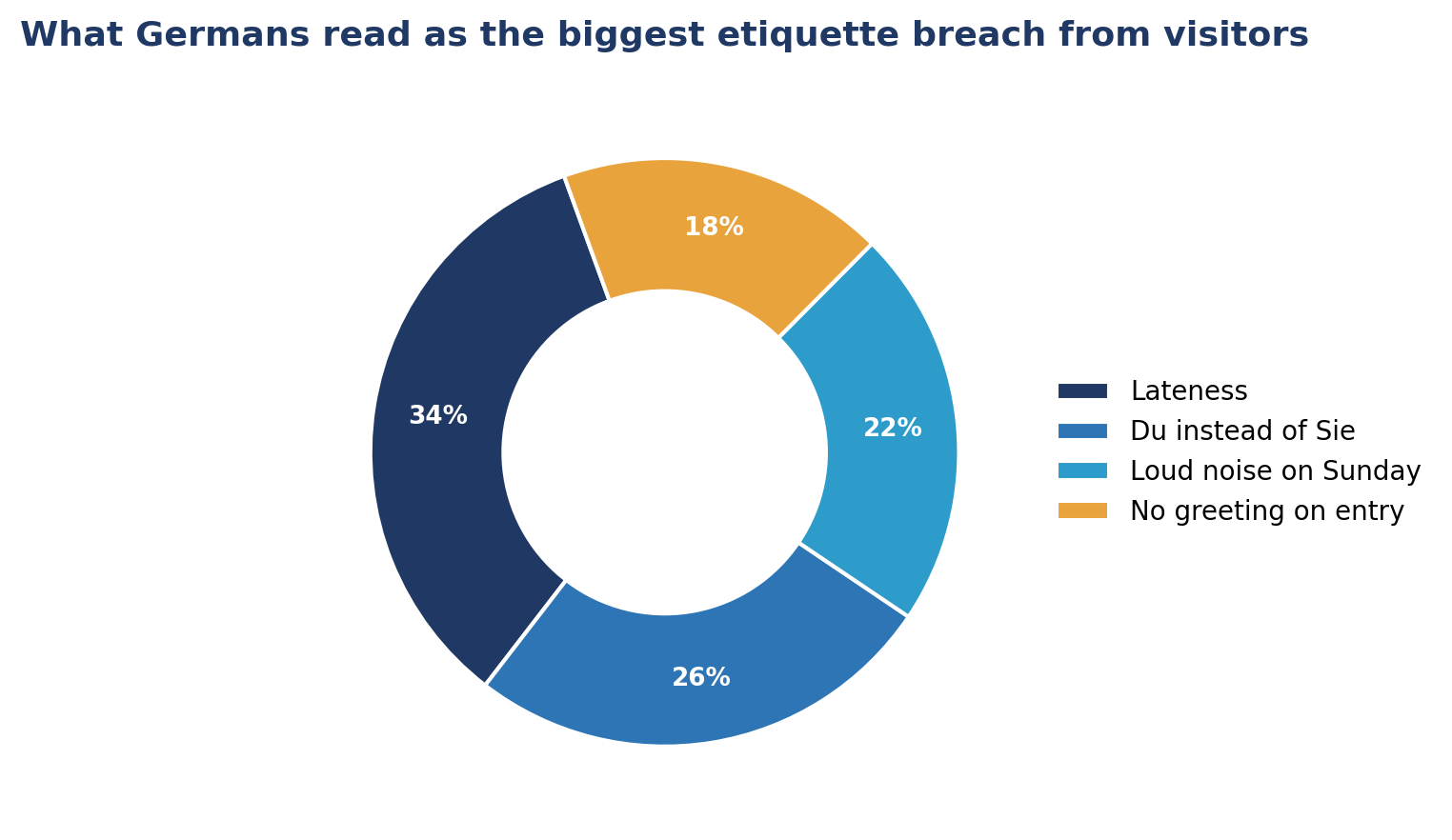
The Sie and Du line is real law, socially speaking. Use Sie with anyone older, senior, or new. They will offer Du when ready — usually preceded by "wir können uns duzen". Accept, and never switch back. Switching the wrong direction is the one etiquette error Germans genuinely remember.
Do not hug strangers. Do not ask "how are you?" as a greeting. Wie geht's? is a real question with a real answer, not a verbal handshake.
Nothing You Do Is Ever Late, Because You Are Never Late
Punctuality in Germany is not politeness theatre. It is a form of respect, and lateness is read as a statement about your opinion of the other person.
The nuance is in the wording. A stated time is a contract. "Ab 20 Uhr" (from 8pm) is an invitation to drift in whenever. Learn the difference and you will never get the frosty look.
Sunday Is Sacred and Silence Is Law
Shops close. Chainsaws stop. Vacuuming at 14:00 on a Sunday can get you a note under the door.
Germans call it Sonntagsruhe — Sunday calm — and it stretches back to a 1919 legal framework still visible in modern regulations. Your recycling-blitz is welcome. Just not on Sunday. And not at 6am.
Staring, Small Talk and the Art of Being Direct
Two myths to break at once. Germans are not cold, and Germans do not have no small talk. They have different small talk.
Myth: Germans stare rudely. Eyes meeting yours for two seconds is not aggression. It is unselfconscious looking. Nothing is being communicated. Relax.
Myth: Germans are unfriendly. The word Freund means something serious. What you call a friend after a week, a German may call a Bekannter — an acquaintance. Warmth exists; it is just earned at a slower clock speed.
Directness is a feature, not a bug. "That plan won't work" is not an attack on you. It is the German equivalent of a helpful hand on the shoulder, delivered without a cushion.
At the Table: The Dos That Surprise People
Food etiquette is where outsiders feel the most watched.
One more: at a dinner party, wait to be told where to sit unless it is obvious. And keep your hands visible on the table, not in your lap — a small habit that reads as honesty.
Etiquette is easier when you speak the language
You can learn the rules in an afternoon. The reflexes — the greeting, the Sie, the small talk — come from practice. A personal AI voice tutor teaches structured lessons you can study at your own pace, any time — from A1 to B2.
Start German with your AI voice tutor →Create a free accountThe Language That Carries the Manners
Here is the quiet truth: most etiquette mistakes are language mistakes.
The conditional — könnten, würden, hätte — is politeness in grammatical form. Germans use it constantly, and learners who skip it sound like they are giving orders. That is not a vocabulary gap. That is a manners gap, and it closes with practice.
Packing List for Your Manners
Do: greet on entering, arrive on time, bring a gift, use Sie until invited, keep Sundays quiet.
Don't: show up at 19:20 for a 19:00 dinner, call your boss by first name, vacuum at 8am, ask what someone earns, or take a direct "no" personally.
Germany rewards preparation. Learn the rules, learn the phrases, and you will be invited back. That second invitation is where the real country opens up.
Be the visitor everyone invites back
German Course Pass gives you self-paced lessons with a personal AI voice tutor, including speaking practice with AI feedback on the formal register that etiquette depends on. Manners and language, learned together.
Get your German Course Pass →Create a free accountFrequently Asked Questions
Do Germans really shake hands that often? In formal and professional settings, yes — on meeting and on leaving. Among friends and young people, far less. Follow the other person's lead rather than offering first.
Is it rude to be late in Germany? Generally yes, especially for meetings, appointments and dinner invitations. Arriving 10-15 minutes late without warning is read as disrespect. "From 8pm" party invitations are the main exception.
Should I use Du or Sie with my German teacher? Start with Sie unless the teacher introduces themselves by first name and says Du. Many language teachers offer Du immediately precisely because it makes speaking practice less stiff.
Why are shops closed on Sunday? It stems from legally protected rest-day rules known as Sonntagsruhe, designed to guarantee one quiet day per week. Some exceptions exist, such as shops in major train stations and airports.
References & Further Reading
- Goethe-Institut, Life in Germany — cultural orientation material for newcomers.
- German Federal Ministry of Labour and Social Affairs, information on Sunday and public holiday rest-day rules.
- Deutsche Welle, Meet the Germans — short series on everyday German habits and customs.
- Duden, Richtiges und gutes Deutsch — reference on formal and informal address conventions.
- LanguageSkills.net German courses — self-paced AI-tutor lessons (A1 to B2) covering both spoken register and cultural context.