You arrive at a Berlin office, smile broadly at the room, and get six level stares back. Nothing is wrong. You have simply walked into a country where a smile is information, not decoration.
Germany customs are not mysterious — they are just specific. Learn the handful of rules below and you will stop feeling like an outsider within about a week.
What you will get from this guide
- The greeting rules, and why a handshake still wins
- Why Germans stare, and how to handle it
- Door, queue and space etiquette explained plainly
- Small-talk rules, plus the phrases that open conversations
The Handshake Still Rules Everything
Germans shake hands. A lot. On arrival, on departure, in meetings, in shops, at the doctor's office. A firm grip, eye contact, maybe a small nod.
That firm grip is not aggression. A limp handshake reads as disinterest, and Germans will quietly file you under "unreliable". Eye contact is the same signal: steady, not staring, not darting.
The German Stare (It Is Not Rudeness)
Germans look at people. On trains, in cafés, in waiting rooms. They do not look away when you catch them.
This unsettles visitors from cultures where eye contact between strangers is brief. But there is no threat in it. English-speaking cultures treat looking as an intrusion; German culture treats pretending not to see as the odd behaviour. You are simply being acknowledged as a person in the room.
The practical advice: do not perform the apologetic half-smile-and-look-away. Meet the gaze briefly, then carry on. You will fit in better than you expect.
Distance, Doors and Queues
Personal space runs slightly larger than in southern Europe, slightly smaller than in Scandinavia. Roughly an arm's length for conversation.
Doors matter. Germans knock. If a door is closed, it is closed for a reason — including office doors, which is why German workplaces can feel silent to newcomers. Leave a closed door closed.
Punctuality Is a Form of Respect
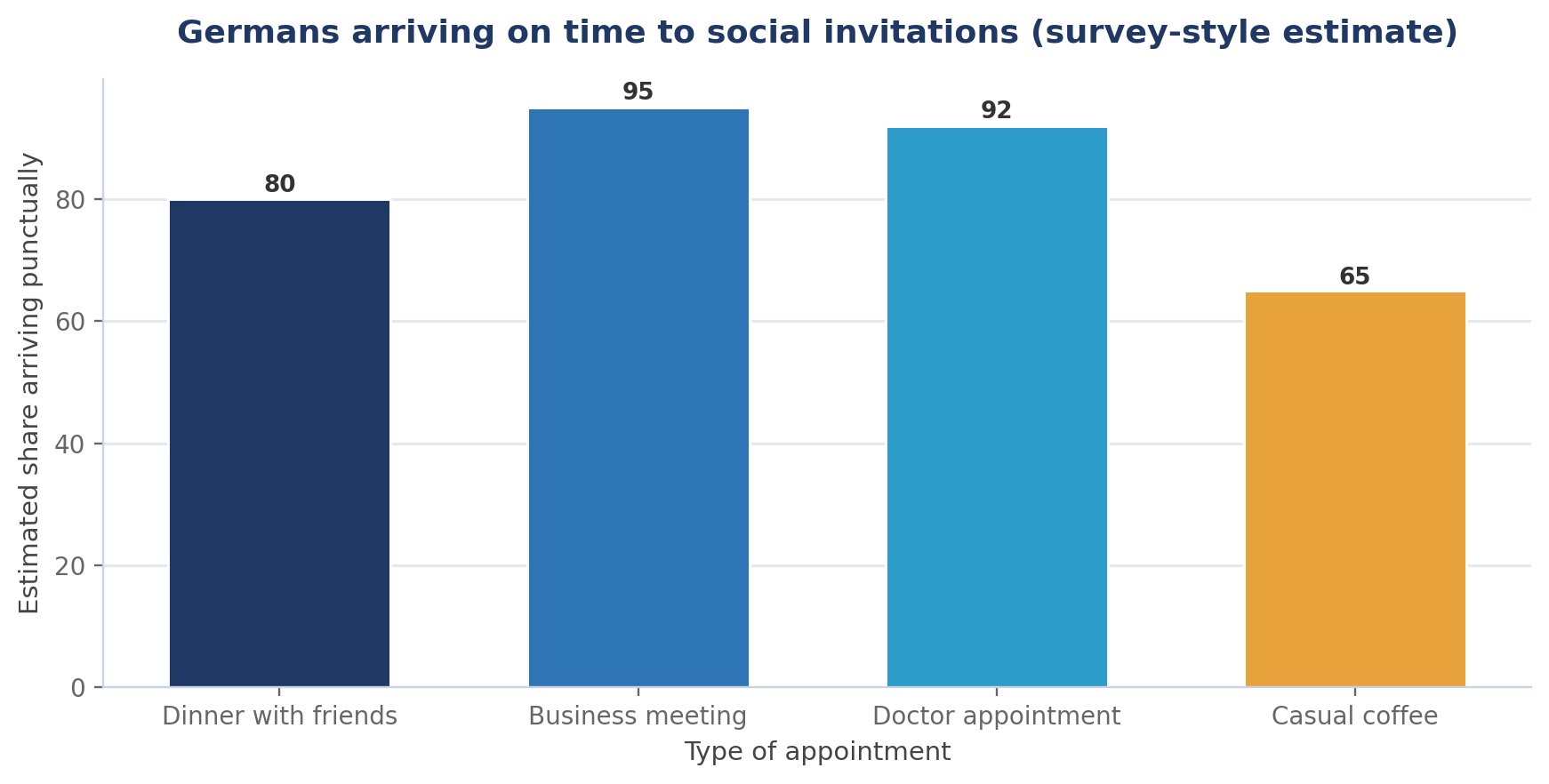
Arriving late is not a small lapse. It communicates that your time matters more than theirs.
If you are going to be late, text early and precisely: Ich versuche, bis 14:10 da zu sein. Vagueness makes it worse, not better.
Small Talk: Short, Then Down to Business
Here is the surprise for many visitors: Germans do small talk, but they do it briefly and honestly.
How are you? In Germany, Wie geht's? can receive an actual answer. A mumbled "fine" repeated back feels hollow. Answer honestly, briefly, then move on.
Safe topics at work: the weather, your journey, sport, holiday plans, food. Topics to avoid with new acquaintances: salary, personal finances, and detailed questions about health. Ask about hobbies rather than income.
The fastest way in is the language
Ready to turn reading into real German? Start your self-paced course today.
Start the German course →Create a free accountYou can memorise etiquette from an article. But German politeness lives inside the grammar — the Sie, the Bitte, the everyday phrases that signal respect. Our self-paced AI voice tutor gives you those phrases in your mouth, ready at the right moment. Button: Learn practical German →
Sie and Du: The Line That Matters
This is the rule visitors break most often, and it is almost invisible in English.
Getting this wrong is not fatal, but it lands oddly — like calling your boss by a nickname on day one. There is even a verb for crossing the line: duzen to offer du, and siezen to keep it formal. Germans will occasionally offer: Wir können uns duzen. Accept warmly.
Bread, Beer and the Table Taboo
Three quick practical notes for social life.
Never start eating before someone says Guten Appetit. Never put your elbows on the table for long stretches. And when someone says Prost, look them in the eye before drinking — that is a genuine rule, and skipping it is noticed.
Gifts, Invitations and Being a Good Guest
Invited to dinner? Arrive on time with a small gift. Wine is welcome if the host drinks; flowers are classic, but unwrap them before handing them over — an unwrapped bouquet is more charming than a wrapped one. Avoid chrysanthemums, which carry funeral associations.
A handwritten Dankeschön note a few days later carries real weight. Formal warmth, done properly, is the German way of saying you matter to me.
Turn etiquette notes into natural German
Ready to turn reading into real German? Start your self-paced course today.
Start the German course →Create a free accountReading about a handshake is not the same as greeting eight colleagues by name on a Monday morning. Our self-paced German courses build the workplace and social German you actually use — polite forms, small talk, meeting language — with an AI voice tutor that gives you feedback on your speaking in real time. Button: Start your German course →
Frequently Asked Questions
Is it rude to smile at strangers in Germany? Not rude, but it is read differently. A smile at a stranger can mean "something is funny" or "I want something from you" rather than generic friendliness. Saying Hallo to shop staff is normal; beaming at everyone on a train is not.
Why do Germans stare so much? Looking at other people is not socially discouraged in Germany the way it is in many English-speaking cultures. It is neutral curiosity, not hostility. Meeting the gaze briefly and then continuing is the normal response.
Should I use "du" or "Sie" with new colleagues? Use Sie until someone explicitly offers du. Age, workplace culture and region all matter, but Sie is never wrong with a new acquaintance, whereas premature du can feel presumptuous.
How late is "too late" in Germany? For business, anything past five minutes needs a message. For social invitations, ten to fifteen minutes is tolerated but noticed. For meetings and appointments, treat the stated time as binding and aim to arrive early.