You arrive on time. The door is shut. The meeting has started. You knock, enter, and eight people look up as if you personally cancelled Christmas. Welcome to Germany — where "on time" means five minutes early and the rules are written in a language you have not learned yet.
None of it is unfriendliness. It is a different set of invisible contracts. Here are the ones that will save your trip.
What you will get from this guide
- The unwritten rules Germans actually enforce
- Money, tickets and bottle deposits, explained
- What to say in shops, trains and doorways
- The phrases that smooth every awkward moment
Punctuality Is a Form of Respect
To many travellers, five minutes late is nothing. In Germany it reads as your time matters more than mine. That is the entire difference in a sentence.
The train row is not a metaphor. German trains leave on the minute. No pleading, no running, no mercy.
Cash Still Rules, and Sundays Close Everything
Two facts break more first trips than any linguistic struggle.
Sunday closure is not folklore. It is law, protected for rest, and it applies to supermarkets too. Plan Saturday like a small expedition.
And the bottle deposit — Pfand — will test your understanding of German economics.
Machines in supermarkets swallow bottles and spit out a receipt. Take the receipt to the till. This is normal, and everyone behind you in the queue knows you are new.
Greetings, Handshakes and the Word "Du"
German formality is navigable, and the map is short.
The leap from Sie to Du is offered by the older or more senior person, or by anyone in a clearly informal space. When in doubt, stay with Sie. Nobody has ever been offended by too much politeness in Germany. Many have been offended by too little.
Small Talk Is Short Talk
Ask "How are you?" and you will get an actual answer — or a mild look of suspicion. Germans do not perform enthusiasm. Chat before a meeting is brief on purpose: pleasantries done, business started.
That last row is the one to remember. If a German colleague says "Let's talk soon," they will propose a time. If they don't, the matter is closed.
Learn Five Phrases, Use Them Constantly
You do not need fluency to travel well. You need about five sentences and the nerve to use them.
One more, unstoppable in its usefulness: Ich verstehe nur ein bisschen Deutsch. You understand only a little German. Nobody expects more, and almost everyone will slow down for you.
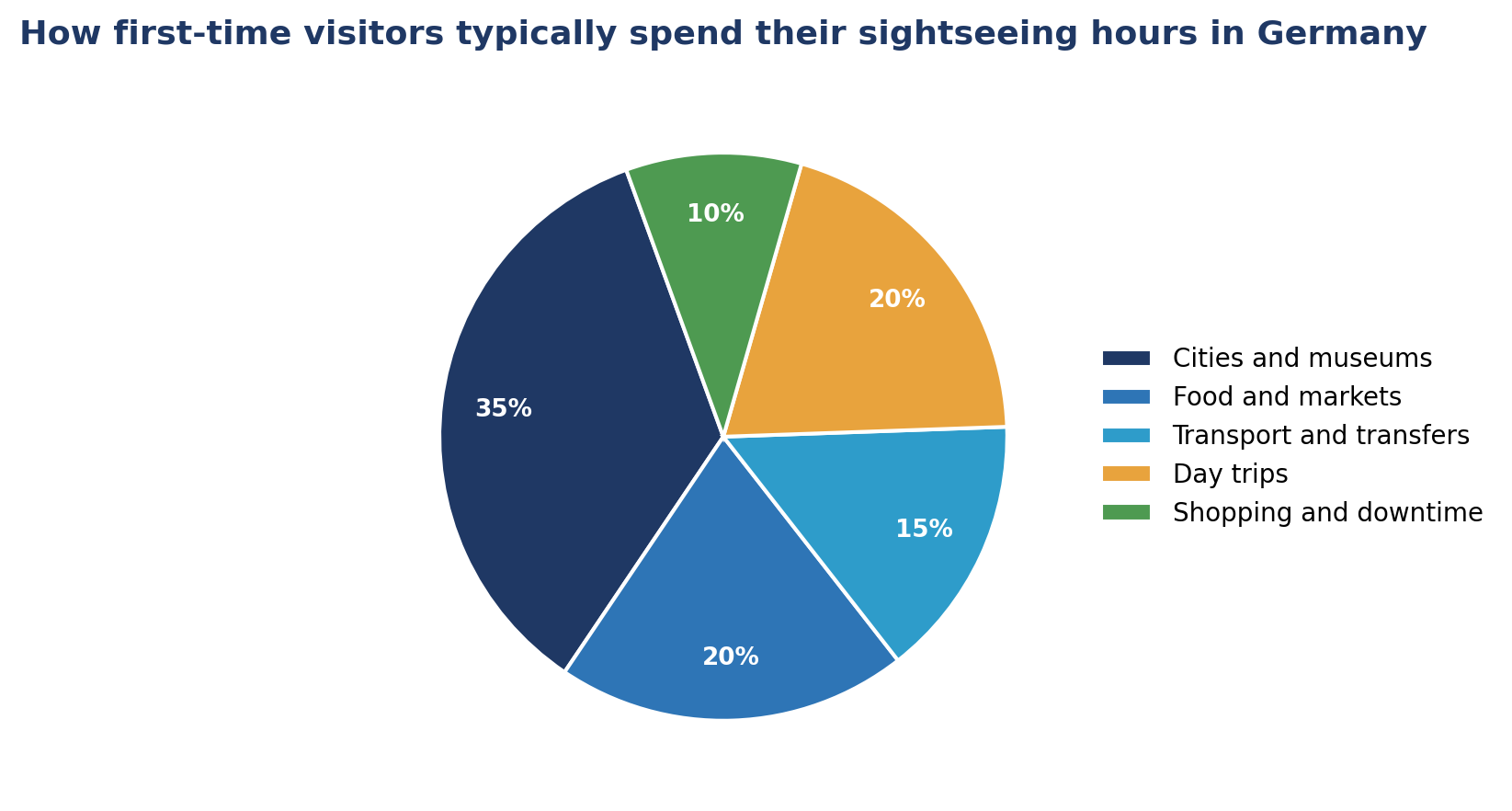
What Travelers Actually Spend Their First Week On
A quick look at where first-timers' energy goes.
Notice the second slice. Germany rewards eating in markets, bakeries and beer gardens far more than ticking off monuments. And yes, "beer garden" counts as culture.
Manners That Cut Both Ways
There are things Germans will not notice you skipping — and things they absolutely will.
The toast rule surprises everyone. Clink, hold eye contact, say Prost, then drink. Skipping the eye contact is considered somewhere between bad luck and bad manners, and people will notice.
Rubbish separation is equally real: glass by colour, paper, packaging and organic waste. In an apartment, missing it once earns a polite correction. Missing it twice is a conversation.
Order, Understand, Belong
Nothing changes a trip like walking into a bakery and ordering without panic. A self-paced German course with a personal AI voice tutor takes you from memorised phrases to real exchanges — orders, directions, small disasters and all.
Learn the German that travels →Create a free accountTrains, Tickets, Doors
Public transport is where frustration is born and efficiency is found.
Validate — entwerten — your paper ticket before travelling. An unstamped ticket is an invalid ticket, and controllers fine accordingly. No drama, no negotiation, a bill.
Frequently Asked Questions
Is it rude to speak English in Germany? No, but open with Guten Tag and, where you can, ask in German. Trying first and switching second is almost always received well. Assuming everyone should switch is what bothers people.
Why does everyone seem so direct? German directness is task-focused, not personal. A blunt correction about a procedure is not an insult. It is a shortcut to the correct result, delivered without decoration.
Should I tip in restaurants? Yes, but not by percentages printed on a bill. Round up or add five to ten percent and state the total when paying. Say the amount you want to give, and the server does the maths.
Do I need cash if I have a card? Bring cash. Small shops, bakeries, kiosks and many markets remain cash-first, and a card-only traveller gets dehydrated in the wrong alley. Fifty euros in notes solves nearly everything.
Go Back Knowing More Than "Danke"
The second trip is always better than the first. Learn to read menus, ask real questions and follow the answers — self-paced lessons with a personal AI voice tutor get you there before your next flight.
Start your German course →Create a free accountReferences & Further Reading
- German National Tourist Board — practical visitor and etiquette information: https://www.germany.travel
- Deutsche Bahn — tickets, reservations and Deutschlandticket coverage: https://www.bahn.com
- Goethe-Institut — language and cultural orientation for visitors: https://www.goethe-institut.de
- Duden — German usage dictionary for formal and informal address: https://www.duden.de
- Federal Ministry of Labour and Social Affairs — context on Sunday closing law (Ladenschlussgesetz): https://www.bmas.de