You studied for a year. You can order a coffee, decline an adjective, argue about the dative with confidence. Then a Berliner looks at you and says "Na?" — and you have absolutely nothing.
That one syllable is a whole conversation. German slang is where the language stops being a grammar exercise and starts being a place people live.
What you will get from this guide
- The everyday German words textbooks quietly skip
- Regional slang maps so you know who says what
- Real idioms with literal translations and honest meanings
- How to learn slang without sounding like a tourist doing karaoke
Why Textbooks Drop German Slang
Textbooks teach the German of exams, not the German of kitchens. That is not laziness — it is triage. A book has 200 pages and needs der, die, das to survive. Slang is messier: it shifts by city, by generation, by how much beer is on the table.
But here is the trap. Standard German gets you understood. It never gets you in. The gap between "correct" and "welcome" is exactly where slang lives.
The German Slang Words You Hear Every Single Day
Start here. These are not exotic — they are wallpaper. You will hear them in shops, on trams, in group chats.
Notice how much of this is about attitude, not information. German small talk is not small. It is a status check, a mood reading, a tiny social handshake.
Regional Slang: One Country, Several Languages
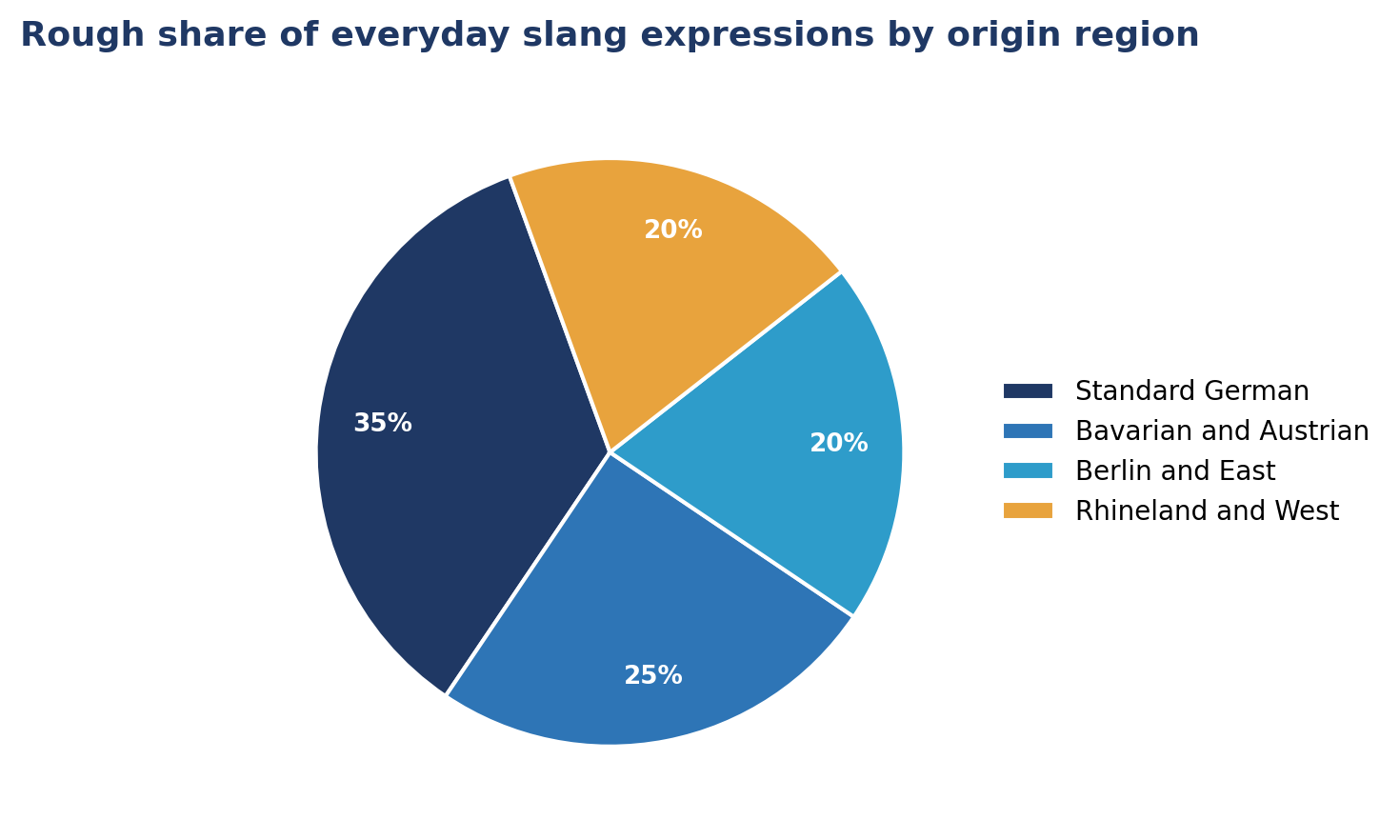
Germany is not linguistically uniform, and pretending otherwise marks you instantly as an outsider. Bavarian slang is not Berlin slang. Cologne slang is not Saxon.
Moin in Hamburg is the most efficient greeting in Europe. It works at 7 a.m., at midnight, and over the phone. Try that with Guten Morgen.
Idioms That Make Germans Laugh (And You Confused)
Idioms are where German shows its sense of humour. The images are absurd and they stick.
The thumb-press is a real physical gesture, by the way. Do it and a German will instantly know you are playing the home team.
How to Use German Slang Without Embarrassing Yourself
Slang is a friendship language, not a tourist language. Misuse it and you sound like a bank manager in a backwards cap.
Rule one: listen before you speak. Slang is a password you earn by hearing it three times. Rule two: match the room. Geil with friends is fine; with your landlord, less so. Rule three: start with safe, low-risk words. Krass, Quatsch, Bock and Na are almost impossible to deploy badly.
Slang travels faster with a voice in your ear
You can memorise a list. You cannot hear the timing, the tone, the little eyebrow lift that makes "Na?" warm instead of accusatory. A personal AI voice tutor gives you that rhythm, lesson after lesson, at your own pace.
Learn German with your AI voice tutor →Create a free accountFormal vs. Slang: The Same Sentence, Two Worlds
Here is a table you can use tomorrow. Left column is what you write in an email. Right column is what people actually say.
Learn the left column first. It keeps you safe. Learn the right column second. It makes you a person.
Slang and the CEFR Levels: Where It Fits
Slang lives mostly above the exam floor. The Goethe-Institut and telc exams test standard German, so slang is not where you gain points — it is where you gain friends.
That B2 step is a real cliff. Textbooks stop helping just when slang starts mattering.
Where to Hear German Slang Honestly
Podcast and streaming sit close to spoken reality. Deutsche Welle's Langsam gesprochene Nachrichten is standard German, but its Deutschtrainer series sneaks in everyday phrasing. Beyond that, German comedy, football interviews and regional radio are the unedited source.
The rule of thumb: if a phrase appears in three unrelated places within a month, it is current. If it only appears in a 1998 textbook, it belongs in a museum.
Sound like a local, not a lesson
Grammar gets you correct. Slang gets you invited. Our self-paced German course puts real conversation in front of you from week one, with a personal AI voice tutor that corrects the words textbooks never taught.
Start your German course →Create a free accountFrequently Asked Questions
Is German slang rude? Most of it is neutral. Krass, Bock, Quatsch and Na are completely safe among friends. A small handful of words, including geil, were originally vulgar and have softened — know your audience before you use them broadly.
Which German slang should I learn first? Start with Na, Quatsch, krass and Bock haben. They are high-frequency, low-risk and instantly make your German sound less like a textbook and more like a person talking.
Do Germans use dialect slang in professional settings? In most offices, standard German rules. But regional greetings like Servus or Moin are common and welcome, and light idiom use signals comfort. Save the hard dialect for after-work drinks.
Will slang help me pass a Goethe or telc exam? Indirectly. Exams test standard German, so slang will not earn points. But it sharpens listening comprehension for real-world audio, which quietly lifts your overall fluency.
References & Further Reading
- Duden, Duden — Die deutsche Rechtschreibung, duden.de — standard reference on contemporary usage.
- Deutsche Welle, Deutsch lernen programme and Deutschtrainer, dw.com/deutschlernen.
- Goethe-Institut, German language courses and CEFR level descriptions, goethe.de.
- Gesellschaft für deutsche Sprache (GfdS), commentary on colloquial and regional German, gfds.de.
- Atlas zur deutschen Alltagssprache, University of Augsburg and University of Liège, atlas-alltagssprache.de — regional word maps.