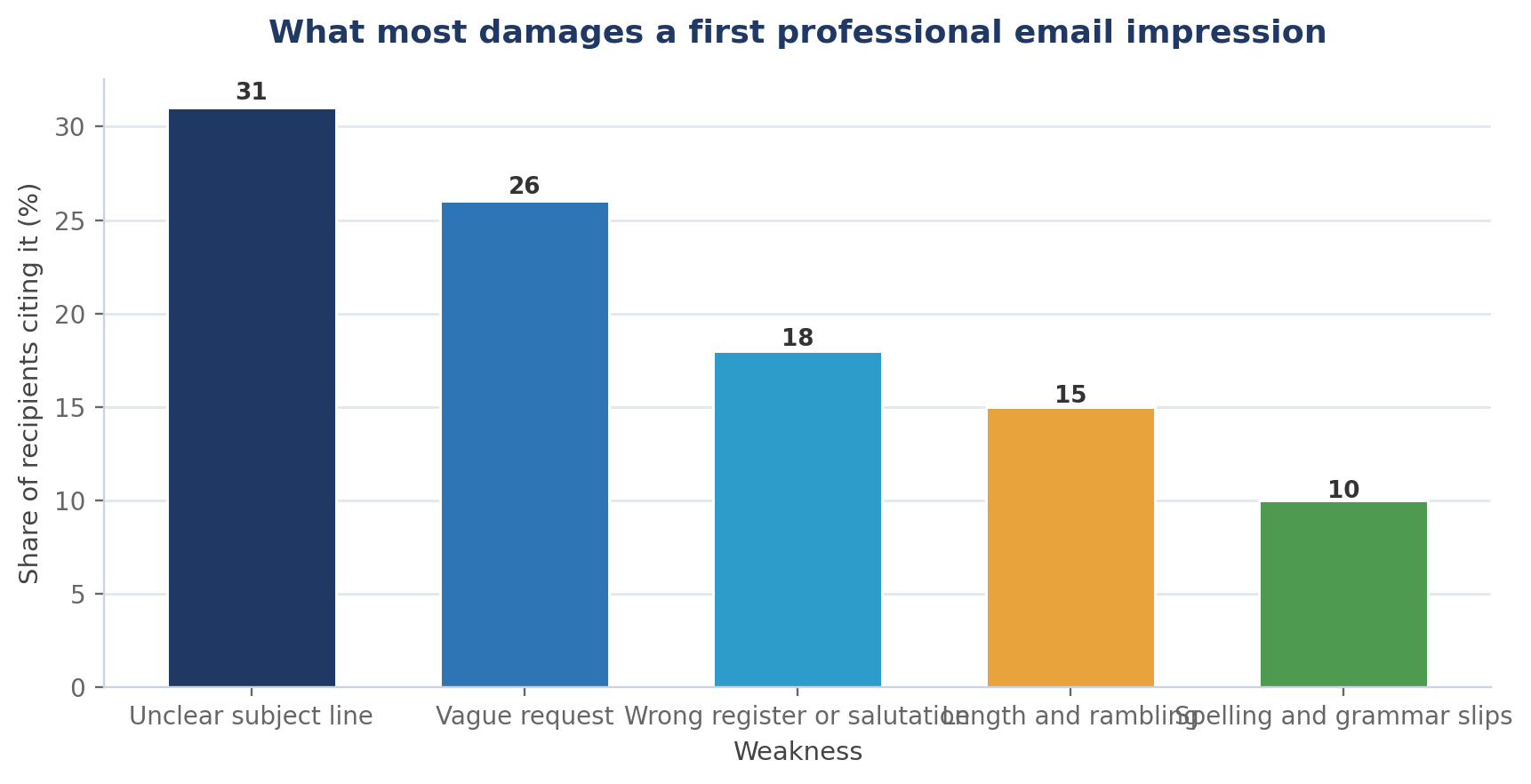
An email is a strange artefact. It is permanent, it is forwarded, and it is often the first impression a colleague forms of your English. Which is precisely why the people who write them well get taken more seriously than the people whose grammar is technically better.
The good news: professional English email is highly formulaic. It rewards pattern recognition far more than creativity, and the patterns are learnable in an afternoon.
What this guide gives you
- The five-part structure every business email follows
- Salutations and sign-offs by formality level
- Polite request patterns that never sound demanding
- Chasing, apologising and declining — the hard ones
- Subject lines that get your email opened
The five-part structure
Almost every professional email, in every industry, follows the same skeleton.
The rule underneath: one email, one purpose. Emails that ask for three unrelated things get answered for one of them, usually the easiest.
Subject lines that get opened
Avoid all-caps and exclamation marks. Professional English email is calm by default, and calm reads as competent.
Salutations and sign-offs
This is the table worth memorising, because getting it wrong is the most visible kind of error.
One British/American distinction worth knowing: Yours sincerely pairs with a named recipient, Yours faithfully with an unnamed one. American English uses Sincerely for both.
Openings that set the right tone
Note how much of professional English consists of acknowledging before asking. English email culture rewards a brief thank-you before a request, and skipping it can read as brusque.
Polite requests: the four levels
English can make a request sound demanding or effortless, using almost the same words.
For requests to senior people, or first contact, use the third or fourth. The fourth is the safest default in professional English and never sounds weak.
The hard ones: chasing, apologising and declining
Note the pattern in the declines and bad news: state the problem, then immediately offer something. English professional culture tolerates a "no" far better when it comes with an alternative.
A good professional email does three things: it acknowledges, it asks clearly, and it commits to a next step.
Ready to turn reading into real English? Start your self-paced course today.
Start the English course →Create a free accountWrite like a professional, not like a translation
Reading phrase lists gets you recognition. A personal AI voice tutor gets you production — rehearsing real workplace email scenarios, with instant AI feedback on the register that native colleagues notice immediately.
Button: Explore the English Course Pass →
A complete example
Five sentences, one purpose, one clear request. That is what a strong professional email looks like.
Common mistakes and quick fixes
Building the skill
That last practice is the most valuable. Nearly every first draft in a second language is 30% too long, and shortening it improves clarity, register and confidence all at once.
Ready to turn reading into real English? Start your self-paced course today.
Start the English course →Create a free accountPractise before you need it
Create a free languageskills.net account for business English modules and self-paced AI tutor practice — so your next email to a client is your second draft, not your first.
Button: Create your free account →
Frequently Asked Questions
How formal should a business email be in English? Slightly less formal than most learners expect. Dear Sarah and Kind regards are standard professional; excessive formality can read as cold or even sarcastic.
Is it OK to use contractions in business email? Yes, in most professional contexts. I'd, we'll and don't are normal — though a formal proposal may avoid them.
How long should a professional email be? Short. Two to four brief paragraphs, one purpose, one clear next step.
What is the polite way to ask for something? Would you be able to…? is the safest professional default — it is courteous and gives the recipient room to decline.
References & Further Reading
- British Council — Business English and professional communication resources
- Cambridge English — Business English qualifications and guidance
- BBC Learning English — English at Work series and free lessons
- Council of Europe — CEFR levels and written-interaction descriptors
- European Commission — Multilingualism and language-learning policy